Key takeaways
- Steel Frame Systems give designers flexibility for complex geometry, long spans and open-plan layouts that masonry cannot match.
- The lightweight, screw-fixed nature means assemblies can be adapted after installation without major demolition.
- Fire, acoustic and thermal performance are all achievable within flexible SFS build-ups using tested systems.
- Real BAS Frames projects show that design flexibility translates into buildable, delivered outcomes, not just theory.
Case Studies: Flexible Steel Frame Designs in Practice
A Comprehensive Analysis of Steel Framing Systems (SFS) in Modern British Construction
The Engineering Behind SFS
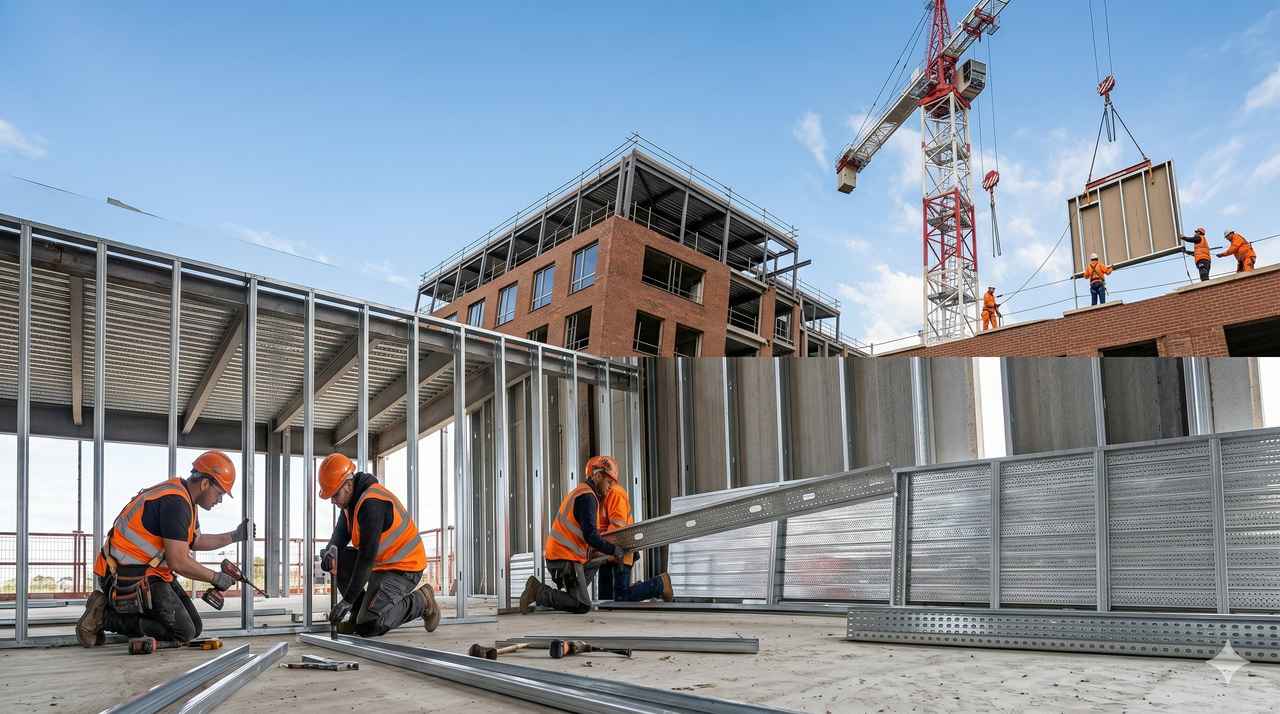
SFS is a light-gauge, galvanised steel structural system. Unlike the heavy “hot-rolled” steel used for a building’s primary skeleton, SFS is “cold-rolled,” meaning it is shaped at room temperature. This process allows for incredibly high tensile strength while keeping the material lightweight and easy to manipulate on-site.
- C-Studs: These act as the vertical load-bearing members. They are engineered to resist lateral wind loads and provide the necessary support for internal and external finishes.
- U-Tracks: These horizontal channels are secured to the floor and soffit. They provide the “rail” in which the studs sit.
- Cleats and Brackets: Precision-engineered connectors that ensure the SFS is safely integrated into the primary structure.
Flexible Design Methodologies
The adaptability of SFS is its greatest asset. Depending on the structural requirements of the building, expert SFS contractors typically utilise one of three primary design configurations:
1. Infill Walling Systems
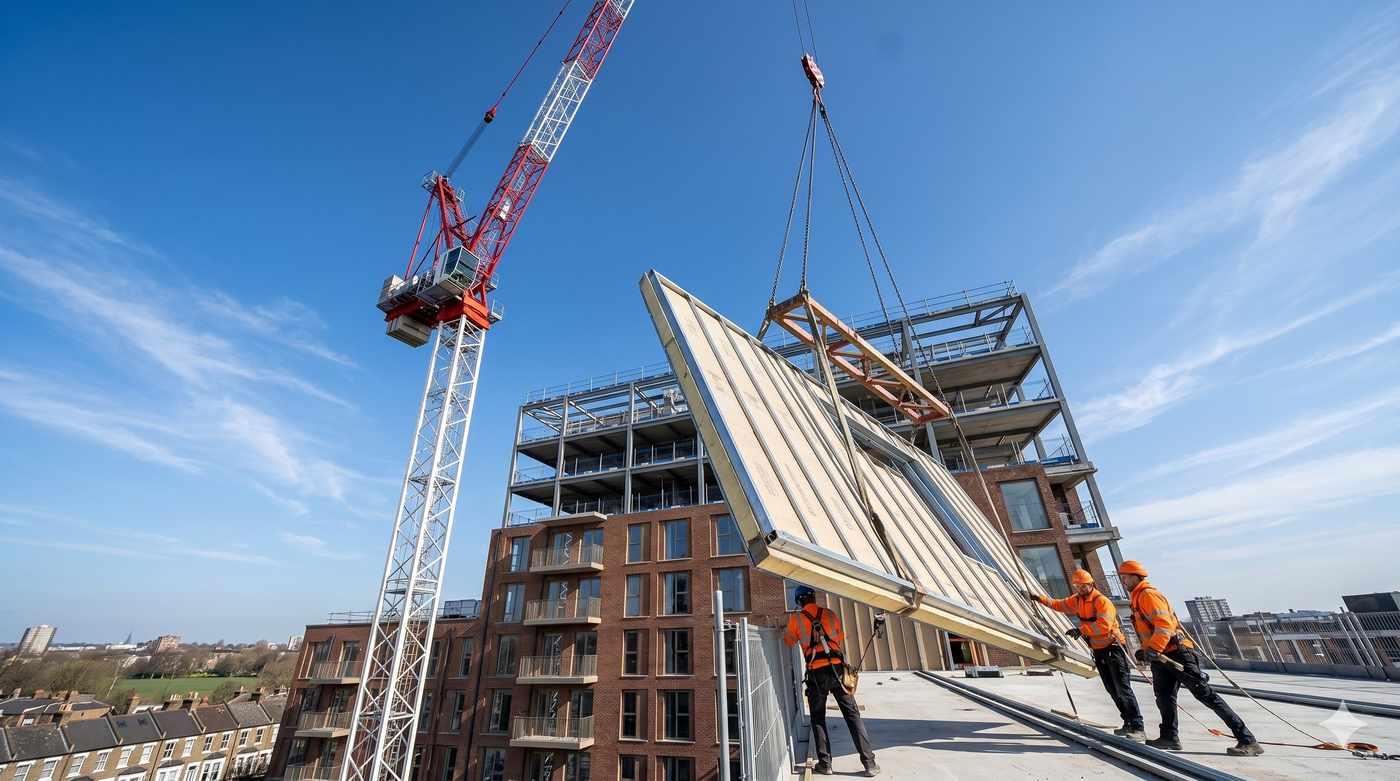
Infill is the most widely used SFS application. Here, the framing sits between the floor slabs and columns of the primary structure. It provides a flat, secure surface for external cladding and internal plasterboard. This method is highly favoured in multi-storey residential blocks because it allows for “early dry-in,” where the building becomes weather-tight much faster than with traditional brickwork.
2. Continuous Walling (Oversail) Systems
In an “oversail” configuration, the SFS is fixed to the outside of the primary frame, effectively bypassing the floor slabs. This is an ideal solution for buildings requiring a seamless external aesthetic or where thermal bridging must be minimised to the absolute limit. By “wrapping” the building in steel, architects can ensure a continuous layer of insulation.
3. High-Bay Walling
Specifically designed for internal partitions that require extreme height without intermediate support, High-Bay SFS is common in industrial units, cinemas, and shopping centres. These systems are engineered to provide superior fire ratings and acoustic insulation, often reaching heights of up to 20 meters.
The Advantages of SFS Over Traditional Masonry
Technical Performance: Fire, Sound, and Thermal
Modern building regulations in the UK (Part L, Part B, and Part E) demand rigorous performance standards. SFS is uniquely positioned to meet these through integrated design:
| Performance Category | SFS Benefit |
|---|---|
| Fire Resistance | Steel is non-combustible. When combined with specialised boards, SFS walls can provide up to 120 minutes of fire protection. |
| Acoustic Insulation | Multi-layer SFS partitions effectively dampen sound, essential for residential apartments and hotels. |
| Thermal Efficiency | The precision of SFS allows for airtight construction and the easy installation of high-R-value insulation. |
SFS in Practice: Case Studies
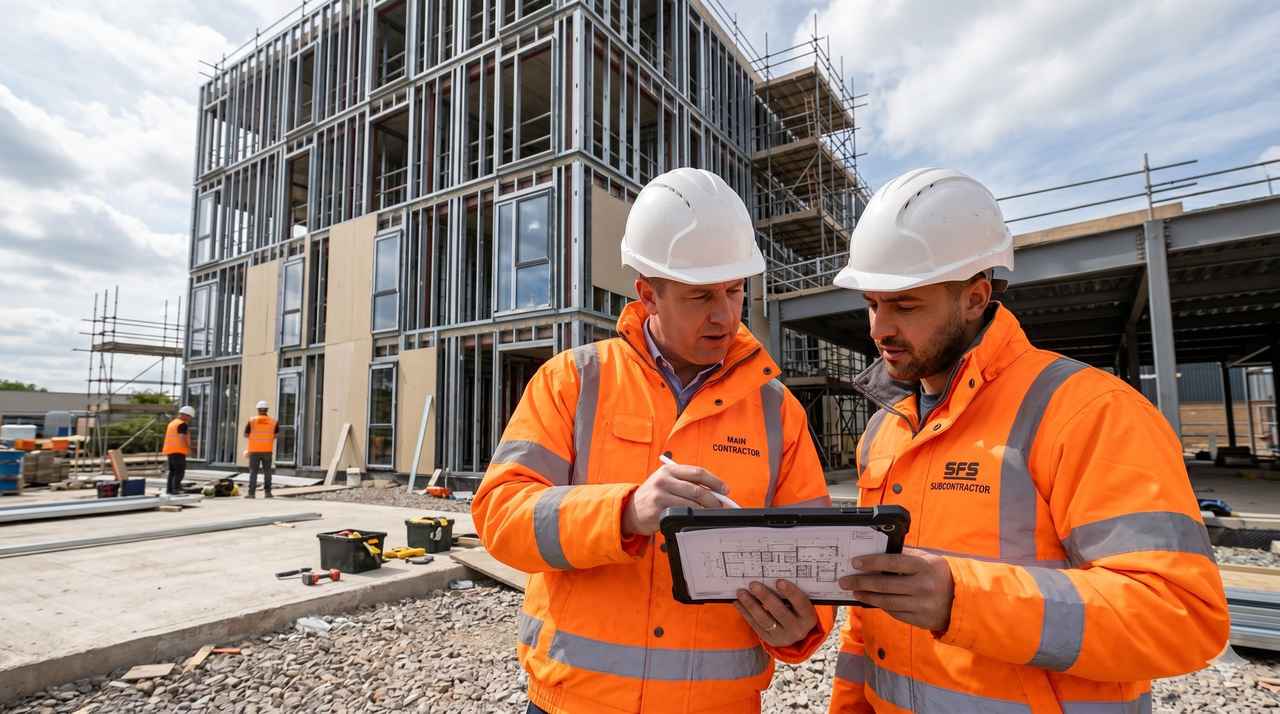
At BASF Frames, our portfolio demonstrates the versatility of steel. From urban residential towers to expansive commercial hubs, SFS provides the structural integrity required for diverse environments. One notable benefit highlighted in our case studies is the ability to work in constrained urban sites where large-scale material storage is impossible. SFS components are delivered “just-in-time” and assembled quickly, reducing the logistical footprint.
Conclusion: The Future of the Built Environment
As we look toward a future defined by sustainable, high-performance housing and infrastructure, Steel Framing Systems will continue to lead the way. Their combination of design flexibility, environmental responsibility, and structural reliability makes them an unbeatable choice for developers and architects alike.
Ready to integrate SFS into your next project? The team at BASF Frames offers the technical expertise to guide you from design to completion. Contact us today for a consultation on your project requirements.
Real-world examples of SFS design flexibility
The design flexibility of Steel Frame Systems is not a theoretical benefit — it is demonstrable in the way SFS projects are delivered on site across a wide range of building types and complexities. From curved façades on landmark residential schemes to the rapid reconfiguration of partition layouts on fast-moving commercial fit-outs, SFS’s adaptability is a practical advantage that experienced main contractors rely on when managing design risk.
On curved building façades, SFS offers a particular advantage: cold-formed steel sections can be fabricated to custom radii, enabling smooth curves in external walling that would require bespoke formwork in concrete or complex coursing in masonry. The Steel Construction Institute documents numerous case studies where SFS has enabled architectural ambition that would have been prohibitively expensive in traditional materials.
For post-completion adaptability — increasingly important as buildings are designed to accommodate future changes of use — SFS’s non-load-bearing internal partitions can be removed and rebuilt without structural alteration. On a BTR building that may need to convert individual apartments to larger units in response to changing market demand, or a commercial building adapting to hybrid working patterns, this future flexibility has measurable asset value. Explore more about how SFS supports design evolution in our article on design adaptability in steel frame construction.
Further reading:Steel Construction Institute | Metsec Framing Systems
Related:Cost | Infill | What Is | Fire
Frequently asked questions
How flexible are Steel Frame Systems for complex building shapes?
Cold-formed steel sections can be fabricated to custom profiles, radii and non-standard dimensions, making SFS highly adaptable for complex building shapes. Curved external walls, cranked sections, raking soffits and non-orthogonal plan forms can all be accommodated within an SFS system — typically at lower cost and programme impact than equivalent concrete or masonry solutions.
Can SFS be adapted after installation?
Yes — non-load-bearing SFS walls and partitions can be removed, repositioned or modified without structural alteration. This post-installation flexibility is one of SFS’s most commercially valuable attributes for developers and institutional owners who need to adapt buildings to changing occupier requirements over time.
What is the tallest SFS wall that can be specified?
SFS wall heights of up to 10–12 metres are achievable with appropriate stud depth and gauge, wind load assessment and connection detailing. For very tall walls, deeper studs (146mm or 200mm) or composite stud configurations may be required. Structural design by a qualified engineer is essential for tall SFS walls, and deflection head movement allowances must be increased accordingly.
How does SFS handle complex junction details?
Complex junctions — corners, returns, openings, level changes — are managed through bespoke stud and track configurations, purpose-made corner beads and stop beads, and careful coordination between the SFS design drawings and the architect’s detail drawings. BAS Frames works with design teams from RIBA Stage 3 to ensure junction details are buildable and compliant before installation commences.