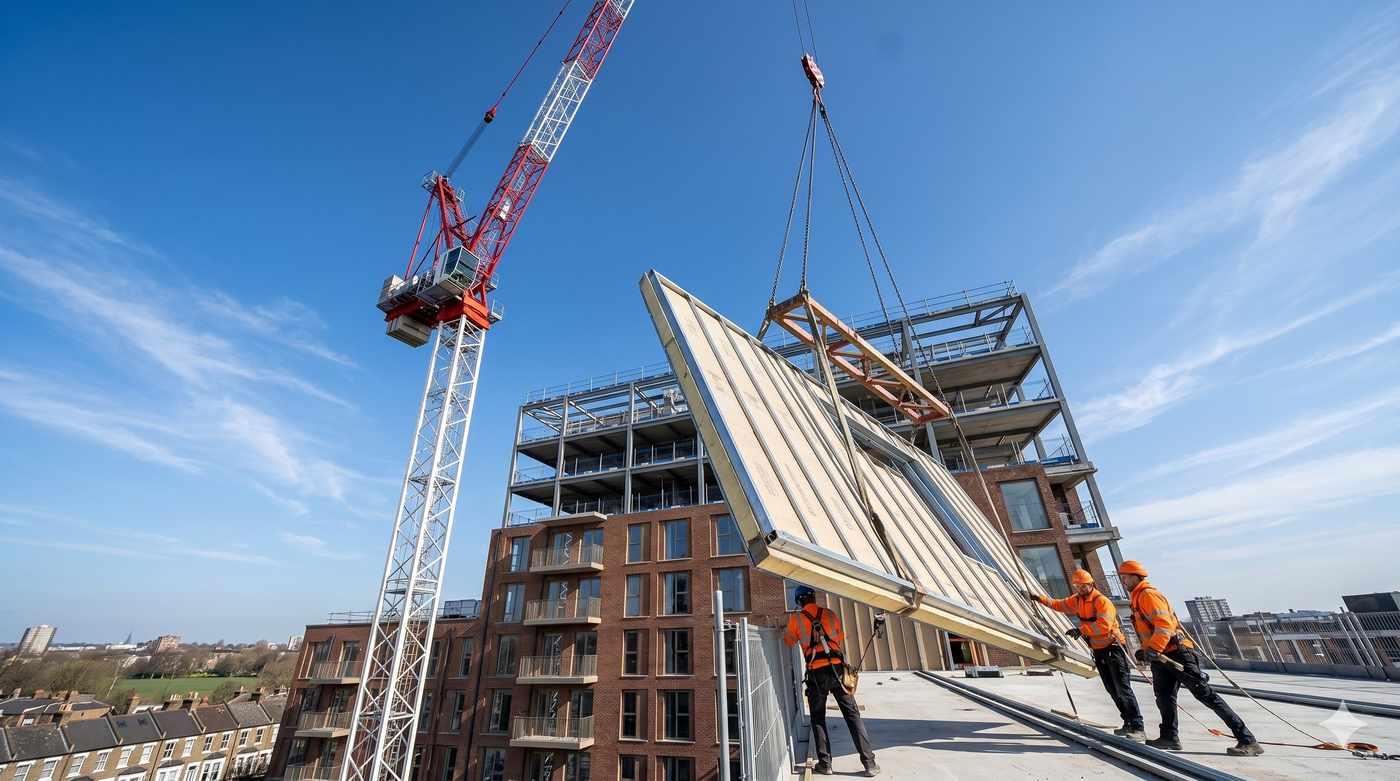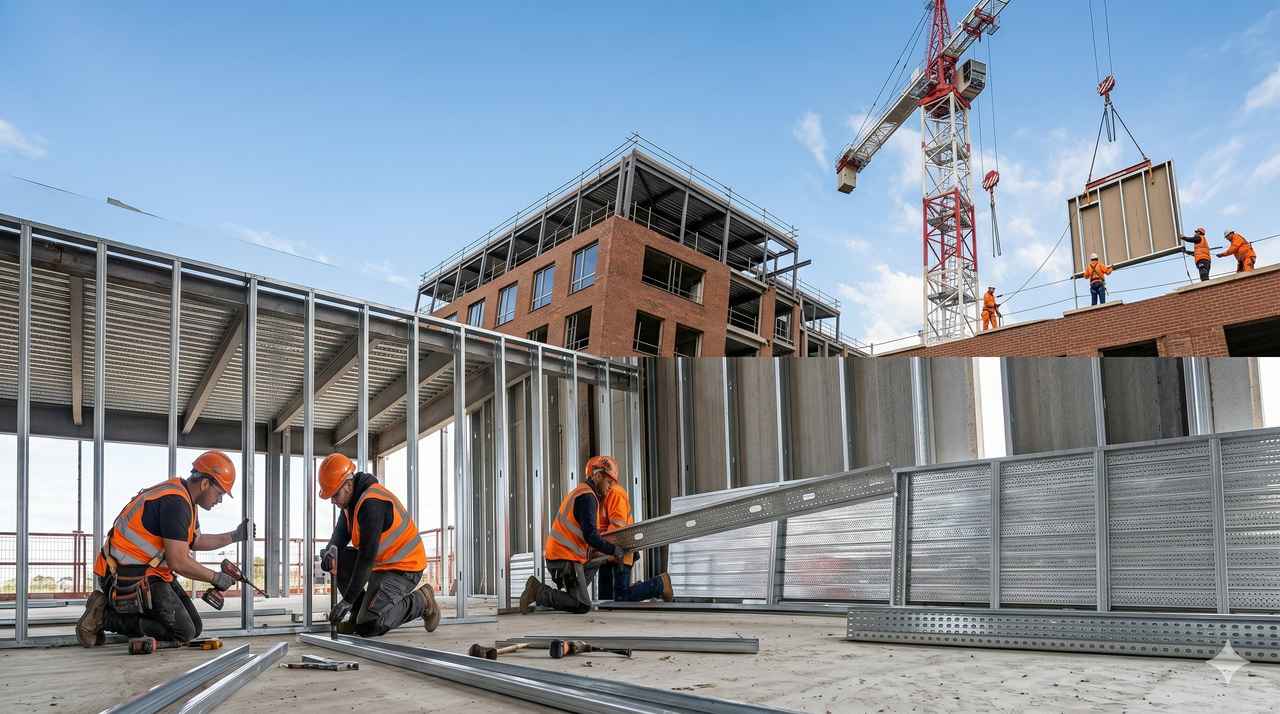
Key takeaways
- There is no single SFS rate — pricing is driven by stud depth and gauge, deflection-head detailing, board build-up, fire rating, working height and the supply/install scope split.
- Indicative 2026 UK ranges: supply-only framing £25–£75/m², framing supply-and-install £60–£140/m², and a full through-wall package £140–£320/m² depending on fire rating and Higher-Risk Building status.
- A ±40% spread between tenders on the same drawings is almost always a different read of scope, not margin — compare like-for-like against a ten-point checklist.
- For early cost planning, budget a range (≈£180–£260/m² through-wall, mid-rise, outside central London) rather than a single point rate.
For developers and quantity surveyors pricing a new-build envelope in 2026, one question dominates the early cost plan: what does an SFS package actually cost per m²?
The honest answer is that any single figure is misleading. SFS pricing is driven by stud depth, gauge, deflection-head detailing, sheathing and board build-up, working height, site access and the scope split between supply and install. A 100 mm SFS infill on an accessible four-storey block in Slough is not the same product as a 200 mm cantilevered SFS on a 12-storey high-rise in central London — and the rates per m² should reflect that.
This guide gives developers, QSs and main contractors a realistic 2026 cost framework for SFS infill packages in the UK. It covers indicative supply-only and supply-and-install ranges, what moves a price up or down, and how to read an SFS quotation so the comparison between subcontractors is genuinely like-for-like. If you want a refresher on the system itself before pricing it, our pillar guide on what SFS construction is and how it integrates with primary structures gives the technical foundation for the cost discussion below.
Indicative SFS cost ranges in the UK, 2026
The figures below are typical market ranges for non-loadbearing SFS infill packages on commercial, residential and mixed-use buildings in the UK. They are indicative budgeting figures only — every project should be priced on its own drawings, structural design and access conditions.
Supply-only SFS framing
(cold-formed sections, head/base tracks, brackets, fixings)
- £25–£45 per m² for standard 70–100 mm depth, 1.2–1.6 mm gauge sections on regular grids
- £45–£75 per m² for deeper 150–200 mm sections, heavier gauge (2.0–2.5 mm), or where bespoke brackets, oversail or cantilever conditions apply
Supply-and-install SFS framing only
(no sheathing, insulation or boards)
- £60–£95 per m² on accessible sites with regular floor-to-soffit heights up to 3.5 m
- £95–£140 per m² on constrained urban sites, working at height above 18 m, or with complex deflection-head detailing
Through-wall SFS package
(frame + sheathing board + insulation + internal plasterboard linings, fully fitted)
- £140–£220 per m² for standard residential and commercial specs with 60-minute fire resistance
- £220–£320 per m² for 90 or 120-minute fire-rated through-wall systems, enhanced acoustic build-ups, or HRB (Higher-Risk Building) specifications under the Building Safety Act
These ranges align with what we see across our recent project portfolio, and with published cost benchmarks from manufacturers including Metsec and Intrastack. They exclude scaffold, primary cladding (rainscreen, brick, render), and main contractor preliminaries.
What drives SFS cost per m² up or down
A QS reviewing tender returns will often see a ±40% spread between subcontractors on the same drawings. That spread is rarely “margin” — it is almost always a different read of the technical scope. The biggest cost drivers are:
Stud depth and gauge
A 100 mm × 1.2 mm stud and a 200 mm × 2.5 mm stud are not interchangeable. The deeper, heavier section costs more in raw steel and weighs more on the slab edge. For wind-load and limiting-height calculations, our SFS infill walls technical guide explains how stud selection follows directly from height, exposure and façade weight.
Floor-to-soffit height
Up to 3.5 m, standard sections work. From 3.5 m to 5 m, deeper sections, blocking and strapping or splice details add cost. Above 5 m, intermediate restraint or oversized sections push the rate significantly.
Deflection-head detailing
Slotted head tracks (such as Metsec’s proprietary slotted head) cost more than fixed tracks but accommodate vertical movement in the primary frame. On steel-framed buildings with significant deflection, the head detail is non-negotiable — and it is one of the most common scope ambiguities in cheap tenders.
Fire resistance rating
A 60-minute through-wall system uses one or two layers of fire-rated plasterboard. A 120-minute system uses three layers, often with sheathing board and Glasroc-type external boards. The board cost alone can double between specifications.
Site access and working height
Town-centre London sites with restricted craneage and lifting constraints add 20–40% to install rates compared with open suburban sites. Above 18 m (Higher-Risk Building threshold), additional Building Safety Act compliance, Gateway 2 documentation and competence evidence add programme and cost.
Programme pressure
Compressed programmes shift cost upward because they require larger gangs, longer hours, or temporary works to compress the sequence. Our case study on the Denham Crematorium project shows what a compressed 2,000 m² SFS programme actually involves operationally.
Scope split
A “supply-only” rate and a “supply-and-install” rate from the same supplier are not directly comparable to a “design-supply-install-coordinate” package. The latter includes engineering, RIBA Stage 4 detailing, structural calculations and project management — typically 15–25% more than supply-and-install but with materially less risk transfer to the main contractor.
How to read an SFS quotation properly
A QS comparing three SFS tenders should check that each priced return covers the same ten items. The most common scope ambiguities — the ones that cause variations and disputes mid-project — are:
- Design responsibility. Is the subcontractor producing structural calculations, or working from drawings? Our steel frame design service explains where design responsibility typically sits in a competent SFS package.
- Deflection-head detailing — slotted, double-track, or proprietary system?
- Cavity barriers and fire stopping at slab edges and around openings.
- Wind-post or jamb-stiffener allowance at large openings.
- Sheathing board specification — Glasroc X, cement particle board, or moisture-resistant plasterboard?
- Insulation type and thickness — quilt, mineral wool, or rigid PIR within the cavity?
- Internal lining build-up — single, double or triple layer; standard, FireLine or SoundBloc?
- Air-tightness membrane and tape — sometimes excluded entirely.
- Working at height allowances — MEWP, scaffold, or fall-arrest?
- Programme allowance — fixed-duration or rate-only, with what gang size?
Any one of these omitted from a tender return will appear later as a variation. A subcontractor pricing them properly upfront often looks more expensive on day one but delivers within budget at handover.
What’s typically included in a competent SFS package
Beyond the line-by-line scope check, a competent through-wall SFS quotation includes design coordination, supply of fully-traceable BS-certified cold-formed sections, on-site installation by SMAS and CHAS-accredited gangs, and project handover documentation. Our deeper guide to what’s included in an SFS package breaks down each element and explains where the value sits.
Budgeting tip — use a range, not a point estimate
For early-stage cost planning, we recommend QSs use a range rather than a single rate per m². At RIBA Stage 2/3, allow £180–£260/m² for a typical through-wall SFS package on a mid-rise residential or commercial building outside central London. Tighten the range as drawings firm up, structural design progresses, and the cladding type is fixed.
If you want a project-specific budget figure rather than an indicative range, BAS Frames provides fixed-scope pricing from RIBA Stage 3 drawings within five working days. Get in touch via our contact page with your structural drawings and we will return a costed scope.
Related reading
- What is included in an SFS package — the full scope breakdown for QSs procuring an SFS subcontractor.
- SFS infill walls — technical guide — the design and detailing decisions that drive specification (and therefore cost).
- 2,000m² in six weeks: the SFS delivery standard — what compressed-programme delivery looks like in practice.
Further reading: Steel Construction Institute | RICS BCIS
Related: Infill | What Is | Fire | Thermal
Frequently asked questions
How much does SFS cost per m² in the UK?
SFS pricing has no single rate. As indicative 2026 UK figures: supply-only framing is around £25–£75 per m², framing supplied and installed is roughly £60–£140 per m², and a fully-fitted through-wall package (frame, sheathing, insulation and linings) runs about £140–£320 per m² depending on fire rating, acoustic build-up and Higher-Risk Building status. Always price on project drawings.
What affects SFS cost per m²?
The main cost drivers are stud gauge and depth, sheathing board type (OSB, cement particle board or Glasroc), deflection-head specification, working height, cavity barrier requirements, and whether the package includes design. Panellised systems typically cost more per m² but offer programme savings that offset the premium.
Is SFS more expensive than blockwork?
On a supply-and-install basis, SFS is typically comparable to or marginally more expensive than blockwork per m². However, when programme savings are factored in — SFS installs 30–40% faster than blockwork on mid-rise schemes — the total project cost of SFS is often lower, particularly on schemes with high site preliminary costs.
How do I get an accurate SFS quotation?
An accurate SFS quotation requires the gross walled area, floor-to-ceiling heights, stud depth and gauge, sheathing board specification, cavity barrier and firestop requirements, and access conditions. BAS Frames provides itemised quotations that clearly set out scope, exclusions and programme assumptions.