Key takeaways
- SFS and drylining are distinct trades that meet at a critical interface: SFS forms the structural infill/envelope frame; drylining lines and finishes the internal face.
- The technical, sequential and contractual interfaces between them are where programmes and responsibilities most often slip.
- Procuring both from one contractor removes the coordination seam and the “not my scope” gaps at the boundary.
- Getting the interface right protects fire, acoustic and airtightness performance across the combined wall.
SFS and Drylining: How the Two Systems Work Together on Commercial Projects
On most commercial construction projects, Steel Frame Systems (SFS) and drylining are procured and managed as separate packages. The SFS subcontractor closes the building envelope; the drylining subcontractor lines the interior. The two scopes are distinct in terms of materials and sequence, and dividing them is a defensible procurement decision.
But ‘defensible’ is not the same as ‘optimal’. The interface between SFS and drylining is one of the most common sources of programme delay, scope gap, and quality failure on commercial projects. Understanding exactly how the two systems interact — technically, sequentially, and contractually — is the first step to managing that interface effectively, regardless of how the package is structured.
This article explains where SFS ends and drylining begins, the technical connections between the two systems, the coordination risks that arise when they are managed separately, and why an integrated combined package delivers better outcomes on the projects where it is applicable. For a general introduction to what Steel Frame Systems are and how they work, see our overview article.
What Each System Does: A Clear Division
Before examining the interface, it is worth being precise about what each system contributes to a commercial building.
Steel Frame Systems (SFS)
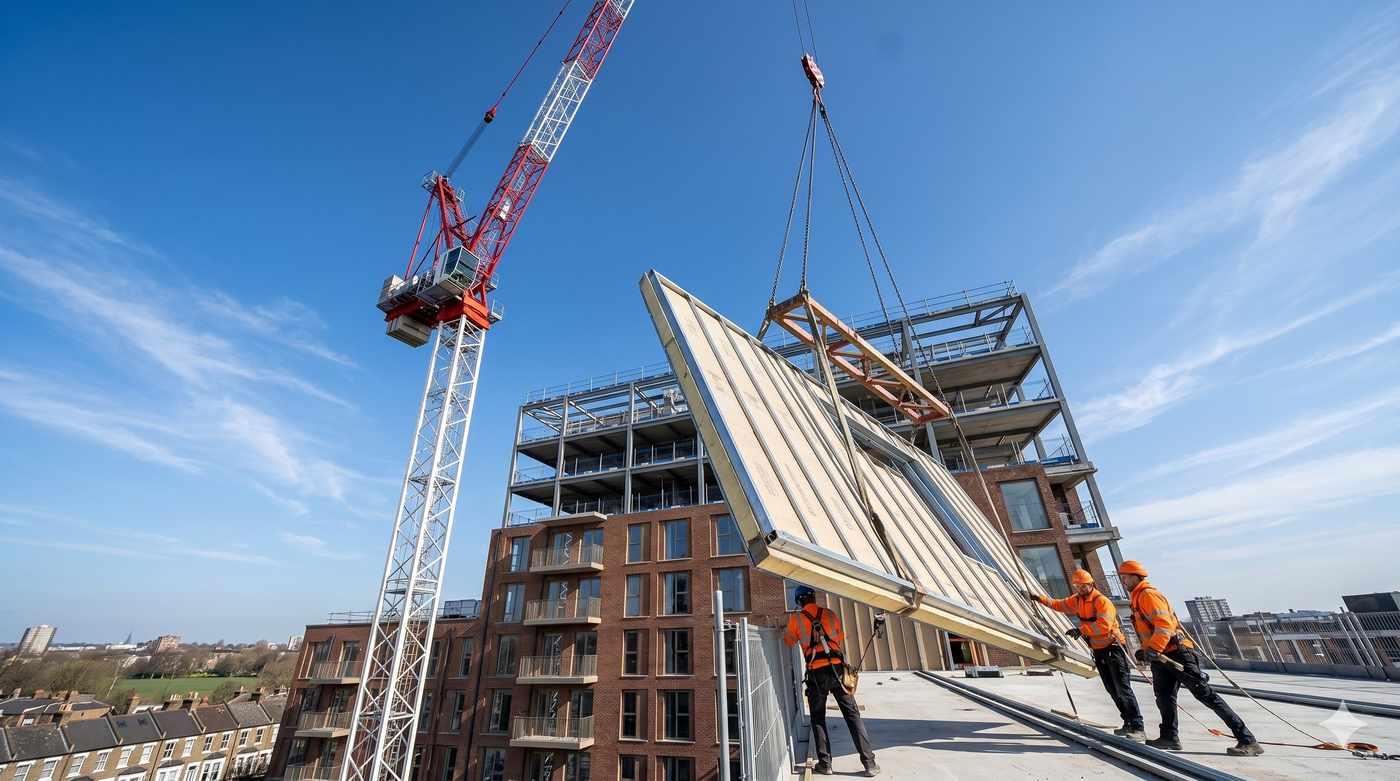
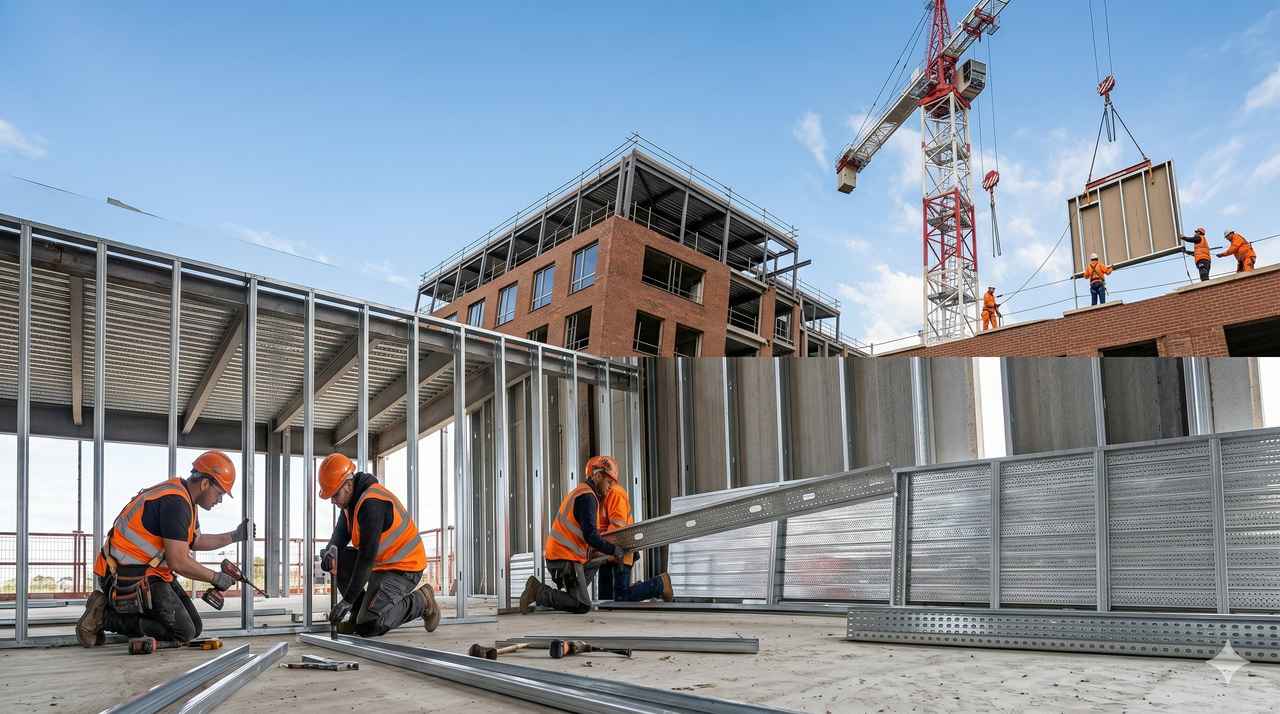
SFS is a cold-formed light gauge steel framing system used to construct the structural skeleton of external walls and, in full-build applications, internal load-bearing walls. On most mid-rise commercial and residential buildings, the most common SFS application is the infill wall system — a non-load-bearing steel frame fixed between the primary concrete or hot-rolled steel structure to provide the substrate for the building envelope.
The SFS frame does the structural work of the external wall. It resists wind load, accommodates structural movement, supports the weight of sheathing boards and cladding, and provides the fixing datum for the external facade system. It does not, by itself, provide a finished interior surface, thermal insulation to Part L standards, acoustic performance, or fire compartmentation in most configurations.
Drylining
Drylining delivers the internal performance of the building envelope and the interior subdivision of space. In the context of an SFS-framed external wall, drylining services typically encompass the internal lining of the SFS frame — plasterboard fixed to the inner face of the studs — together with any insulation installed within the stud cavity, vapour control layers, and the tape, joint, and finish applied to the plasterboard surface.
Separately, drylining covers all internal partition work: the metal stud partitions that subdivide the floor plate into rooms and spaces, suspended ceiling systems, and any specialist performance boards (fire-rated, acoustic, moisture-resistant) required by the specification.
SFS provides the structural skeleton. Drylining provides the performance skin. On the external wall, both act on the same set of studs. That shared substrate is where the interface — and the coordination challenge — is found.
The Technical Interface: Where the Two Systems Share a Substrate
The most significant technical interface between SFS and drylining occurs at the external wall assembly. Both systems operate on the same stud frame, and the sequence in which they are executed determines the performance of the completed wall.
The external wall build-up
A typical SFS-framed external wall assembly, from outside to inside, consists of:
- External cladding — brick slip, rainscreen, render, or curtain wall, fixed to the outer face of the sheathing board or directly to the studs via a bracket system.
- Sheathing board — fixed to the outer face of the SFS studs to provide racking resistance and the substrate for breather membrane and cladding fixings. This is SFS scope.
- SFS stud cavity — the void between outer sheathing and inner lining, which accommodates insulation, services first fix, vapour control membranes, and cavity barriers.
- Insulation within the stud cavity — mineral wool or rigid insulation between studs. This is typically drylining scope, installed after SFS frame completion and before internal boarding.
- Internal plasterboard lining — one or more layers of plasterboard fixed to the inner face of the SFS studs, taped, jointed, and finished. This is drylining scope.
The scope boundary sits within the stud cavity. The SFS contractor builds the frame and fixes the outer sheathing. The drylining contractor fills the cavity with insulation, installs any vapour control layer, and fixes the internal lining. Both trades work on the same studs, in the same zone, in sequence.
Cavity barriers: a shared responsibility that is frequently mismanaged
Approved Document B requires cavity barriers at every floor level in the external wall cavity, and at specified intervals within the facade to restrict fire and smoke movement through the void. The installation of cavity barriers is a statutory requirement, and failure to install them correctly is a building safety issue, not simply a quality defect.
In practice, cavity barriers are frequently left in a grey area between the SFS scope and the drylining scope. The SFS contractor argues they are a drylining item; the drylining contractor argues they are part of the SFS frame. When neither owns them clearly, they are either omitted, installed incorrectly, or installed late — after other work has made correct installation difficult. For the full requirements around fire performance in drylining assemblies, see our guide to fire-rated drylining for UK commercial projects.
Cavity barriers must be assigned explicitly to one contractor in the scope documents. ‘To be agreed on site’ is not an acceptable position on a statutory fire safety requirement. The SFS contractor, who installs the frame within which the barriers sit, is generally better placed to own this responsibility — but this must be stated in the subcontract.
The Sequential Interface: Programme and Access Dependencies
Even when the technical scope is clearly divided, the sequential dependency between SFS and drylining creates programme risk that must be actively managed.
Sequence on a typical commercial floor
The standard installation sequence on a mid-rise commercial building works as follows:
- SFS frame erected floor by floor, from sole track to head track, with stud installation and sheathing boarding completed
- External cladding or facade installation commences, working floor by floor behind the SFS programme
- Drylining mobilises for internal cavity insulation and vapour control layer installation once the SFS frame is complete on a given floor and the floor above is weather-tight
- Internal lining boards are fixed once first-fix services (MEP) have been installed within the cavity
- Tape, joint, and finishing follows boarding completion, with a handover to follow-on trades
The critical dependency is weather-tightness: the drylining contractor cannot install insulation or board internal faces while the building is open to the elements. This means the drylining programme is directly dependent on the SFS contractor’s progress, and any delay to SFS pushes drylining, which pushes MEP first fix, which pushes all subsequent trades.
The sectional handover problem
On larger commercial projects, the programme is typically managed through sectional handovers: SFS completes a defined zone or floor, which is handed to drylining, which is handed to MEP, and so on. This works in theory but requires both contractors to understand and respect the handover conditions. If the SFS contractor hands over a zone before sheathing is complete, or before deflection head details are installed, the drylining contractor either waits or proceeds with incomplete information — both of which are costly.
The coordination discipline required to make a divided SFS-drylining package work on programme is real and demanding. It requires named site managers on both packages, clear handover checklists, and a main contractor with the bandwidth to manage the interface actively. For an account of how programme management works on a demanding SFS installation under a tight six-week schedule, see our case study on 2,000m² delivered at Denham Crematorium.
The Contractual Interface: Where Scope Gaps Create Risk
When SFS and drylining are let as separate packages, the scope boundary must be defined with precision. The following items are most commonly disputed or omitted when scope documentation is inadequate:
| Item | Often assumed to be SFS scope | Often assumed to be drylining scope |
| Cavity insulation | Sometimes included in SFS sheathing scope | Often assumed drylining |
| Vapour control layer | Rarely explicitly assigned | Rarely explicitly assigned |
| Cavity barriers | Logically SFS (frame interface) | Often pushed to drylining |
| Internal boarding to SFS external walls | Not SFS | Should be explicit drylining scope |
| Reveals and window linings | SFS frames the opening | Drylining linings often omitted from scope |
| Fire-stopping at floor penetrations | SFS frame interface | Often left unassigned |
| Deflection head seals | SFS installs the detail | Sealant application often unassigned |
Each of these items is small in isolation. Collectively, they represent a significant programme and cost risk if they are not explicitly assigned before the packages go to site. The standard pattern is for both subcontractors to price on the assumption that the other package includes the disputed item, for the gap to emerge on site, and for the resolution to be a variation to one or both subcontracts — at a cost that always exceeds what the item would have cost if it had been priced competitively at tender.
The Case for a Combined SFS and Drylining Package
The coordination and scope risks described above are real, but they are not inevitable. They are the consequence of a procurement model that creates an interface and then relies on two separate contractors to manage it. The alternative is to eliminate the interface by appointing a single contractor for both scopes.
What a combined package delivers
A combined SFS and drylining appointment — where one contractor is responsible for SFS installation, internal lining, cavity insulation, cavity barriers, and internal partition work — places all of the interface risk within a single scope. The coordination that would otherwise require active management by the main contractor becomes internal programme management for the appointed subcontractor.
- Cavity barriers are owned and installed by the same contractor who erects the SFS frame — no interface gap
- Internal lining follows SFS frame completion without a handover negotiation between separate trades
- Sectional programme is managed within one team, with a single point of contact for the main contractor
- Scope gaps between items like reveals, window linings, and deflection head seals are resolved at tender, not on site
- Variations to the SFS scope that affect drylining — additional openings, late drawing changes — are managed within one contract rather than across two
The Denham Crematorium project illustrates this directly. Appointed as a full-package SFS contractor, BAS Frames managed late ventilation opening additions — which required cutting back completed boarding and modifying the frame — within a single day, because the same team owned both the SFS frame and the internal boarding. In a divided package, that modification would have required coordination between two subcontractors, a variation instruction, and almost certainly a programme delay.
When a divided package is appropriate
A combined package is not always the right procurement model. On very large projects where the SFS and drylining scopes are so large that no single subcontractor has the capacity to deliver both, division may be the only practical option. Similarly, where the SFS scope is complete and the project is moving to a fit-out phase with a different programme and contractor base, separate procurement of the drylining package is standard practice.
The decision should be made on the basis of the actual project conditions — scope scale, programme structure, contractor capacity, and the complexity of the SFS-drylining interface — rather than as a default procurement preference.
Design Coordination: Resolving the Interface Before Site
Whether the packages are combined or divided, the most effective way to manage the SFS-drylining interface is to resolve it at design stage, before any steel is fixed on site.
The key design coordination questions that must be answered before the packages go to tender are:
- What is the nominal SFS stud depth, and does it provide adequate cavity for the specified insulation thickness plus any services runs within the cavity?
- What is the total wall build-up thickness from structural face to finished plasterboard face, and has this been coordinated with the room dimension and door/window reveal specifications?
- Are deflection head details drawn and specified for each floor level, with deflection allowances based on the structural engineer’s deflection data?
- Are cavity barrier positions marked on the drawings and assigned to a named scope?
- Have window and door reveals been designed and included in one of the two packages?
- Has the vapour control layer position been confirmed as either inner face of sheathing or outer face of internal boarding, and has it been assigned to a scope?
BAS Frames provides SFS design input at pre-tender stage on commercial projects, working alongside the design team to review the SFS-drylining interface details and identify coordination issues before they become site problems. This is particularly valuable on projects where the external wall build-up is complex or where the SFS and drylining scopes are closely integrated.
Performance Across the Combined Assembly
The performance of the completed external wall — thermal, acoustic, and fire — is a function of the combined SFS and drylining assembly, not of either system in isolation. This has important implications for specification and for the allocation of performance responsibility between packages.
Thermal performance
The target U-value for a commercial external wall is typically in the range of 0.18–0.25 W/m²K under UK Building Regulations Approved Document L. Achieving this requires insulation both within the stud cavity (drylining scope) and, in most cases, at the outer face of the studs (which may be SFS or facade scope depending on the cladding system). If the two packages are let separately and neither is given explicit responsibility for the total thermal performance of the assembly, it is entirely possible for both to comply with their individual scope requirements while the combined wall fails to meet the specified U-value. See our guide to what is included in an SFS package for how thermal scope is typically structured within a full SFS appointment.
Acoustic performance
External wall acoustic performance — the reduction of external noise transmitted into the building interior — is determined by the mass of the internal lining, the depth of the insulated cavity, and the junction details at floor and ceiling. All three variables span the SFS-drylining interface. A specification that assigns acoustic performance responsibility to neither package, or to both without defining who is accountable, will not be reliably delivered. For detailed guidance on acoustic system specification within drylining, see our article on acoustic drylining solutions.
Fire performance
The fire performance of the external wall assembly — cavity barriers, internal lining fire ratings, and the continuity of compartmentation at floor levels — spans both scopes. The drylining installation must be sequenced so that fire-rated boarding is installed before any ceiling or floor screed conceals the base of the wall. The cavity barriers installed by the SFS contractor must be positioned to coordinate with the floor level of the drylining lining. Neither system delivers adequate fire performance independently; the performance is a property of the combined assembly correctly installed in sequence.
Conclusion
SFS and drylining are complementary systems that together form the building envelope and the internal environment of a commercial building. Specifying either in isolation, without understanding how it connects to the other, is a reliable route to scope gaps, programme delays, and performance failures on site.
The most resilient approach is to resolve the interface at design stage, assign every interface item explicitly in the scope documents, and seriously consider whether a combined package appointment — where a single subcontractor owns both the SFS frame and the internal drylining — is appropriate for the scale and complexity of the project.
At BAS Frames, our commercial SFS installation and drylining services are available independently or as a combined package, with design input provided at pre-tender stage to support coordination. To discuss how we can structure a combined package for your next project, contact the BAS Frames team.
Related reading:
→ What Are Steel Frame Systems in Construction?
→ SFS Infill Walls: How They Work on Concrete and Steel Frame Structures
→ Drylining Services — BAS Frames
→ Fire-Rated Drylining: Specification Guide for UK Commercial Projects
→ Metal Stud Partitions: What They Are and When to Specify Them
→ Acoustic Drylining Solutions
→ 2,000m² in Six Weeks: The SFS Delivery Standard
→ What Is Included in an SFS Package?
Further reading:British Gypsum Technical Resources | Gypsum Products Development Association
Related:Cost | Infill | What Is | Fire
Frequently asked questions
Are SFS and drylining always procured together?
On most commercial and residential mid-rise projects, SFS and drylining are procured from the same specialist subcontractor — because the two trades are closely integrated on site and sharing a single package reduces interface risk. However, on some large schemes, SFS supply-and-fix and drylining finishing are procured separately, with the main contractor managing the interface.
What is the interface between SFS and drylining?
The SFS frame provides the structural substrate to which drylining plasterboard is fixed. The interface involves: ensuring stud spacing is appropriate for board span, coordinating M&E services in the cavity before boarding, providing movement joints where required, and ensuring head track details accommodate structural deflection without affecting board integrity.
Can SFS and drylining be installed by different subcontractors?
Yes, but this creates an interface risk that must be managed carefully. The SFS subcontractor’s installation tolerances directly affect the drylining finisher’s ability to achieve a flat, plumb surface. If the same subcontractor does both trades, accountability for any defects is clear. With separate subcontractors, responsibility for remediation of interface problems must be defined in the subcontract conditions.
What quality checks should be done between SFS installation and drylining?
Before drylining commences, the SFS framework should be checked for: plumb and level of studs, correct stud spacing, completion of M&E first-fix in the cavity, installation of acoustic resilient bars where specified, and sign-off of any fire-rated details by building control. These checks should be recorded as part of the quality management process.