Key takeaways
- A metal stud partition is a non-load-bearing internal wall of cold-formed steel C-studs and U-tracks, lined with plasterboard.
- Specification starts with stud gauge, section size and height limit — these set how tall and robust the partition can be.
- The head condition (fixed, deflection or sliding) is the most under-specified detail and governs how the partition handles slab movement.
- Against masonry, metal stud is lighter, faster and easier to reconfigure, while still meeting fire and acoustic requirements with the right board.
Metal Stud Partitions: What They Are and When to Specify Them
Metal stud partitions are the default internal wall system for modern commercial construction in the UK. They are faster to install than masonry, lighter in weight, more adaptable to change, and capable of achieving a wide range of acoustic and fire performance ratings when specified and installed correctly.
Yet despite their ubiquity, metal stud partitions are frequently under-specified. Tender packages routinely describe them in the broadest terms — “metal stud partition to ceiling” — without defining stud gauge, fixing centres, head condition, or performance requirements. The result is an ambiguous scope that invites tender qualifications, encourages value engineering at the wrong end of the specification, and produces installations that fail acoustic or fire testing.
This guide sets out what metal stud partitions actually are, how they are specified, the system types available, and the circumstances where each is most appropriate. It is written for anyone involved in procuring or specifying internal partition work on commercial projects — from a single office fit-out to a multi-storey residential development. For a broader view of drylining services and how partition work fits within the wider internal fit-out scope, see our services overview.
What Is a Metal Stud Partition?
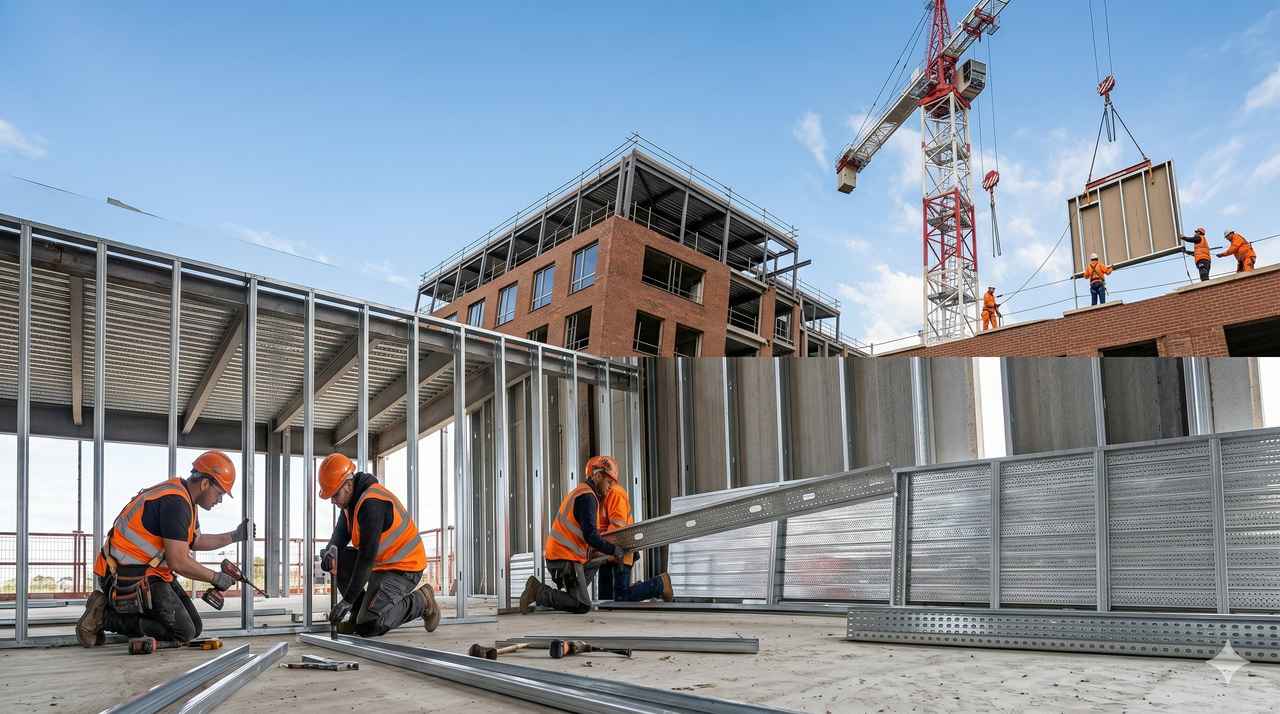
A metal stud partition is a non-load-bearing internal wall constructed from a lightweight cold-formed steel frame, lined on one or both faces with plasterboard. The frame consists of three basic components:
- U-track (sole and head plate) — horizontal channels fixed to the floor and ceiling (or structural soffit) that define the wall position and form the perimeter boundary of the frame.
- C-studs — vertical steel sections inserted into the track at regular centres (typically 400mm or 600mm) to form the wall’s structural spine and the fixing substrate for plasterboard.
- Noggings and blocking — horizontal steel members used to provide additional rigidity at specific heights, or to create fixing points for wall-mounted equipment, sanitary ware, or heavy fixtures.
Plasterboard is then fixed to the studs using drywall screws, with joints taped and filled or skimmed to produce a flat, decoration-ready surface. Services — electrical conduit, data cabling, pipework — are typically run within the partition cavity before the second face is boarded.
Metal stud partitions are non-load-bearing. They divide space, support linings, and can carry a wide range of performance ratings — but they do not contribute to the building’s structural frame. Where load-bearing internal walls are required, a different structural system applies.
Stud Gauges, Section Sizes, and Height Limits
The structural performance of a metal stud partition — its resistance to lateral load, its height capability, and its contribution to fire and acoustic ratings — is determined primarily by two variables: the stud section size (depth) and the steel gauge (thickness).
Section depth
C-studs are manufactured in standard depths, most commonly 48mm, 70mm, 92mm, and 146mm. Deeper sections carry greater bending resistance, allowing taller partition heights and, in some systems, wider stud centres.
The choice of section depth is not simply a structural question. It also determines the cavity width available for services, the thickness of any insulation that can be accommodated within the frame, and the overall partition thickness — which has implications for floor plan efficiency in tight commercial fit-outs.
Steel gauge
UK commercial partition studs are typically manufactured in 0.5mm, 0.6mm, or 0.7mm gauge steel. Heavier gauges (0.7mm and above) are used in applications requiring greater structural performance — taller partitions, wider centres, or elevated lateral load requirements such as partitions adjacent to doors.
Height limits
Every metal stud partition system has a maximum unsupported height, beyond which the stud’s slenderness ratio exceeds the limits of the manufacturer’s test evidence. These limits are not arbitrary — they reflect the point at which wind or impact loads would cause deflection in excess of the serviceability limits prescribed by the specification.
| Stud depth | Standard gauge | Typical max. height |
| 48mm | 0.5mm | Up to 2.7m |
| 70mm | 0.5–0.6mm | Up to 3.6m |
| 92mm | 0.6mm | Up to 4.5m |
| 146mm | 0.7mm | Up to 6.0m+ |
Heights above the standard limits are achievable through double-stud construction, the addition of horizontal bracing, or the use of proprietary heavy-gauge sections. Where partitions exceed 4 metres in height — as is common in commercial lobbies, atriums, and open-plan office developments — the structural design should be reviewed by a qualified engineer. BAS Frames provides structural engineering support for projects where partition heights or loading conditions fall outside standard manufacturer limits.
System Types: Matching the Specification to the Requirement
The term “metal stud partition” covers a range of system configurations. The appropriate type depends on the acoustic, fire, and structural performance requirements of the specific application.
Single-frame partitions
The most common configuration in commercial fit-out: a single row of studs with plasterboard on both faces. Single-frame partitions can achieve acoustic performance in the range of Rw 35–45 dB depending on board type, number of layers, and the presence of acoustic insulation within the cavity. They are suitable for office subdivisions, meeting rooms, and general circulation walls where mid-level acoustic separation is required.
Independent twin-frame partitions
Where higher acoustic performance is required — Rw 55 dB and above — independent twin-frame construction is typically specified. Two separate stud frames are erected with a structural gap between them, eliminating the rigid connection that transmits flanking noise in single-frame construction. Acoustic mineral wool fills the combined cavity. This system is the standard specification for hotel bedroom walls, residential conversions, recording studios, and any application requiring compliance with Approved Document E.
Twin-frame construction is also used in fire-rated applications requiring EI 120 performance, or where structural movement between floor plates must be accommodated without compromising partition integrity. For more on how acoustic performance is specified and delivered, see our article on acoustic drylining solutions.
Staggered-stud partitions
A practical intermediate between single-frame and full twin-frame construction: studs are set alternately against opposite faces of a wide sole and head track, with no stud common to both faces. The system reduces flanking transmission without the full build-up thickness of a twin-frame wall, and is used where plan width is constrained but acoustic performance above single-frame capability is required.
Fire-rated partitions
Fire performance in metal stud partitions is achieved through the specification of fire-rated board types, increased board thickness or layering, and correct perimeter detailing. Standard single-frame partitions with two layers of 15mm fire-rated board can typically achieve EI 60; EI 90 and EI 120 require heavier gauge studs, additional board layers, or independent twin-frame construction. For a full treatment of fire-rated drylining specification, see our dedicated guide to fire-rated drylining for UK commercial projects.
Demountable partitions
Demountable metal stud systems use proprietary aluminium or steel framing with dry-fixed, screw-less board attachment systems designed to allow dismantling and re-erection without damage to the boards or frames. They are used in commercial office environments where the specification requires Cat A or Cat B fit-out with a defined dilapidations strategy, or in leased spaces where tenant flexibility is a requirement. Performance ratings are lower than fixed construction and must be verified against the specific proprietary system.
Head Conditions: The Most Under-Specified Detail
The head condition — the junction between the top of a metal stud partition and the structure or ceiling above — is the detail most frequently omitted from commercial partition specifications and most frequently responsible for performance failures.
Three head conditions are in common use, and they are not interchangeable:
- Fixed head — the head track is fixed directly to the structural soffit. This is the standard condition for fire-rated partitions, where a rigid connection is required to maintain compartmentation. It is not suitable where structural movement between floors is anticipated.
- Floating head (deflection head) — the head track is fixed to the structural soffit but studs are inserted into it with a slip tolerance (typically 25mm or 50mm), allowing vertical movement without loading the partition frame. This is the standard condition for partitions in concrete and steel frame buildings where floor-to-floor deflection under imposed load is a design consideration.
- Ceiling-height partition — the partition terminates at ceiling tile level rather than at the structural soffit. This is architecturally convenient but acoustically poor: sound transmits freely over the top of the partition through the ceiling void. It should not be used where acoustic separation is a performance requirement.
Specifying a metal stud partition without defining the head condition is specifying an incomplete system. The head detail affects structural performance, acoustic performance, fire performance, and programme — all of which must be resolved before the partition is built, not after.
When to Specify Metal Stud Partitions: Application Guide
Metal stud partitions are appropriate across a wide range of commercial applications. The following guidance covers the most common scenarios and the specification considerations specific to each.
Commercial office fit-out
The majority of commercial office fit-out in the UK uses metal stud partitions for all internal subdivision. Single-frame construction with acoustic mineral wool infill is adequate for most general office separation. For meeting rooms, boardrooms, and cellular offices in open-plan environments, acoustic performance requirements should be assessed against the background noise level and the sensitivity of the activities being separated — not simply assumed from a generic specification. For guidance on what a commercial drylining installation involves from survey through to handover, see our article on the drylining installation process.
Residential development and apartment buildings
In residential new-build and conversion projects, Approved Document E sets minimum acoustic performance requirements for separating walls between dwellings. Metal stud partitions used as separating walls — rather than room dividers within a single dwelling — must be designed and tested to meet these requirements. Independent twin-frame construction is the standard approach. For residential projects built on a steel framed system, the partition specification must account for the acoustic properties of the structural frame, as flanking transmission through light gauge steel can be significant if not addressed at design stage.
Healthcare and education
In healthcare and education buildings, partition performance requirements are typically set out in detailed room data sheets that specify acoustic, fire, and impact resistance criteria for each space type. Metal stud partitions are widely used in both sectors, but the specification must be driven by room data rather than generic office partition details. Impact resistance in particular — resistance to trolley and wheelchair impact — is a performance requirement that affects both board specification and stud gauge selection.
Hotels and mixed-use residential
Hotel bedroom wall construction typically requires Rw 50–55 dB or above, depending on brand standard or planning condition. This performance level is not achievable with single-frame construction using standard boarding. Independent twin-frame or staggered-stud systems with high-density acoustic board are the appropriate specification. The same considerations apply to mixed-use developments where residential units are adjacent to commercial or retail spaces.
Industrial and warehouse fit-out
In industrial and warehouse environments, metal stud partitions are used for office subdivision within the shell, welfare facilities, and separation of storage areas. The primary specification drivers in these environments are typically robustness and height capability — partitions in warehouse settings are frequently taller than standard commercial construction, requiring heavier gauge studs and structural engineering input at the design stage. See how BAS Frames approaches SFS installation in commercial environments including large-scale and non-standard height applications.
Metal Stud Partitions vs. Masonry: The Specification Decision
For architects and developers who have not previously specified metal stud construction, the comparison with traditional masonry is a useful frame of reference. For a comprehensive analysis of how steel-based systems compare to traditional construction more broadly, see our article on steel frame systems vs traditional construction.
| Factor | Metal stud partition | Masonry partition |
| Weight | Typically 25–40 kg/m² | 150–250 kg/m² |
| Programme | Fast — no drying time | Slower — wet trades required |
| Acoustic performance | Achievable to Rw 60+ with correct system | Dependent on mass and density |
| Fire performance | Achievable to EI 120 with correct system | Inherently non-combustible |
| Adaptability | High — demountable and modifiable | Low — demolition required |
| Services integration | Cavity accommodates services | Chasing required |
| Structural loading | Minimal — suitable for all floor types | Significant — requires structural assessment |
The weight advantage of metal stud construction is particularly significant in refurbishment and rooftop extension projects, where the existing structure may not carry the additional imposed load of new masonry. In these contexts, metal stud partitions are frequently the only viable option.
Writing a Complete Metal Stud Partition Specification
A complete partition specification for a commercial project should define the following for each partition type:
- Stud section depth and steel gauge
- Stud centres
- Board type, thickness, and number of layers on each face
- Cavity insulation specification: product type, density, and thickness
- Head condition: fixed, floating (with deflection tolerance), or ceiling height
- Acoustic performance requirement in dB Rw, referenced to the tested system
- Fire performance requirement in EI minutes, referenced to the tested system and manufacturer
- Penetration and service coordination requirements
- Fixing requirements for wall-mounted equipment: location, backing type, and load capacity
Specifying at this level of detail eliminates ambiguity at tender, reduces the risk of post-contract variation claims, and ensures that the installed partition actually delivers the performance the building requires. For large commercial packages, BAS Frames can provide design input at pre-tender stage to review partition specifications and identify coordination issues before they reach site.
Conclusion
Metal stud partitions are one of the most widely used elements in commercial construction — and one of the most under-specified. The gap between a partition that is described correctly and one that performs correctly is almost always found in the details: head condition, board layering, acoustic insulation specification, and the selection of a tested system rather than a combination of components that has never been assessed together.
The specification decisions described in this guide are not complex. But they require deliberate attention at design stage, and they require a subcontractor who understands the relationship between specification and performance — not one who simply installs what is drawn without questioning whether the drawing delivers what the specification requires.
BAS Frames delivers metal stud partition installation as part of our wider drylining services across residential, commercial, and industrial projects in London and the South East. To discuss your next project, contact our team.
Related reading:
→ Drylining Services — BAS Frames
→ Fire-Rated Drylining: Specification Guide for UK Commercial Projects
→ Acoustic Drylining Solutions
→ The Drylining Installation Process
→ Steel Frame Systems vs Traditional Construction
→ What Are Steel Frame Systems in Construction?
Further reading:British Gypsum Technical Resources | Steel Construction Institute
Related:Cost | Infill | What Is | Fire
Frequently asked questions
What are metal stud partitions?
Metal stud partitions are non-load-bearing internal walls constructed from cold-formed steel C-section studs fixed between floor and ceiling tracks. Plasterboard is screwed to both faces of the frame to create a finished wall surface. They are the standard partition system in commercial and residential construction in the UK.
What sizes do metal studs come in?
UK metal studs are typically available in 48mm, 70mm, 92mm and 146mm depths. Stud depth affects acoustic performance, partition thickness and the cavity space available for services. 70mm is standard for most commercial partitions; 92mm or 146mm is used for acoustic-critical or services-heavy applications.
How are metal stud partitions fixed?
Floor and ceiling tracks are fixed to the structural slab using appropriate fixings for the substrate. Studs slot into the tracks at 400mm or 600mm centres and are crimped or screwed to prevent rotation. Plasterboard is fixed to both faces with drywall screws at 300mm centres, with joints taped and filled or skimmed for finish.
Can metal stud partitions be moved?
Yes — this is one of the key advantages of metal stud over masonry partitions. Non-load-bearing metal stud partitions can be dismantled and rebuilt without structural alteration, making them well suited to buildings where layout flexibility is required. Demountable partition systems take this further, allowing panels to be relocated without damage.