Key takeaways
- Steel Frame Systems can absorb mid-project design changes — wall repositions, new openings, layout revisions — without demolition or programme collapse.
- SFS components are fabricated to millimetre accuracy using 3D CAD; revised sections can be manufactured and delivered faster than any wet-trade equivalent.
- High strength-to-weight ratio eliminates many internal load-bearing walls, giving architects and clients greater open-plan freedom throughout the build.
- Unlike blockwork or concrete, SFS changes produce minimal waste — components can be swapped or repositioned without disrupting the surrounding structure.
When it comes to construction, change is inevitable. Whether it’s repositioning a wall, adjusting a window opening, or rethinking an entire floor layout, clients regularly modify their plans during the build process. Design intent evolves. Site conditions impose new constraints. Occupier requirements shift between RIBA Stage 3 and practical completion. And while these changes are a natural part of any project, how easily and cost-effectively they can be incorporated depends heavily on the building system in use.
This is where Steel Frame Systems (SFS) truly shine. For developers, main contractors and architects working on residential, build-to-rent or commercial schemes, design adaptability is one of the most underrated commercial advantages of light gauge steel framing — yet it rarely features prominently in subcontractor pitches or specification comparisons. This guide explains why it should.
Why steel makes adaptability easy
Unlike traditional building methods such as concrete frames or masonry blockwork — where any post-design alteration often requires significant demolition, structural re-assessment, wet-trade rework and extended programme delays — steel frame structures offer unmatched flexibility. The system is inherently modular, precisely dimensioned, and open to adjustment both at design stage and during on-site execution.
Cold-formed light gauge steel sections are manufactured to tight dimensional tolerances. According to the Steel Construction Institute, the controlled factory environment in which SFS sections are produced means that substitutions, revisions and additions integrate cleanly into existing frame geometry — something that simply cannot be replicated with poured concrete or laid blockwork.
This inherent modularity is not accidental. It is an engineered characteristic of the system, and one that experienced SFS subcontractors build into their programme planning and commercial models from the outset.
Changes during construction? No problem
One of the biggest practical advantages of a steel frame is that modifications can be made quickly and with minimal disruption to the wider programme. Whether a client decides to widen a doorway, add a new window opening, extend a room, or reconfigure an internal partition wall, the adaptable nature of steel framing allows these updates to be implemented efficiently — often within days rather than weeks.
In contrast, making the same changes in concrete or blockwork construction usually involves breaking out existing structure, waiting for revised engineering approvals, sourcing additional materials, re-building and finishing — all of which adds cost, creates waste, and extends the programme. On a typical mid-rise residential scheme, a late-stage blockwork revision can add two to four weeks of delay. The equivalent SFS revision, handled by an experienced subcontractor, can often be completed within a week.
The commercial implication is significant. On a build-to-rent development where weekly site preliminaries run at £45,000–£65,000, the ability to absorb design changes without programme slippage is a direct financial benefit — not just a convenience.
Modular and precise by nature
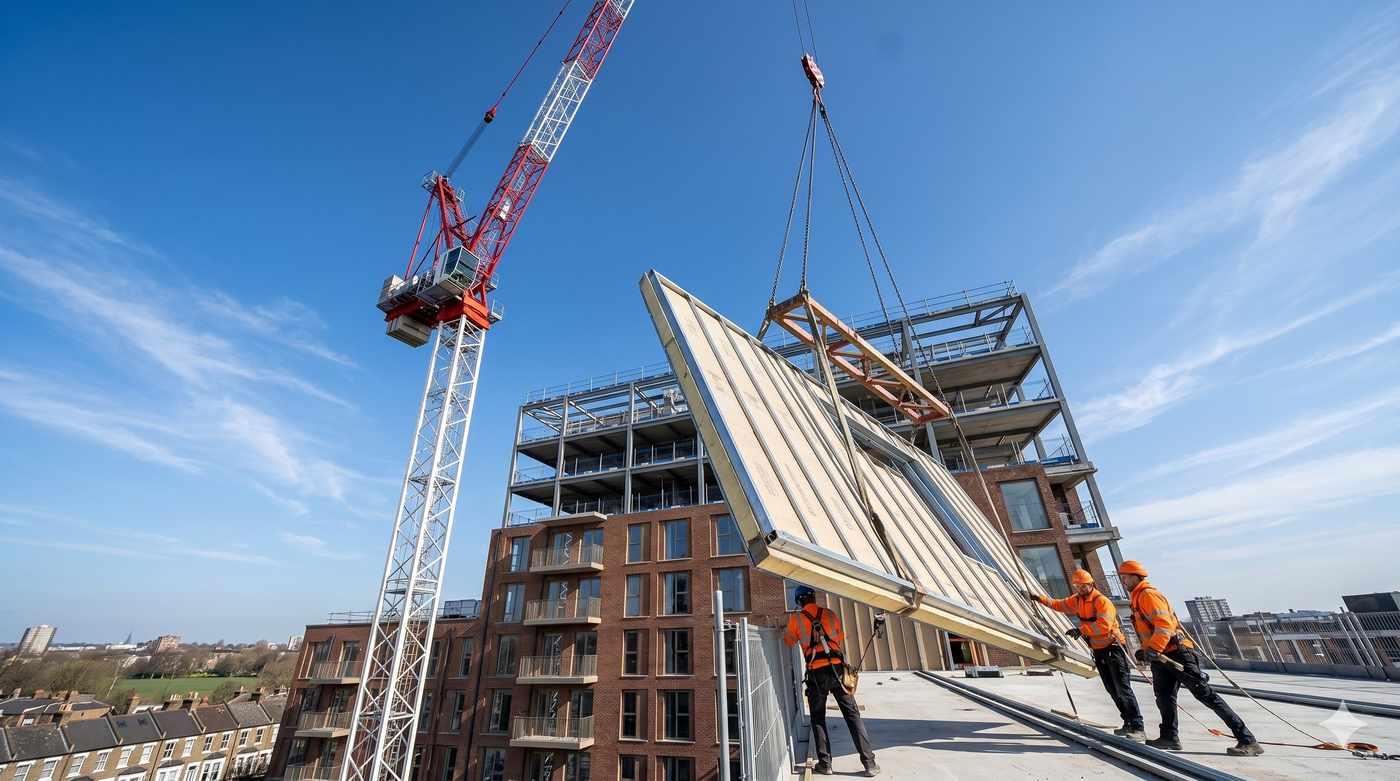
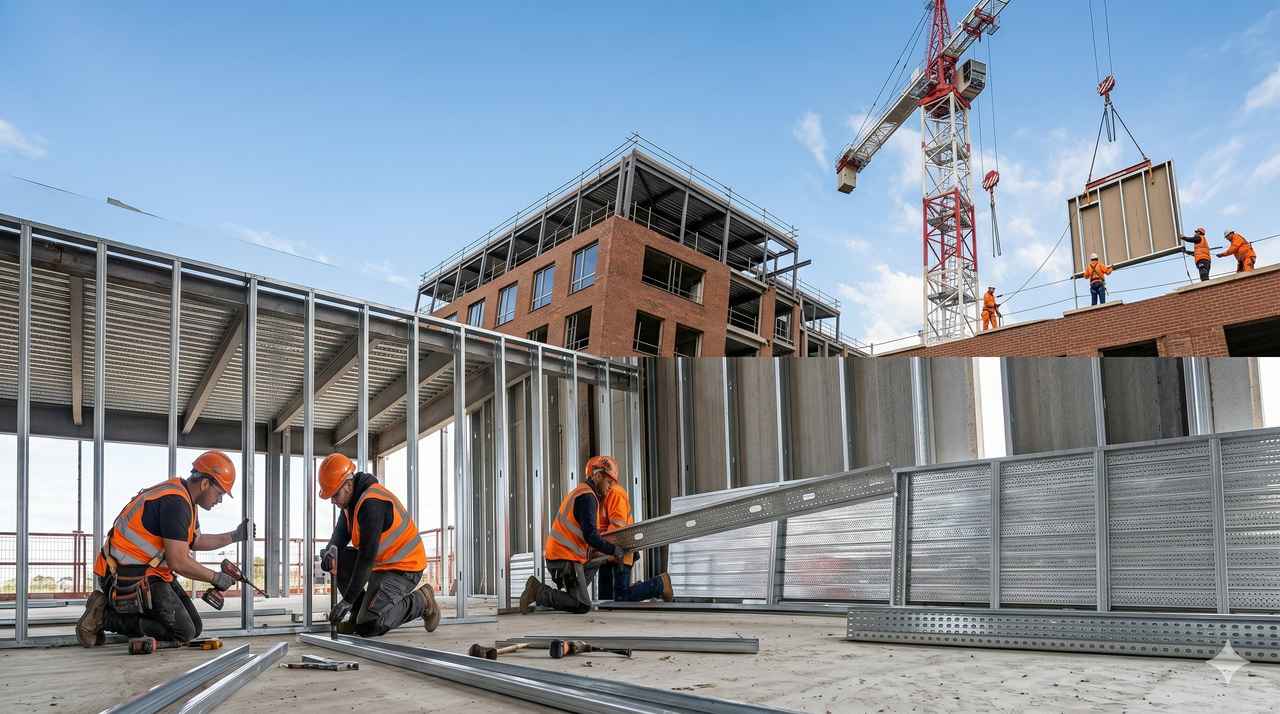
Steel frames are designed using advanced 3D modelling and Building Information Modelling (BIM) software. This means that even last-minute design changes can be updated digitally, coordinated against other building elements, and translated into modified fabrication drawings with millimetre accuracy. The revised sections can be manufactured and delivered to site quickly, integrating seamlessly with the installed frame.
Manufacturers such as Metsec, Hadley Group and other leading UK SFS section suppliers produce cold-formed steel to consistent tolerances, meaning that replacement or additional components fit first time. There is no equivalent in masonry construction — a replacement blockwork wall must be built by hand, course by course, with no guarantee of matching the dimensional accuracy of the original.
For projects using a panellised SFS approach, design revisions can be incorporated at factory stage before panels are delivered, removing on-site modification entirely. This is particularly valuable on higher-risk buildings where the Building Safety Act 2022 requires a robust golden thread of documentation for any design change.
Reduced costs and less waste
In traditional construction methods, change means rework. Rework means waste — broken-out masonry, discarded concrete, redundant reinforcement — and waste means added cost that is rarely fully recovered through variations. With steel, there is little to no need for demolition or re-fabrication on site. Components can be swapped or repositioned without disrupting surrounding structural elements, reducing both material loss and unnecessary labour expenditure.
Steel is also the world’s most recycled construction material. Any sections that are removed or replaced during a design revision can be returned to the steel supply chain and recycled, meaning that even the waste from an SFS design change has residual value. On a 2,000m² infill package, the difference in variation cost between an SFS scheme and an equivalent blockwork scheme can run to tens of thousands of pounds.
For detailed cost benchmarks, see our guide to SFS cost per m² in the UK (2026), which covers typical package rates, variation allowances and how to read a compliant SFS quotation.
Structural flexibility without sacrificing strength
Steel’s high strength-to-weight ratio means that SFS structures require fewer internal load-bearing walls to achieve the same structural performance as concrete or masonry alternatives. This translates directly into more open-plan floor plates, greater column-free spans, and more freedom to reconfigure internal layouts — both at design stage and, crucially, after construction has started.
The structural logic of a steel frame also makes it easier to incorporate future adaptability. A developer planning a build-to-rent block today may need to reconfigure apartment layouts for a different occupier demographic in fifteen years. An SFS frame, with its non-load-bearing internal partitions, makes that future adaptation significantly more viable than a concrete or masonry equivalent.
This principle extends to external wall systems too. SFS infill walling — steel framing installed between the primary structural frame and floor slabs — can be adapted, re-clad or upgraded without affecting the building’s primary structure. For commercial and mixed-use buildings with evolving façade requirements, this is a substantial long-term advantage.
Meeting client expectations in real time
Clients often do not see the full picture until construction begins. As they walk the site, visualise the space as it takes shape, and receive feedback from future occupiers or investors, ideas change. Floor-to-ceiling heights feel different in reality than on drawings. Natural light behaves differently than rendered images suggest. A partition wall that seemed logical on plan feels constraining when stood next to it.
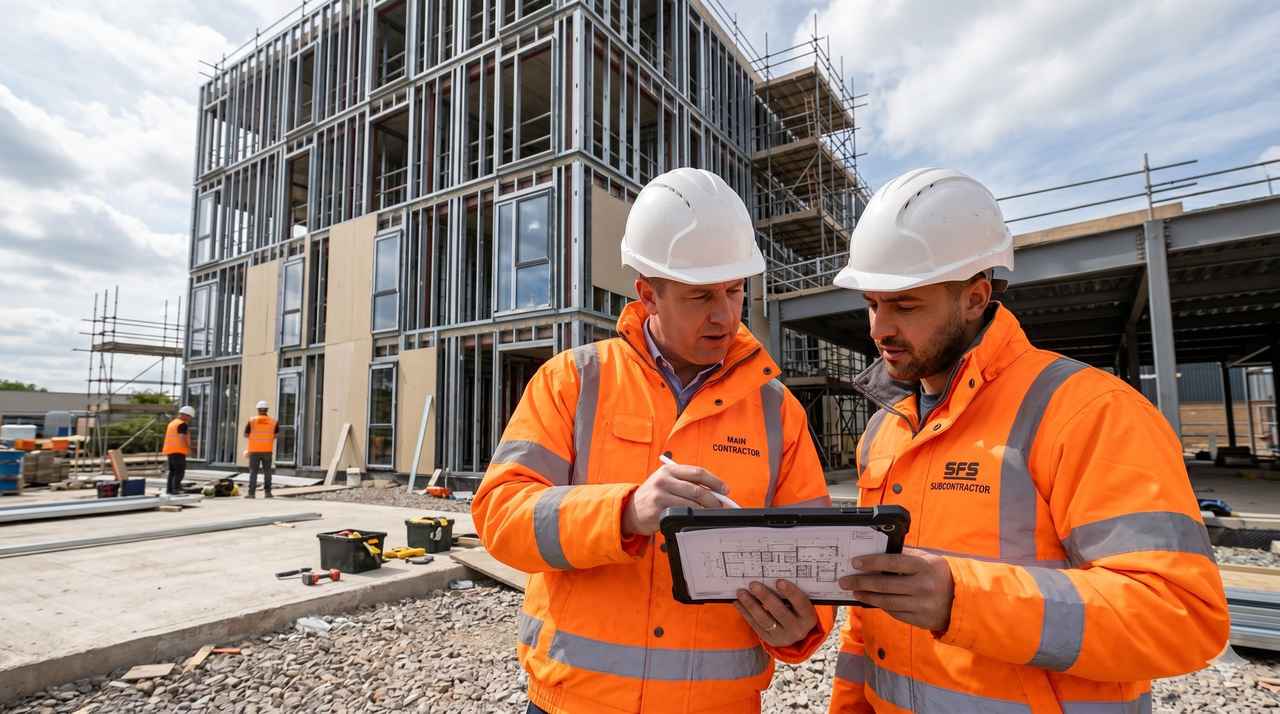
With a steel frame system, you can accommodate an evolving client vision, improve satisfaction, and maintain momentum — all without the frustration and commercial exposure of costly structural setbacks. The ability to say “yes, we can do that” to a client mid-programme, and mean it, is one of the most powerful things an SFS subcontractor brings to a project team.
On complex schemes — high-rise residential, mixed-use city-centre developments, phased regeneration projects — the combination of BIM-driven design accuracy and SFS’s inherent modularity creates a virtuous loop: changes are easier to model, easier to cost, easier to fabricate, and easier to install than in any other structural system.
Adaptable design, delivered with precision
At BAS Frames, we understand that no project ever goes 100% according to plan — and that’s perfectly okay. That’s why we specialise in Steel Frame Systems, working closely with our design and manufacturing partners to ensure every change — big or small — can be handled with ease, documented correctly, and delivered on programme.
Whether you are specifying an infill package for a concrete-framed BTR block, a full-build SFS structure for a low-rise residential scheme, or a panellised system for a time-critical student accommodation project, design adaptability is built into our process from day one.
If you’re looking for a structure that grows with your vision, even during construction, a steel frame system is the smart choice.
Need help with a project that might evolve over time? Get in touch with the BAS Frames team. We’ll show you how to build flexibility into your design from the outset.
Frequently asked questions
Can you make structural changes to a steel frame after installation has started?
Yes — this is one of the key practical advantages of SFS over concrete or blockwork. Steel frame components can be removed, repositioned or replaced without requiring demolition of adjacent structure. Revised fabrication drawings can be produced and new sections delivered to site quickly, minimising programme disruption. Minor changes are often completed within days; larger revisions within one to two weeks, depending on the extent of the modification.
How does SFS compare to blockwork for mid-project design changes?
Blockwork changes typically require breaking out existing masonry, structural re-assessment, re-building and finishing — adding weeks and significant cost. SFS changes involve updating digital drawings, replacing or adjusting steel sections, and continuing installation with minimal wet trades. For most residential and commercial schemes, SFS is the lower-risk choice when design evolution is likely.
Does design adaptability add to the cost of a steel frame package?
Minor revisions are generally absorbed within a well-managed SFS package. Significant scope changes may attract a variation cost, but this is typically far lower than the equivalent change in concrete or masonry — because there is no demolition, no curing time, and no secondary trades waiting on the structure to be remade. For SFS pricing context, see our 2026 SFS cost guide.
What types of projects benefit most from steel frame adaptability?
Build-to-rent, student accommodation, mixed-use residential, and commercial fit-out projects benefit most — these sectors frequently experience design evolution between RIBA Stage 3 and construction. SFS is also well suited to rooftop extensions and over-cladding projects where the existing structure imposes constraints that require flexible framing solutions.