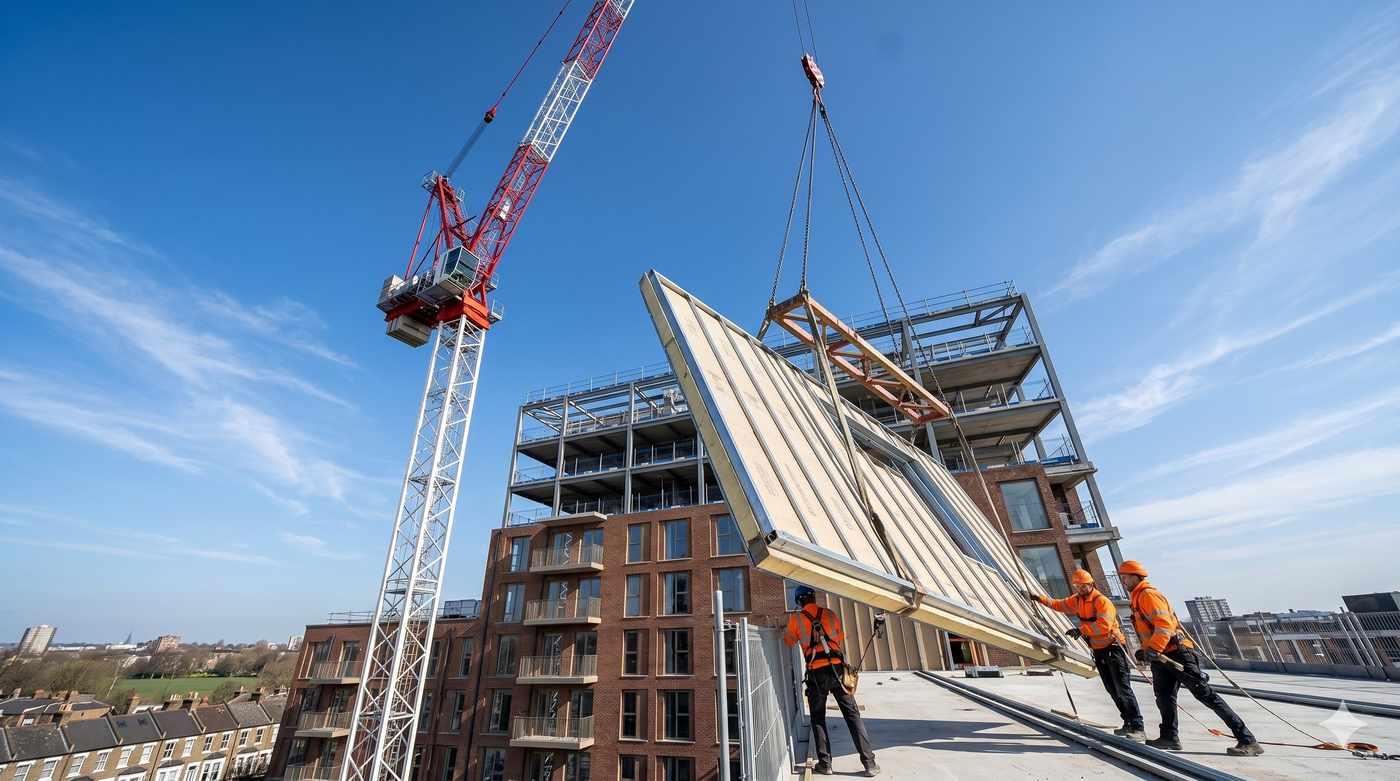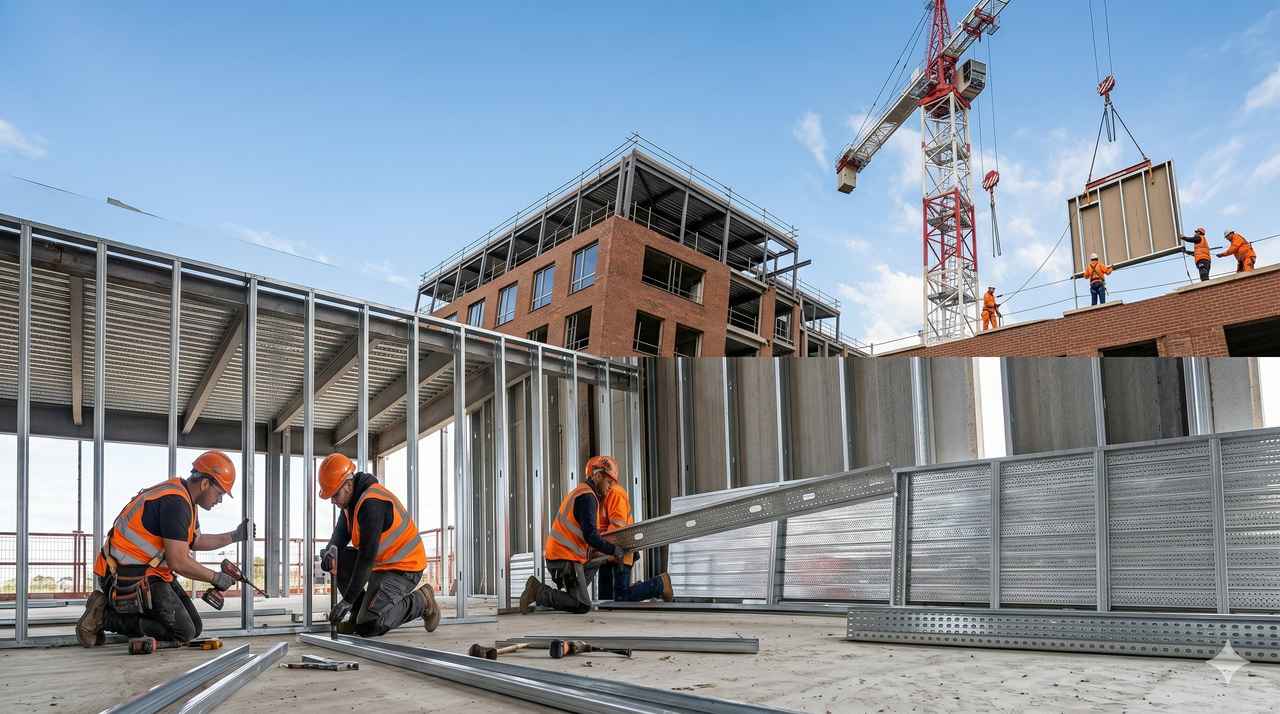
| Steel structure framing in the UK covers four distinct methods: hot-rolled primary structural steelwork (heavy I-beams and columns), cold-formed light gauge steel framing (SFS — used for infill walls, partitions and low-rise structural framing), modular volumetric steel construction (3D modules delivered fully fitted), and hybrid systems combining hot-rolled primary frames with SFS infill walls. The right method depends on building height, programme, cost, and Building Safety Act compliance requirements. Most UK mid-rise commercial construction uses a hybrid approach: hot-rolled primary frame + cold-formed SFS infill walls. |
What steel structure framing means
Steel structure framing is an umbrella term covering any building approach that uses steel as the primary structural material for walls, floors, roofs or the main building skeleton. In UK construction it spans heavy hot-rolled structural steelwork through to lightweight cold-formed light gauge steel framing, with several methods between.
This guide explains the four main approaches to steel structure framing used in UK construction in 2026, when to use each, how they compare on cost and programme, and which method suits which building type. If you’re choosing between steel methods at concept design stage or trying to understand the trade-offs at procurement, this is the comparison reference.
The four steel structure framing methods
1. Hot-rolled structural steelwork (primary frame)
Heavy structural steel sections — typically 200mm to 1,000mm deep I-beams and columns — forming the primary load-bearing skeleton of a building. The steel is rolled hot from raw billets at temperatures above 1,000°C, then welded and bolted on-site into the building frame.
Used for: primary structural frames of large commercial buildings, industrial sheds and warehouses, multi-storey offices, bridges, large public buildings. The primary frame carries the full building load.
Strengths: very high load capacity, large clear spans (15-30m+ achievable), fast on-site erection (a typical office can be topped out in 8-12 weeks), well-established UK supply chain, mature engineering standards (Eurocode 3).
Limitations: heavy (typical 35-90 kg/m² of floor area for primary steel), requires fire protection in all but industrial applications, expensive per kg compared to alternatives, lead times can stretch on bespoke fabrications.
2. Cold-formed light gauge steel framing (SFS)
Thin-walled cold-formed steel sections — typically 1.2mm to 2.5mm thick — used for infill walls, internal partitions, and primary structural framing on low-to-mid-rise buildings. The steel is rolled at room temperature through forming dies to produce C-studs, U-tracks and bespoke profiles.
Used for: SFS infill walling on mid-rise concrete or hot-rolled framed buildings, internal partition walls, structural framing on buildings up to ~4 storeys, cladding substrates, modular and panellised wall systems.
Strengths: light weight (25-35 kg/m²), fast install rates (50-400m² per day depending on method), excellent dimensional precision (±2mm factory tolerances), Class A1 non-combustible material, easy to integrate with services and finishes, 100% recyclable.
Limitations: structural capacity limited compared to hot-rolled (works up to about 4 storeys as primary structure), requires fire-rated boarding for fire resistance, more vulnerable to corrosion in aggressive environments without proper galvanising specification.
For full detail see our pillar guide on framing with steel and our SFS infill walling guide.
3. Modular volumetric steel construction
Complete 3D building modules — apartments, hotel rooms, student bedrooms, bathroom pods — fabricated off-site using cold-formed or hot-rolled steel framing, fully fitted out in factory, then craned into position on a foundation slab or podium.
Used for: highly repetitive building types where the module can be a single design replicated hundreds of times — hotels, student accommodation, BTR apartments, healthcare wards.
Strengths: maximum programme compression (factory production runs parallel with site groundworks, on-site assembly can take just 2-3 weeks for a building envelope), best dimensional control, easiest to document for Building Safety Act compliance.
Limitations: module size limited by transport (max 4m wide × 12m long for standard HGV), architectural flexibility constrained by repetition, design lock-in early in project, factory setup costs require minimum project scale to amortise.
Full coverage in our modular steel frame construction UK guide.
4. Hybrid systems (hot-rolled + SFS)
The dominant UK mid-rise approach. A primary structural frame in hot-rolled steel (or reinforced concrete) forms the skeleton, with cold-formed light gauge steel handling all the infill walls, partitions and cladding substrates. The two methods complement rather than compete.
Used for: virtually every mid-rise commercial and multi-storey residential building in the UK. BTR apartments, hotels, hospitals, offices, mixed-use developments.
Strengths: combines the load capacity of hot-rolled with the speed and dimensional precision of SFS. Each material is used where it does its best work. Mature UK supply chain on both sides.
Limitations: requires good design coordination between the structural engineer (hot-rolled frame) and the SFS subcontractor (cold-formed walls). Interface details — at slab edges, columns, openings — need careful resolution.
Comparison: when to use which method
The right steel structure framing method depends on building type, height, programme, and cost priorities:
- Single-family or low-rise residential (up to 4 storeys): SFS as primary structure, often delivered as panellised or modular
- Mid-rise residential (4-15 storeys): Hybrid — hot-rolled (or concrete) primary frame + SFS infill walls. The UK standard approach for BTR and student accommodation
- Mid-rise commercial (4-20 storeys): Hybrid — same as mid-rise residential. Hot-rolled primary frame + SFS infill walls
- High-rise (20+ storeys): Hot-rolled or concrete primary frame + SFS infill walls for the upper floors; structural steelwork dominates
- Hotels with repetitive room layouts: Modular volumetric where the room is identical (chains like Premier Inn) or hybrid panellised + volumetric pods
- Industrial sheds, warehouses, distribution centres: Hot-rolled portal frame structures dominate; SFS rarely used
- Residential extensions to existing buildings: SFS as primary framing, replacing traditional masonry or timber
Cost comparison
Indicative UK 2026 cost ranges per square metre of building floor area, structural framing only:
- Hot-rolled primary frame (mid-rise commercial): £180-£280/m² of GIA (gross internal area)
- Concrete primary frame (mid-rise residential): £150-£240/m² of GIA
- SFS infill walling (additional to primary frame): £85-£550/m² of wall area (depending on cladding type)
- Modular volumetric (complete fitted-out apartment): £1,900-£2,800/m² (versus £1,700-£2,400 traditional)
- Light gauge steel as primary structural (low-rise housing): £180-£260/m² of GIA
These are structural framing costs only — fit-out, M&E, finishes, foundations and external works are additional. For comparable cost data on SFS specifically see our SFS cost per m² guide.
Building Safety Act considerations
All steel structure framing methods can comply with the Building Safety Act for Higher-Risk Buildings. The Gateway 2 evidence requirements are the same regardless of method: structural calculations, fire performance data, material traceability, installation documentation, Construction Control Plan.
Modular and panellised methods often produce better Gateway 2 evidence than purely site-built methods because the factory production environment creates real-time documentation as work proceeds. See our Gateway 2 Evidence Pack overview for full detail.
Steel structure framing in practice — what UK projects look like
A typical UK mid-rise project in 2026 — say, an 8-storey BTR scheme in London — combines steel structure framing methods as follows:
- Foundations and podium: reinforced concrete (suspended slab on piles)
- Primary structural frame: reinforced concrete or hot-rolled steel columns and beams. Concrete more common in residential, hot-rolled more common in commercial
- Floor slabs: post-tensioned concrete or composite metal-deck floors
- External infill walls: SFS infill walling (cold-formed light gauge steel) — typically 6,000-12,000m² on a mid-rise scheme
- Internal partitions: SFS partition walls (cold-formed light gauge steel)
- Roof structure: hot-rolled steel or composite. Sometimes panellised SFS on flat roofs
- Cladding substrate: the SFS infill wall doubles as the cladding substrate
- Modular elements: sometimes bathroom pods (volumetric modular SFS) inserted within the SFS shell
All these methods working together is the standard UK approach. No single method dominates a building — the best material is chosen for each role.
Speak to a UK steel framing specialist
Choosing the right steel structure framing method depends on your specific project — building type, height, programme, budget, Building Safety Act exposure, site constraints. For project-specific advice, contact the BAS Frames team for a no-cost concept-design consultation.
Related guides: framing with steel, SFS infill walling, modular steel frame construction, panellised vs stick-build SFS.
Frequently asked questions
The most common questions about steel structure framing methods in UK construction.
What are the four main steel structure framing methods used in UK construction?
Four methods: (1) hot-rolled structural steelwork (heavy I-beams and columns for primary frames), (2) cold-formed light gauge steel framing (SFS for walls and partitions), (3) modular volumetric steel construction (3D modules delivered fully fitted), and (4) hybrid systems combining hot-rolled primary frames with SFS infill walls — the UK mid-rise default.
What’s the difference between hot-rolled and cold-formed steel framing?
Hot-rolled structural steel is heavy I-beams and columns (200-1,000mm deep, rolled at 1,000°C+) for primary structural frames. Cold-formed light gauge steel is thin-walled sections (1.2-2.5mm thick, rolled at room temperature) for infill walls and partitions. Both used together on most UK mid-rise projects.
What’s the best steel structure framing method for a UK mid-rise BTR project?
A hybrid approach: reinforced concrete or hot-rolled steel primary structural frame, plus cold-formed SFS infill walls (typically panellised for speed). This combination delivers the load capacity of heavy steel, the speed and precision of light gauge steel, and the cost-efficiency of using each material for its best application.
How does modular steel structure framing compare to traditional construction?
Modular steel construction delivers building envelopes 40-60% faster than traditional masonry by manufacturing modules off-site (factory production runs parallel with site groundworks). Total project cost savings typically 8-15% on programme-critical schemes despite a per-m² premium of 5-15%. Best for hotels, student accommodation, BTR.
Can all steel structure framing methods meet the Building Safety Act?
Yes — all four methods (hot-rolled, cold-formed, modular volumetric, hybrid) can comply with the Building Safety Act for Higher-Risk Buildings when properly designed and documented. Gateway 2 evidence requirements are the same regardless of method. Modular and panellised methods often produce better evidence because factory production creates real-time documentation.