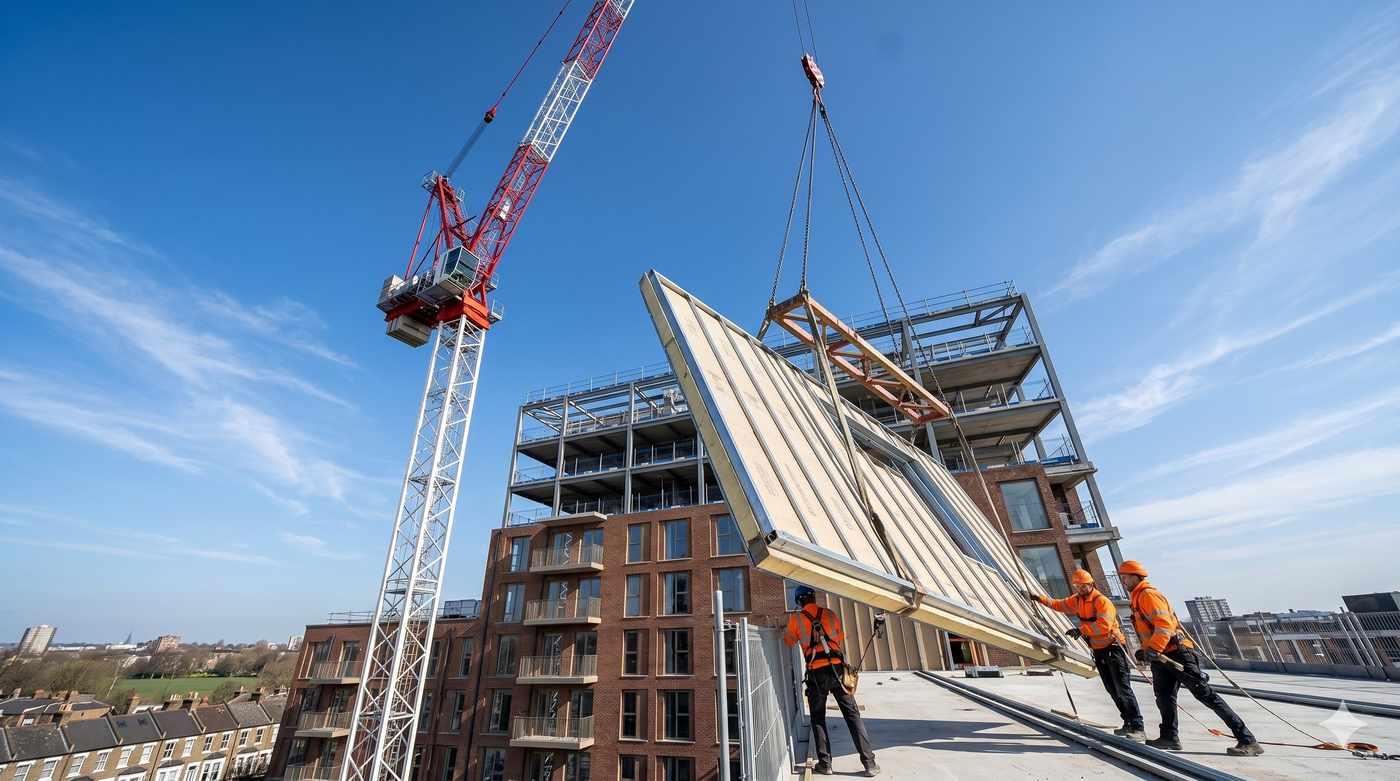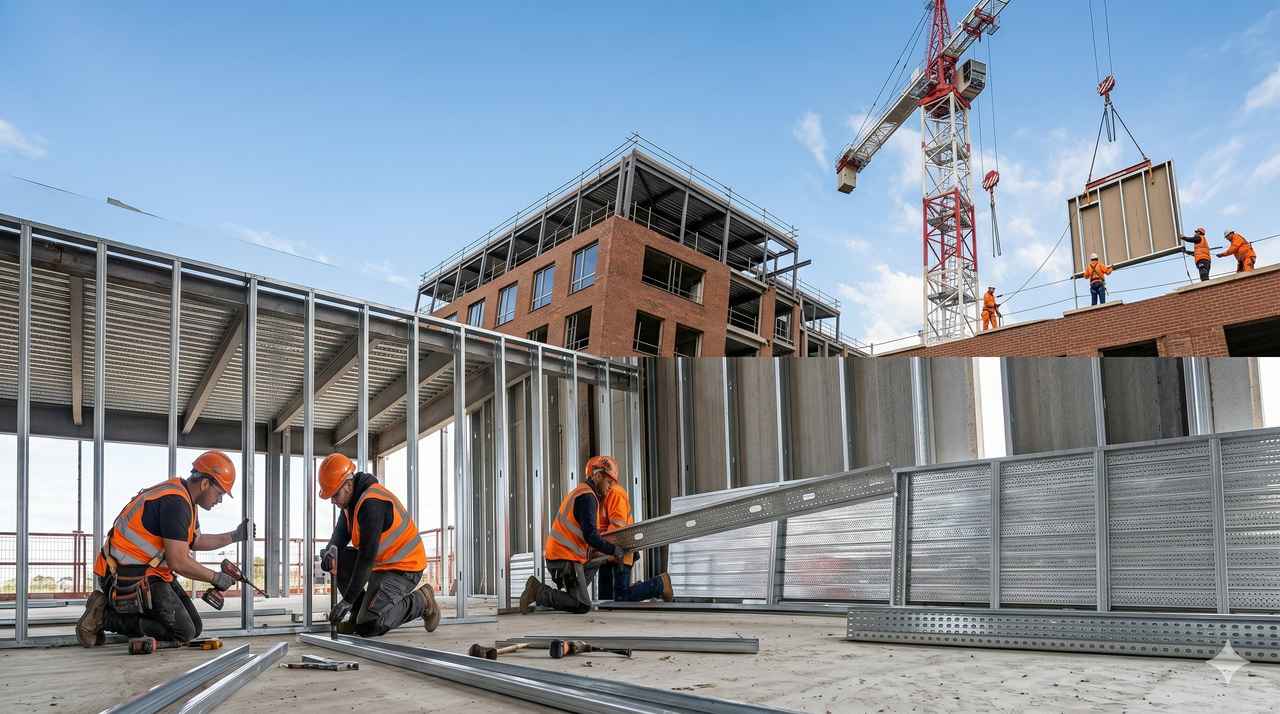
| Choose an SFS subcontractor on seven criteria: (1) end-to-end capability — design, supply and install in-house rather than coordinated across multiple firms; (2) completed project history matching your scale and building type; (3) SMAS SSIP, CHAS or Constructionline accreditation plus ISO 9001/14001/45001; (4) ready-to-deliver Gateway 2 Evidence Pack for Higher-Risk Buildings; (5) PI insurance to at least £5m (£10m for HRBs); (6) willingness to host a live-project site visit; (7) transparent programme reporting with weekly look-ahead. Red flag any contractor who refuses site visits or cannot describe their Building Safety Act compliance process. |
Why this matters more in 2026
Choosing an SFS subcontractor has always mattered. In 2026 it matters more, for three reasons that have all come together at once:
- The Building Safety Act regime. Higher-Risk Buildings under the BSA carry duty-holder responsibilities that flow through the contracting chain. A main contractor accepting work from an SFS subcontractor that can’t produce Gateway 2 evidence is taking on the documentation burden personally.
- Increased programme pressure. Build-to-Rent and student accommodation developers run tighter programmes than they did five years ago, with bigger penalties for slippage. An SFS subcontractor who slips a 6-week programme by 2 weeks isn’t a minor annoyance — they cost the main contractor real money.
- Skills tightening. Skilled SFS install crews have become harder to recruit and retain in the UK market post-2022. Some ‘SFS subcontractors’ in the market are actually labour brokers reselling crews they don’t directly employ — with all the variability in quality that implies.
The seven questions below are a practical screen. Any SFS subcontractor that can give credible answers to all seven is probably worth shortlisting. Any that can’t answer half is probably worth ruling out, regardless of how attractive their tender price is.
Question 1: Do they handle design, supply AND install?
The strongest SFS subcontractors handle the full scope: design coordination with the main contractor’s structural and architectural teams, material supply (or close partnership with one or two main suppliers), and install with their own employed crews.
Why this matters: every interface between design, supply and install is a place where things go wrong. The structural engineer designs to one tolerance; the material supplier delivers to another; the install crew sees both and finds neither matches the other. End-to-end subcontractors eliminate the interfaces. They own the whole problem.
Watch for: subcontractors who design but subcontract install to a separate crew; subcontractors who install but rely on the main contractor’s design team for technical input; subcontractors who only supply material and expect the main contractor to find their own installer. None are necessarily bad, but each introduces interface risk.
Question 2: What’s their largest completed scheme?
An SFS subcontractor who has delivered five 500m² packages is a different proposition from one who has delivered a 10,000m² package. Both have value but they’re not interchangeable. The scale of work an SFS contractor has completed predicts the scale they can manage going forward.
Why this matters: SFS projects above 5,000m² need different operational capability — multiple crews working in parallel, weekly material call-off coordination with manufacturers, sophisticated programme management. Capabilities that don’t develop without practice.
Watch for: subcontractors whose largest completed project is significantly smaller than the scope they’re tendering for. Stepping up by 2x is reasonable. Stepping up by 5x or more usually exposes capability gaps under pressure.
Question 3: Do they hold SMAS SSIP or equivalent accreditation?
Health and safety, quality, environmental — these are baseline accreditations that any serious construction subcontractor should hold and that any main contractor’s procurement team should require. The mainstream UK accreditations are:
- SMAS SSIP (Safety Management Advisory Services Safety Schemes in Procurement)
- CHAS (Contractors Health and Safety Assessment Scheme)
- Constructionline (combined H&S, quality and capability accreditation)
- ISO 9001 (quality management)
- ISO 14001 (environmental management)
- ISO 45001 (occupational health and safety management — formerly OHSAS 18001)
Why this matters: these accreditations require auditable evidence of management systems, training records, safety performance and process documentation. A subcontractor that holds them has been through external audit. A subcontractor that doesn’t may be perfectly competent — but you’re trusting on first impressions rather than verified records.
Watch for: subcontractors who claim ‘we follow ISO 9001 principles’ but aren’t certified, or whose certifications expired and weren’t renewed. Certification has to be current to count.
Question 4: Can they provide a Gateway 2 Evidence Pack template?
For any Building Safety Act Higher-Risk Building work, ask to see a sample Gateway 2 Evidence Pack from a previous project. The Evidence Pack should cover, at minimum: structural calculations sealed by a chartered engineer, fire performance data with test certification, U-value calculations, acoustic data, supplier traceability, installation method statements, and a Construction Control Plan.
Why this matters: assembling a Gateway 2 Evidence Pack retrospectively at project completion is much harder than assembling it as you go. Subcontractors who have done this before have templates, processes and discipline. Subcontractors doing it for the first time will be slower, more error-prone, and may need significant main contractor support.
Watch for: subcontractors who don’t know what a Gateway 2 Evidence Pack is, or who describe it as ‘the main contractor’s responsibility’. Both responses suggest they haven’t done this work before.
Question 5: How do they handle programme slippage?
Programme slippage is a fact of construction life. The question isn’t whether it will happen — it’s how the subcontractor handles it when it does. Ask specifically: ‘If you slip your programme by 2 weeks on this project, what’s your recovery plan?’
Good answers describe a structured response: additional crews on the affected work, parallel sequencing where possible, weekly recovery look-ahead reports, pre-agreed escalation to the main contractor for early visibility. Bad answers describe blame (‘it would only happen if the main contractor caused it’) or denial (‘we don’t slip programmes’).
Why this matters: an SFS package on the critical path that slips 2-4 weeks can delay an entire scheme by the same amount. Recovery capability is more important than the original programme estimate; everyone’s original estimate looks optimistic until reality hits.
Question 6: Insurance, PI cover, and warranties?
The current UK norm for SFS subcontractor insurance, as a minimum:
- Public Liability: £10m minimum
- Employer’s Liability: £10m minimum (statutory minimum, but most main contractors require explicit confirmation)
- Professional Indemnity: £5m minimum (£10m+ for Higher-Risk Building work)
- Contract Works insurance: If the subcontractor is carrying material risk during construction
Confirm currency by requesting an insurance certificate dated within the last 3 months. PI cover should remain in force for 6+ years post-completion (the limitation period for negligence claims in construction).
Why this matters: insurance is the backstop for everything that can go wrong. Inadequate cover means risk transfers back to the main contractor (or, worse, the developer) if a serious issue emerges post-completion.
Question 7: Can they show you a project mid-flight?
Ask to visit a current live project before contract award. A capable, confident SFS subcontractor will be happy to arrange this. They’ll show you their work in progress, introduce you to their site manager, walk you through their quality control process, and let you talk to the main contractor on that project for an unfiltered reference.
Watch for: refusals to host site visits, citing confidentiality, client restrictions or insurance. These are sometimes legitimate but more often a way to hide work that wouldn’t pass inspection. A subcontractor who can’t show you anything they’ve done is asking you to trust them on no evidence.
Why this matters: photos in a tender pack are easy to curate. A live site visit shows you what the actual work looks like in the middle of being delivered — including the corners that finished photography typically excludes.
Red flags — what to walk away from
Beyond the seven questions above, some patterns should rule out an SFS subcontractor regardless of any other strengths:
- Cannot describe their Building Safety Act compliance process for HRB work — suggests they haven’t done HRB work or don’t take the regime seriously
- Refuses to share details of completed projects beyond marketing summaries — suggests there isn’t much to share or the work doesn’t bear close inspection
- Significant price gap below other tenders without a credible explanation — usually means undisclosed scope cuts, undisclosed margin compression that won’t survive contract execution, or undisclosed subcontracting that will reduce quality
- No directly employed install crews — labour broking introduces every quality variability the seven questions are trying to screen out
- Cannot provide an SFS subcontractor reference from a Tier 1 main contractor — top-tier main contractors have rigorous subcontractor management; absence from their approved lists usually means the subcontractor has failed at that level before
Checklist (downloadable PDF)
We maintain a copy of these seven questions plus the red flag checklist as a downloadable PDF, formatted for use in subcontractor evaluation meetings. Get in touch to request a copy.
See our credentials and ongoing projects
BAS Frames is an SFS specialist subcontractor with end-to-end design, supply and install capability, SMAS SSIP accreditation, ISO 9001/14001/45001 certification, ready-to-deliver Gateway 2 Evidence Pack templates, and projects underway across the UK in BTR, student accommodation, hotels, healthcare and commercial. We’re happy to host site visits to current projects and to provide direct references to the Tier 1 main contractors we work with.
Discover our work on our case studies page, including detailed reference to the Fulham Depot scheme. If you’re looking for an SFS subcontractor in Fulham or Bristol specifically, see our regional capability pages on SFS contractor in Fulham and SFS contractor in Bristol.
Frequently asked questions
The most common questions main contractors ask when evaluating SFS subcontractors for UK construction projects.
What should I look for when choosing an SFS subcontractor?
Look for: (1) end-to-end capability (design, supply and install in-house), (2) project history matching your scale, (3) SMAS SSIP or equivalent H&S accreditation, (4) a ready Gateway 2 Evidence Pack template, (5) PI insurance to at least £5m, (6) willingness to let you visit a live project, and (7) transparent programme reporting.
Do I need an SFS specialist subcontractor or can my main contractor self-deliver?
Most main contractors subcontract SFS rather than self-deliver because the specialist skills, supplier relationships and equipment (cold-form punch machines, deflection-head tooling) don’t transfer well from general building work. Specialist subcontractors deliver faster, with fewer snags, and provide the technical evidence trail Gateway 2 demands.
What accreditations should an SFS subcontractor hold?
Look for: SMAS SSIP (or equivalent like CHAS, Constructionline), ISO 9001 quality management, ISO 14001 environmental management, ISO 45001 (or OHSAS 18001) for H&S management. CSCS cards for all on-site operatives. For Higher-Risk Buildings, a documented Building Safety Act compliance process is now essential.
How do I verify an SFS subcontractor’s track record?
Request: a list of completed projects with values, photos and dates; permission to contact the main contractor on 2-3 of those projects for references; site visit to a current live project. Reputable contractors welcome this. Be wary of any who refuse site visits or cite confidentiality — these are red flags.
What insurance should an SFS subcontractor carry?
Minimum: £10m Public Liability, £10m Employer’s Liability, £5m Professional Indemnity (higher for HRB work — £10m+), and Contract Works insurance if they’re carrying material risk. Confirm currency by requesting a certificate dated within the last 3 months. PI cover should remain in force for 6+ years post-completion.