Key takeaways
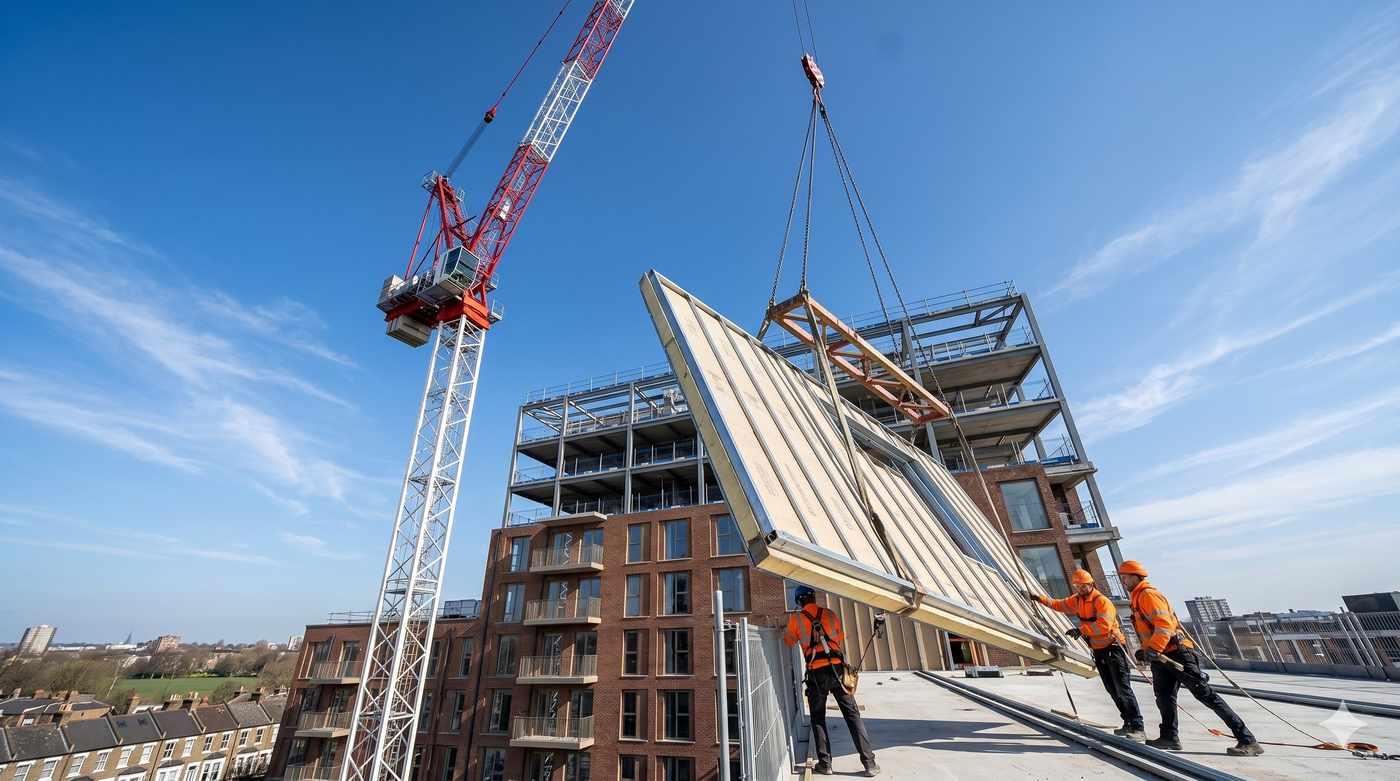
- Metal stud walls are lighter and faster to install than timber or masonry, with less waste and predictable, factory-accurate sections.
- The build-up is simple — C-studs in U-tracks, boarded and jointed — with services run through pre-punched knockouts.
- Getting fixings, board specification and service integration right avoids the common pitfalls that cause callbacks.
- The speed and demountability make metal stud the default for commercial fit-out and reconfigurable space.
Why Choose Metal Stud Walls?
- Efficiency: Metal stud walls have distinct advantages over timber and masonry, including being lighter and quicker to install.
- Durability: They are more resistant to fire, termites, and moisture.
- Sustainability: Opting for recyclable steel framing furthers greener building.
- Cost-Effective: Over a building’s lifetime, metal stud walls save money through minimal maintenance and faster installation times.
The Cost Argument
Metal studs weigh roughly a third of what timber members do, so it’s often possible for one person to lift and position a longer stud easily. While metal studs might be around 30% more expensive than wood, bulk orders of studs and track invariably attract a discount. Labour savings and reduced maintenance typically reduce or reverse this gap over time.
The Durability Factor
Steel studs are strong relative to their weight. Metal stud framing resists warping, rotting, and insect damage. In coastal areas or bathrooms, this stability prolongs the life of finishes and helps prevent hidden structural rot behind the boards.
The Safety Standard
Steel is non-combustible. With appropriate fire-rated boards and insulation, these systems routinely meet the fire performance required by contemporary building regulations, protecting escape routes and enhancing acoustic performance.
The Speed Advantage
Metal stud systems are fast and clean to install, making them an excellent choice for rapid office fit-outs, retail refits, or temporary housing where speed and durability count.
Anatomy of Lightweight Partitions
What are lightweight partitions? They rest on the primary structure instead of supporting it. They employ a lightweight steel frame, fixings, insulation, and plasterboard cladding.
Studs and Tracks
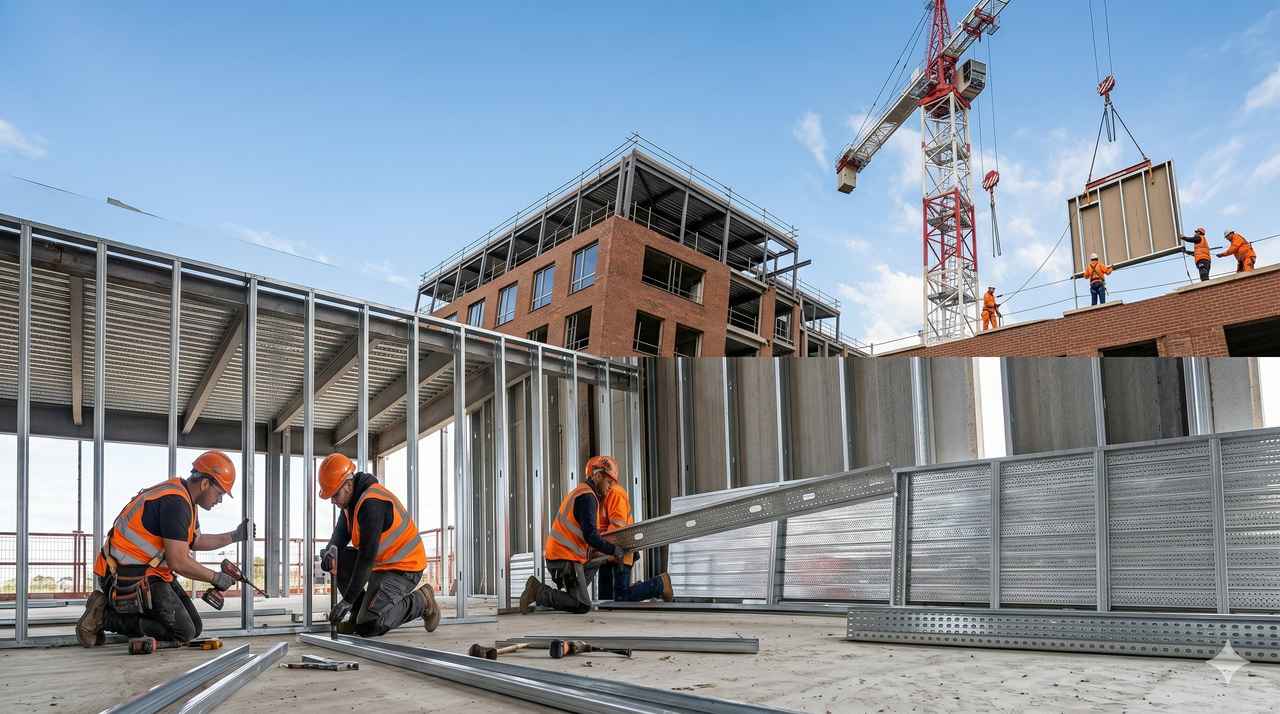
Vertical studs become the ‘ribs’ of the wall, with horizontal tracks fixing to the floor and ceiling. Typical profiles are C-studs for the verticals and U-tracks for the head and base.
Fixings and Bracing
- Self-drilling drywall screws for plasterboard to studs.
- Framing screws or rivets for stud-to-track joints.
- Concrete anchors for attaching tracks to slabs.
Insulation and Services
Within this metal frame, installers typically insert acoustic batts or mineral wool. Metal studs are pre-punched with service holes so that electricians and plumbers can thread cables or small pipes through the frame without compromising its strength.
Plasterboard Cladding
Plasterboard is screwed to both sides of the frame. Different boards suit different functions: moisture-resistant for bathrooms or fire-rated for commercial corridors.
Constructing Metal Frame Walls
1. Setting Out
Determine precisely where the wall will go. Mark the wall line on the floor for the U-track and transfer it to the ceiling.
2. Fixing Tracks
Secure the base and head track to your marked lines. The track partition walls must be screwed to the floor at approximately 600mm centres.
3. Installing Studs
Make every vertical stud 3 to 5 mm shorter than the floor-to-ceiling height so it slides easily into the tracks. Position studs at 400 mm or 600 mm centres.
4. Adding Services
Run electrical cables and plumbing through pre-punched holes. Protect all services from sharp metal edges with grommets.
5. Boarding Up
Screw plasterboard into the metal studs, staggering vertical joints between boards to enhance rigidity.
Beyond the Basics
Acoustic Performance
For sound suppression, the frame, boards, and insulation combine. Acoustic insulation within the cavity dampens sound energy between rooms.
Load-Bearing Walls
Most partitions are non-load-bearing. However, structural metal stud walls use heavier gauge steel to carry floors or roofs.
Curved Partitions
Curved partitions are built out of flexible tracks. For tighter curves, thinner specialised ‘flexible’ boards are typically employed in two layers.
Integrating Building Services
Electrical Wiring
Cables run through pre-punched holes. Electricians should use specific tools for metal stud framing to avoid distorting the steel sections.
Plumbing Pipework
Pipes should be fixed with specialised brackets and wrapped in insulation to minimise vibration.
Ventilation Ducts
Wall cavities can accommodate small ducts for fresh air. This is particularly beneficial in commercial properties where air quality is crucial.
Common Pitfalls to Avoid
- Improper alignment: Improper fixing of tracks and studs can compromise wall stability and lead to cracked joints.
- Neglecting insulation: Failing to integrate services and insulation leads to poor acoustic and thermal performance.
- Overloading: Avoid overloading non-load-bearing partitions with heavy fixtures like cabinets without proper reinforcement.
- Ignoring instructions: Always follow manufacturer instructions and building codes to prevent costly errors.
Metal stud walls provide an accurate, versatile modern method for erecting internal divisions. For your next partition wall job, success comes down to planning, choosing the right specifications, and coordinating services early.
Frequently Asked Questions
- Are metal stud walls as strong as timber stud walls? Yes, they provide similar strength and resist warping, twisting, and rot.
- Can metal stud walls be used for load-bearing structures? Only when specified by a structural engineer using heavy-gauge steel framing.
- How are services like electrical and plumbing integrated? Through pre-punched holes using protective grommets.
- Are metal stud walls good for sound insulation and fire resistance? Yes, when combined with the correct insulation and fire-rated plasterboard.
- What are the most common mistakes when building metal stud partitions? Incorrect stud spacing and failing to use a deflection head where movement is expected.
- Can I hang heavy items on a metal stud wall? Yes, but you must use extra studs or plywood pattresses for reinforcement.
- Are metal stud walls suitable for wet areas like bathrooms? Yes, provided you use moisture-resistant boards and proper tanking.
Further reading: British Gypsum Technical Resources | Steel Construction Institute
Related: Infill | What Is | Fire | Thermal
How fast can metal stud partitions be installed?
A skilled metal stud partition team can install 80–120m² of walled area per day. This is significantly faster than wet plaster alternatives, which require multiple visits for scratch coat, finish coat and drying time. Metal stud partitions can be boarded and ready for decoration within days of the framework being erected.
What is the minimum partition thickness for metal stud?
The minimum metal stud partition thickness depends on the stud depth. A partition using 48mm studs with 12.5mm board each side has an overall thickness of 73mm. Using 70mm studs with 12.5mm board each side gives 95mm overall. Thinner partitions are possible with 48mm or even 32mm studs, but may have limitations on height, acoustic performance and services integration.
Can metal stud partitions support heavy wall-mounted items?
Metal stud partitions can support wall-mounted items of moderate weight — shelving, TV brackets, radiators — using appropriate toggle bolts or by installing noggins (horizontal blocking between studs) at the required fixing points. Very heavy items (above 25kg per fixing) may require a timber or steel backing board within the partition cavity, specified and installed before boarding.
Are metal stud partitions suitable for wet areas?
Standard metal stud partitions are not suitable for direct water exposure, but moisture-resistant variants using galvanised studs and moisture-resistant plasterboard (green board) or cement-based tile-backer boards are widely used in bathrooms, kitchens and shower rooms. The key is correct specification of all components — stud, board, tape, jointing compound and finish — for the moisture exposure class.