Key takeaways
- Steel studs are non-combustible (A1/A2 reaction-to-fire), so they add nothing to a building’s fire load — a clear compliance path under BS EN 13501-1 scrutiny in 2026.
- Steel is dimensionally stable: it will not warp, twist or bow like timber, so walls stay plumb and square and avoid nail-pops and cracked joints.
- Pre-punched service knockouts and millimetre-accurate sections let first-fix trades work faster, cutting the overall programme.
- Material cost is similar, but metal stud’s total installed cost is usually comparable or lower on commercial and mid-rise work once speed, waste and fire documentation are factored in.
Metal Stud Partitions vs. Timber: Why Steel is the Non-Combustible Choice for Multi-Story Developments
When designing internal partitions for multi-storey residential or commercial projects in the UK, the choice often comes down to two materials: Timber or Metal Studs. While timber has a long-standing tradition in domestic housing, the shifting regulatory landscape of 2026—and the inherent physical properties of the materials—make light gauge steel (LGS) the superior choice for modern, high-density developments.
At BAS Frames, we specialise in the precision of steel because it offers a level of safety, stability, and speed that timber simply cannot match in a professional construction environment.
1. Fire Safety: Non-Combustible vs. Fuel Source
The most critical distinction is how these materials behave in a fire.
- Timber: Wood is a combustible material. While “mass timber” chars to protect its core, standard timber studs in partitions can still act as a fuel source. To meet fire ratings, timber requires heavy chemical treatments or excessive layers of plasterboard to keep the heat away from the frame.
- Steel: Light gauge steel is inherently non-combustible. It does not ignite, smoke, or contribute to the fire load of a building. In 2026, where “Reaction to Fire” classifications (BS EN 13501-1) are under intense scrutiny, steel provides a clear path to compliance. This is why our drylining services prioritize metal stud systems to ensure maximum safety for every interior space.
2. Structural Stability and “Straight Walls”
Timber is a natural, hygroscopic material—it breathes, expands, and contracts based on the moisture in the air.
- The Timber Issue: Over time, timber studs can warp, twist, or “bow.” This leads to aesthetic defects like nail pops, cracked plaster at the joints, and uneven walls.
- The Steel Advantage: Steel is inorganic and dimensionally stable. For developers using an SFS Infill system, the combination of a structural steel external frame and metal stud internal partitions ensures the entire building envelope remains perfectly plumb and square for the life of the structure.
3. Precision and Speed of Installation
In the current UK market, labour costs and project timelines are the biggest risks to profitability.
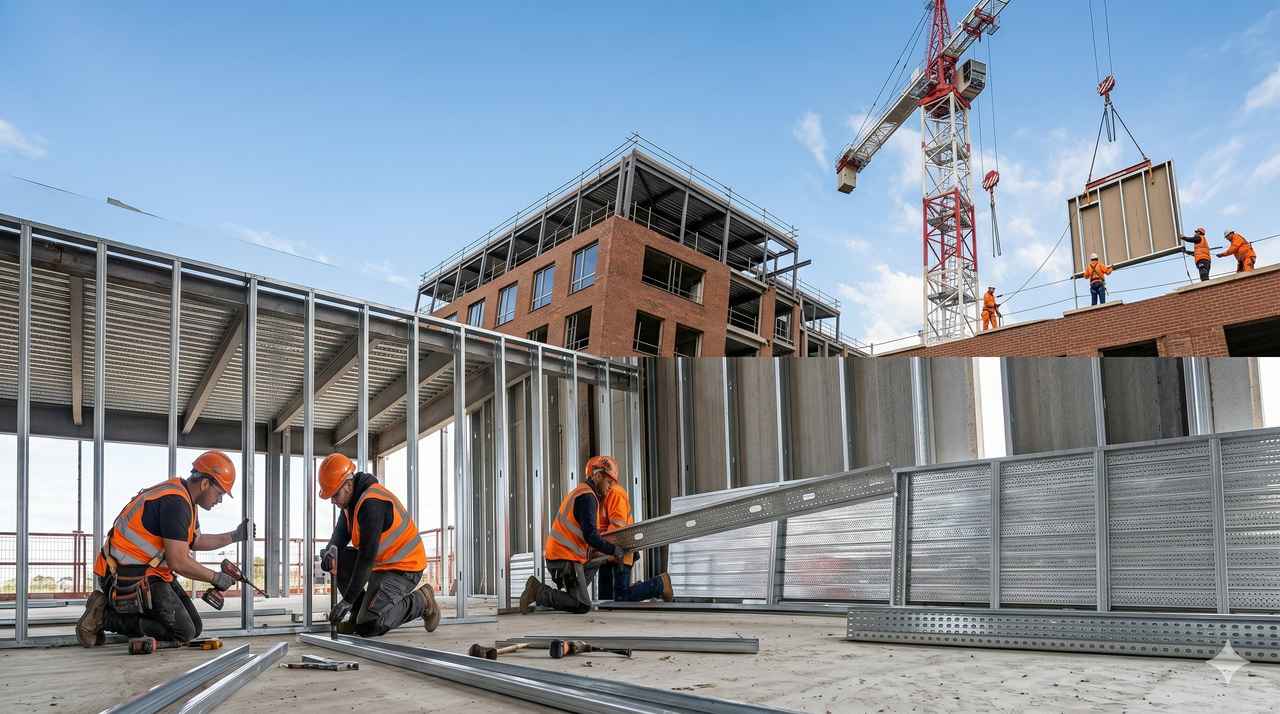
- Pre-Engineered Accuracy: BAS Frames utilises 3D modeling to ensure every metal stud is cut to the exact millimeter. Unlike timber, which often requires on-site “fudging,” steel components arrive as a precise kit.
- Integrated Service Zones: Metal studs feature pre-punched “knockouts” for electrical and plumbing. When we provide professional drylining, these features allow first-fix trades to work significantly faster, reducing the overall build program.
4. Versatility in Modern Building Envelopes
Modern construction often requires a hybrid approach. For many projects, we utilise an Infill wall solution which sits between the primary structural frame. This system provides a high-performance weather-tight skin that timber frames struggle to replicate at height, especially when considering wind loading and thermal expansion.
Comparison Summary: Metal vs. Timber
| Feature | Metal Stud (Steel) | Timber Frame |
| Fire Category | Non-Combustible (A1/A2) | Combustible |
| Durability | Immune to rot/pests | Vulnerable to damp |
| Precision | High (0.5mm tolerance) | Variable (warping) |
| Installation Speed | Fast (pre-punched holes) | Slower (drilling/notching) |
The Verdict for 2026
For small domestic extensions, timber remains a viable option. However, for multi-storey developments and rooftop extensions, the benefits of metal stud partitioning are undeniable. It offers a faster, safer, and more precise foundation for the high-quality finishes your clients expect.
Fire performance: metal stud vs timber
Fire performance is one of the clearest technical differentiators between metal stud and timber partition systems. Metal stud partitions — using cold-formed steel C-section studs and appropriate plasterboard specification — can achieve up to 120-minute fire resistance ratings when specified in accordance with tested systems from manufacturers such as British Gypsum or Knauf. The steel stud does not contribute combustible material to the fire load, and the system’s performance is well-documented through BS EN 1364 testing.
Timber partition systems, while capable of achieving fire resistance ratings when correctly specified, introduce combustible material into the wall construction. In buildings where fire compartmentation is critical — care homes, hospitals, student accommodation, hotels — the additional documentation burden for timber systems under the Building Safety Act 2022 makes metal stud the lower-risk and more straightforward specification choice.
Cost comparison: which is cheaper?
On a pure material cost basis, timber stud is often marginally cheaper than metal stud for straightforward domestic applications. However, for commercial and mid-rise residential projects, the total installed cost of metal stud partitions is typically comparable or lower when programme efficiency is taken into account. Metal stud can be installed faster, requires fewer fixings, and produces less waste — all of which offset the slightly higher material cost per linear metre of stud.
For projects requiring acoustic or fire-rated performance, metal stud systems also tend to be more cost-effective because their performance is more predictable and the risk of remediation (for example, if acoustic testing reveals underperformance) is lower. See our guide to SFS cost per m² for broader context on steel framing economics.
Further reading:British Gypsum Technical Resources | Steel Construction Institute
Related:Cost | Infill | What Is | Fire
Frequently asked questions
Which is better — metal stud or timber partitions?
For commercial and mid-rise residential projects, metal stud partitions are generally preferred due to superior fire performance, dimensional stability, resistance to moisture and pest damage, and faster installation. Timber stud remains common in domestic construction and low-rise residential where cost is the primary driver.
Are metal stud partitions more expensive than timber?
Material costs are similar, but metal stud has a lower total installed cost on commercial projects when programme speed, waste reduction and fire documentation are factored in. Metal stud typically installs 20–30% faster than timber equivalent and produces less site waste.
Can metal stud partitions achieve fire ratings?
Yes — metal stud partitions with appropriate plasterboard specification can achieve 30, 60, 90 and 120-minute fire resistance ratings when installed in accordance with tested systems from manufacturers such as British Gypsum or Knauf. Timber stud can also achieve fire ratings but introduces combustible material into the wall build-up.
What acoustic performance can metal stud partitions achieve?
Single-stud metal partitions with 12.5mm board each side typically achieve Rw 40–45 dB. Twin-stud or resilient bar configurations with acoustic plasterboard can achieve Rw 55–65 dB — well in excess of the 45 dB minimum required by Part E of the Building Regulations for separating walls between dwellings.