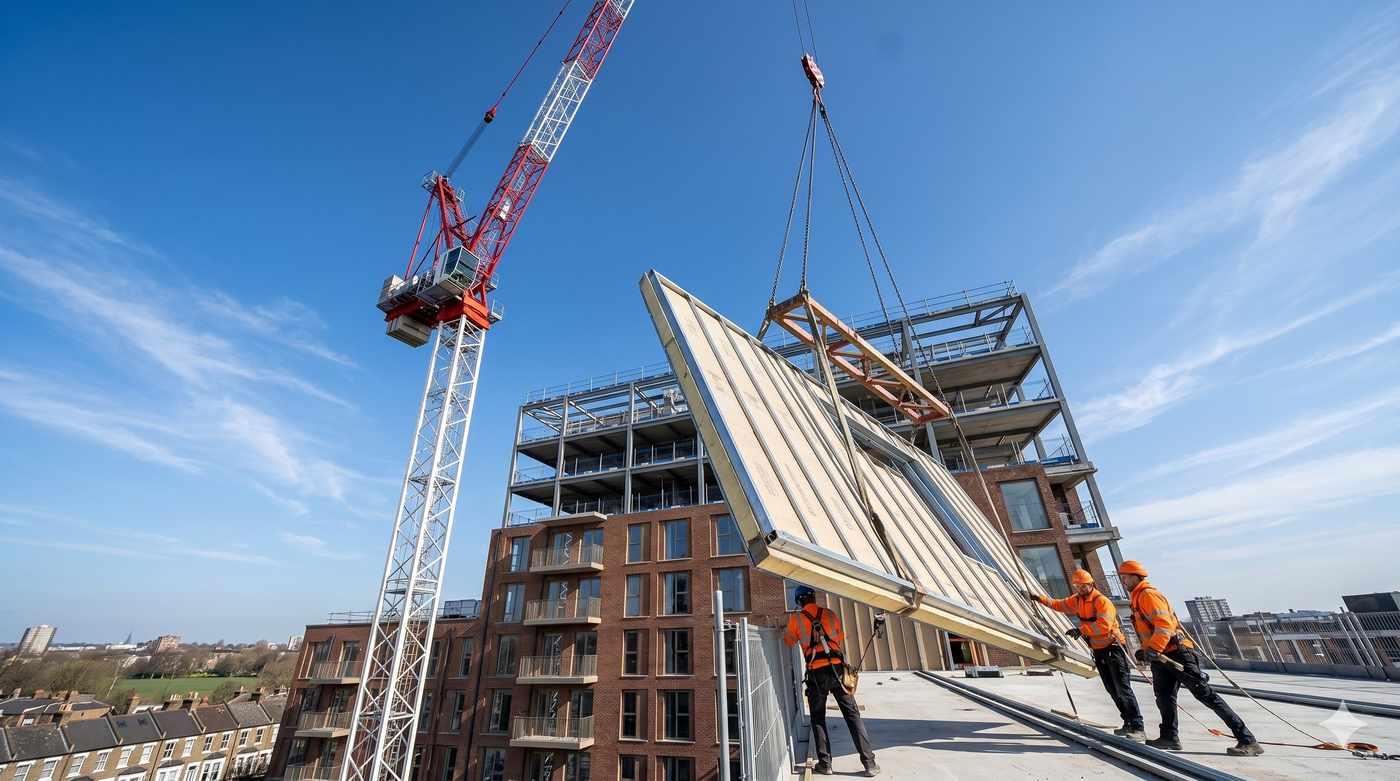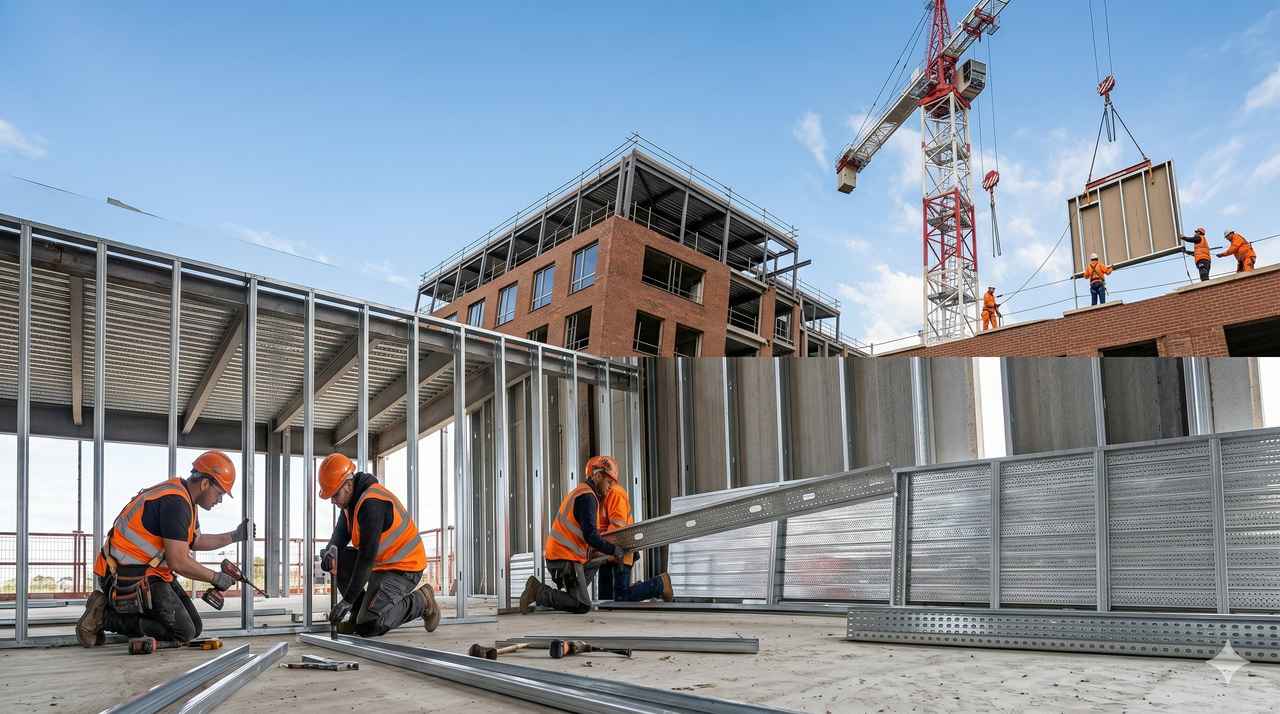
| Steel building studs are cold-formed light gauge steel sections — typically C-shaped in profile, 1.2-2.5mm thick — used as the vertical members in steel-framed walls and partitions. UK standard stud depths are 70mm, 92mm, 100mm and 150mm at 600mm centres. Studs slot into U-tracks fixed to the floor and ceiling. Steel grade is typically S350GD or S450GD to BS EN 10346 with G275 galvanised coating. Specification depends on wall height, wind load, fire rating and acoustic requirements. UK suppliers: Metsec, Hadley, FrameFast, EOS. |
What steel building studs are
Steel building studs are the vertical members in steel-framed walls. They’re cold-formed sections — typically C-shaped in profile, hence the common name ‘C-studs’ — manufactured from sheet steel rolled at room temperature into structural shapes. Combined with U-tracks at floor and ceiling level, they form the skeleton of an SFS (Steel Framing System) wall ready for sheathing, insulation and cladding.
If you’re specifying SFS for the first time, the stud is the component you need to get right. Stud depth determines wall thickness and structural capacity. Stud gauge determines load rating and fire performance. Stud grade and coating determine durability. Stud manufacturer determines availability, BIM content and main-contractor familiarity.
This guide is a structured reference covering UK steel building stud specification in 2026 — sizes, grades, suppliers, and how to choose the right stud for a given application.
Standard UK stud sizes
UK steel building stud sizes are largely standardised across manufacturers. The four most common depths:
- 70mm studs: internal partition walls in residential and commercial buildings. Single-stud partitions achieve REI 60 fire ratings and Rw 45-50 dB acoustic performance with appropriate plasterboard. Most common UK partition stud
- 92mm studs (or 90mm): thicker internal partitions where slightly higher acoustic or fire performance is needed without going to twin-stud construction. Less common than 70mm but used on hotel-grade or commercial-grade partitions
- 100mm studs: external infill walls on lower-rise mid-rise buildings (4-8 storeys). Standard UK external infill stud depth before Part L 2025. Combines structural capacity with adequate insulation depth for older thermal targets
- 150mm studs: external infill walls on higher-rise buildings or where Part L 2025 / Future Homes Standard thermal targets need deeper insulation. The new UK default for external SFS infill walling on Part L 2025-compliant projects
Less common stud depths used for specific applications: 60mm (very thin partitions, services-only zones), 200mm (deep external walls for Future Homes Standard thermal targets), bespoke depths up to 300mm for specialist applications.
Stud gauge (sheet thickness)
Stud gauge — the thickness of the steel sheet used to form the stud — determines the section’s structural capacity and fire performance. Common UK gauges:
- 55mm and 0.7mm: light-duty partitions, used for low-load internal walls in residential and light commercial
- 2mm: medium-duty partitions and infill walls where loads are modest. Common spec for typical apartment partitions
- 5mm: standard infill wall gauge for mid-rise external walls on average wind-load sites
- 0mm: infill walls on tall buildings or exposed coastal sites with higher wind loads
- 5mm: structural studs for low-rise primary framing (load-bearing walls in 2-4 storey buildings)
Heavier gauge increases capacity but also cost. The structural engineer specifies gauge for each project after calculating wind loads, dead loads from cladding, and deflection limits.
Steel grade and coating
UK standard steel building studs use one of two main steel grades:
- S350GD to BS EN 10346: general-purpose grade with 350 MPa yield strength. Default for most UK SFS applications
- S450GD to BS EN 10346: higher-strength grade with 450 MPa yield strength. Used where structural demand is higher or thinner sections are needed for the same capacity
All UK steel building studs are galvanised for corrosion protection. Standard coating specifications:
- G275: 275 g/m² of zinc coating (combined both sides) — the default for internal partitions and most external infill walls in standard environments
- G350: 350 g/m² zinc coating — required for highly corrosive environments (coastal exposure, swimming pools, chemical exposure)
- Aluminium-zinc alloy coatings (Galvalume, Magnelis): newer coatings offering improved corrosion resistance per gram of coating. Available from some UK suppliers but not yet standard
How studs work in a wall
A steel building stud doesn’t act alone — it works as part of a wall assembly. The typical sequence:
- Set out: mark the wall line on the floor slab and the underside of the slab above
- Bottom track: fix a U-track to the floor slab along the wall line. Studs will slot into this track
- Top track (deflection head): fix a U-track to the underside of the slab above, with a 20-25mm gap to allow for slab deflection. Studs slip within this track but don’t fix rigidly
- Studs: cut to length, insert into bottom track, push up into top track. Fix to bottom track only (top remains a slip joint). Spacing typically 600mm centres
- Sheathing: apply cement-bonded sheathing board to one or both faces depending on wall type
- Insulation: install stone wool insulation between studs
- Internal lining: apply fire-rated plasterboard, with vapour control layer beneath
- External finish: the external face becomes the substrate for cladding (rainscreen, brick, render) on external walls
Stud spacing is critical. Standard UK practice is 600mm centres, sometimes tightened to 400mm centres on high-load areas (window openings, corners, exposed elevations). Closer spacing increases capacity but uses more material.
UK suppliers of steel building studs
Four major suppliers dominate the UK steel building stud market:
- Metsec (voestalpine): largest UK production capacity, broadest product range, most comprehensive BIM library. Default specification on most UK projects
- Hadley Group: strong on bespoke cold-rolled sections including non-standard depths. Strong panellised SFS offering
- FrameFast: competitive lead times, particularly on standard sections. Strong subcontractor relationships across UK
- EOS Framing: specialist in fire-engineered systems, particularly relevant for Higher-Risk Buildings under the Building Safety Act
For a detailed supplier comparison and specification advice see our Metsec SFS vs alternatives comparison guide.
Specifying steel building studs — what to write
A complete steel building stud specification line should cover:
- Depth and width:g. “100mm × 50mm C-stud”
- Gauge:g. “1.5mm”
- Steel grade:g. “S350GD to BS EN 10346”
- Coating:g. “G275 galvanised”
- Manufacturer (or ‘or equivalent approved’):g. “Metsec C100/50/1.5 or equivalent approved”
- Spacing:g. “at 600mm centres”
- Track sizes:g. “matching U-tracks at floor and ceiling”
Sample complete specification: “Steel infill wall framing: 100mm × 50mm C-studs, 1.5mm gauge, S350GD steel to BS EN 10346, G275 galvanised, at 600mm centres, fixed to matching 100mm U-tracks. Metsec C100/50/1.5 or equivalent approved. Top track with 20mm deflection allowance.”
Common stud specification mistakes
Three recurring specification mistakes we see on UK projects:
- Specifying stud depth without gauge. A 100mm C-stud at 0.7mm gauge has very different structural capacity from a 100mm C-stud at 1.5mm gauge. Always include gauge in specification
- Missing the deflection allowance. Without the slip-joint detail at the top track, slab deflection cracks the cladding. Specify the deflection allowance (typically 15-25mm depending on slab span and load)
- Wrong galvanising for the environment. G275 is fine for typical internal and external environments. Coastal exposure, swimming pools and chemical environments need G350 or better. Get this wrong and the studs corrode within 10-15 years
Talk to UK steel framing specialists
Steel building stud specification looks straightforward but the consequences of getting it wrong are expensive. For project-specific advice on stud specification — including structural calculations, fire-engineering and supplier selection — contact the BAS Frames team.
Related: see our pillar guides on SFS infill walling, framing with steel, and the detailed SFS wall build-up specification reference.
Frequently asked questions
The most common questions UK specifiers ask about steel building studs and light gauge steel sections.
What are steel building studs?
Steel building studs are cold-formed light gauge steel sections — typically C-shaped in profile, 1.2-2.5mm thick — used as the vertical members in steel-framed walls and partitions. They slot into U-tracks fixed to the floor and ceiling at typically 600mm centres, forming the skeleton of an SFS wall ready for sheathing, insulation and cladding.
What are the standard UK steel stud sizes?
Four most common UK steel stud depths: 70mm (internal partitions), 92mm (heavier-spec partitions), 100mm (external infill on lower mid-rise), 150mm (external infill for Part L 2025-compliant projects). Gauges from 0.55mm to 2.5mm depending on application. Always specified at 600mm centres unless engineered otherwise.
What gauge of steel stud should I use?
Gauge depends on wall type and loads. Light-duty partitions: 0.55-0.7mm. Standard apartment partitions: 1.2mm. Mid-rise external infill walls: 1.5mm. Tall buildings or exposed coastal sites: 2.0mm. Low-rise structural framing: 2.5mm. The structural engineer specifies gauge after calculating wind loads, dead loads from cladding, and deflection limits.
What steel grade and coating should I specify?
UK standard: S350GD steel to BS EN 10346 (350 MPa yield strength) with G275 galvanised coating (275 g/m² zinc). Heavier loads or thinner sections may use S450GD (450 MPa). Coastal, swimming pool or chemical environments need G350 coating or better. Always specify grade and coating — not just stud depth and gauge.
Who supplies steel building studs in the UK?
Four major UK suppliers: Metsec (voestalpine) — largest production capacity, default specification, best BIM library; Hadley Group — strong on bespoke sections and panellised systems; FrameFast — competitive lead times; EOS Framing — specialist in fire-engineered systems for Higher-Risk Buildings.