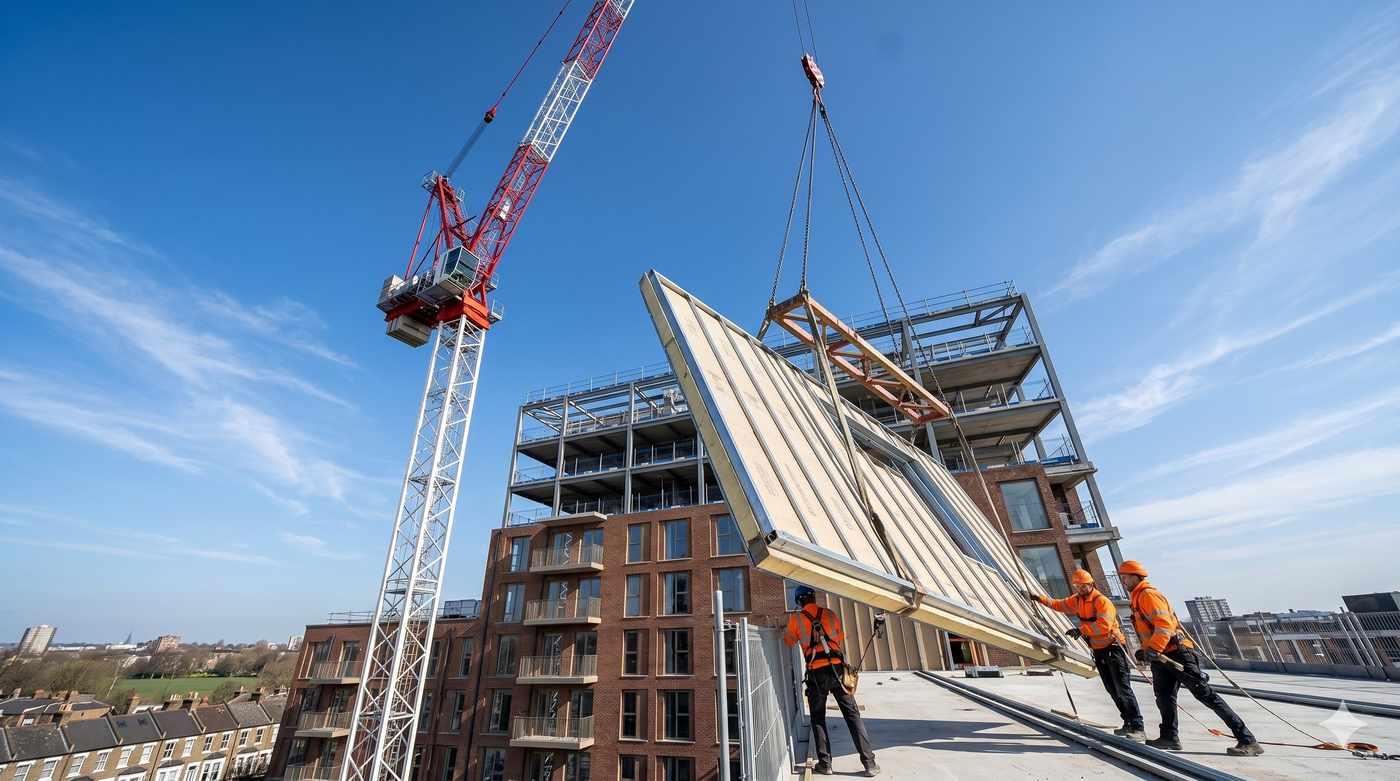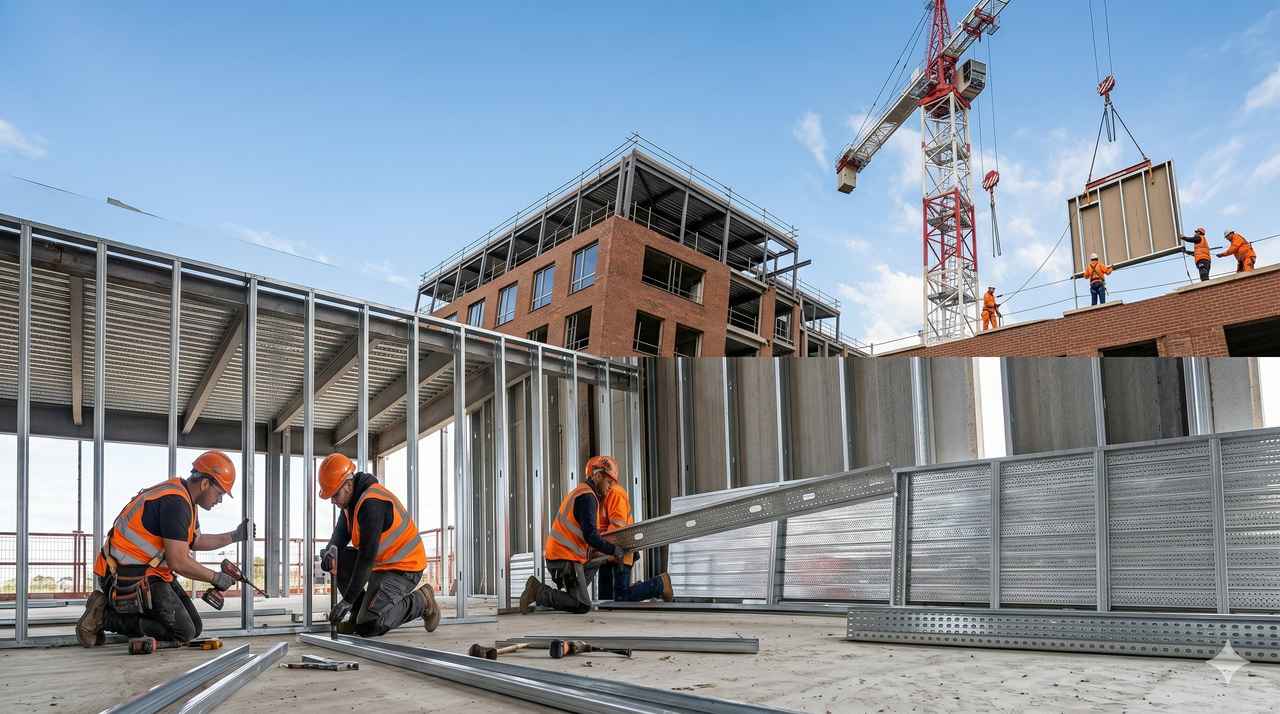
Why a Steel Frame Subcontractor Survives Insolvency Season: The Five Financial Checks Main Contractors Are Now Running
UK construction has lived through one of its hardest insolvency cycles in living memory. Between 2023 and 2025, more than 12,000 construction businesses entered insolvency proceedings — the highest sustained rate of any sector — and the casualties included names that nobody would have predicted three years earlier. The cycle has reshaped how Tier 1 main contractors procure subcontract packages. Where pre-qualification used to be an administrative exercise centred on health and safety accreditations, it is now a serious commercial discipline involving financial analysis, insurance verification, accreditation depth, and project track record.
For Steel Frame System (SFS) specialists, this matters enormously. SFS is a programme-critical package — if the subcontractor fails mid-project, the consequences cascade through every follow-on trade and threaten the entire delivery date. Main contractors know this, and they are now running far more rigorous checks before appointing an SFS subbie than they were five years ago.
This article sets out the five financial and operational checks a Tier 1 commercial team typically runs in 2026, what good looks like in each one, and why an established firm like BAS Frames — trading since 2010 — has a structural advantage over newer entrants in the same market. The five checks are roughly in the order they typically get run, with the most disqualifying first.
Check one: financial stability indicators
The first check is straightforward and brutal. Pull the subcontractor’s filed accounts and credit reports — Companies House, Dun & Bradstreet, Creditsafe — and look at three things. First, the trend. A firm whose turnover, working capital, and net assets are stable or growing is in a different position from a firm whose numbers are deteriorating year on year. Second, the absolute scale. The subcontractor needs to be appropriately sized for the package value. A £6m SFS package awarded to a firm with £4m annual turnover concentrates risk in a way that the procurement insurance might not cover. Third, the timeliness of filings. Late accounts, late confirmation statements, or persistent micro-entity filings on a firm claiming substantial turnover are all warning signs.
What good looks like: clean filings, stable or improving trend over three years, turnover at least three to five times the package value, and a healthy ratio of current assets to current liabilities. Established firms with a long trading history have an inherent edge here because there is more data to evaluate. A firm that has been trading since 2010 has navigated two major construction downturns and emerged solvent — that is itself a strong signal.
Check two: accreditation depth, not just badges
The second check is the accreditation portfolio. Most subcontractors will list SMAS, CHAS, and ConstructionLine on their website. What matters is the depth behind those badges. A current SMAS or CHAS membership demonstrates baseline health and safety competence, but for HRB work under the Building Safety Act the regulator increasingly expects evidence of role-specific competence beyond the headline accreditation.
For SFS specifically, the relevant depth includes engineering competence (a chartered structural engineer or experienced equivalent signing calculations), CSCS at supervisory level for the site team, NHBC registration or equivalent third-party warranty for residential work, and ideally engagement with the Construction Leadership Council’s competence framework.
What good looks like: a full accreditation matrix with named individuals against each role, certificates available on request, and a clear story about how competence is maintained as the team grows. The BAS Frames installation team holds the accreditations expected for HRB work and supplies the evidence on request.
Check three: insurance limits and policy cover
The third check is insurance. Public liability, employer’s liability, and professional indemnity policies all need to be in force at limits appropriate to the project’s exposure. On a substantial SFS package on a HRB, expect main contractor requirements of at least £10m public liability and £5m professional indemnity, sometimes higher. Anything materially below that range is a sign that the subcontractor has been operating in a lower-risk segment and may not be ready for HRB work.
The other thing to check is the policy scope. SFS work involves design responsibility (calculations, fabrication drawings, sometimes performance specifications), and the professional indemnity policy needs to cover that design exposure. A pure construction-only PI policy is not sufficient. Equally, the public liability policy needs to cover the specific activities — working at height, mechanical handling, hot works if relevant — not just generic construction.
What good looks like: a current insurance certificate from a recognised insurer, limits appropriate to the package size, scope that explicitly includes design liability, and no exclusions that would matter on the project type.
Check four: retention and payment history
The fourth check is harder to run from public data but Tier 1 commercial teams have ways of getting at it. The question is whether the subcontractor has a clean payment record with its own supply chain — paying material suppliers on time, settling labour invoices promptly, releasing retention to its sub-subcontractors on time.
A subcontractor that is squeezing its own supply chain on payment is often the same subcontractor whose cash flow becomes precarious quickly when a single payment certificate gets delayed. That precariousness is what turns into mid-project insolvency. Conversations with material suppliers — typically the major UK rolled steel mills, plasterboard manufacturers, and fixings suppliers — will surface this pattern quickly.
What good looks like: long-standing supplier relationships with established partners, a reputation for prompt payment, and no rumours of supplier disputes. The relationships are visible in the firm’s communications — a subcontractor who talks about partnership with specific named suppliers (like the BAS Frames partnerships with Frameclad, Metsec, Hadley, and EOS) has a track record those suppliers would speak to if asked.
Check five: project completion record
The final check is the portfolio. Not “projects we have worked on” — actual project completions, on programme, with the client willing to act as a reference. A subcontractor’s website portfolio is a useful starting point but only useful if the projects are recent, comparable in scale to your package, and verifiable.
For SFS work, look for completed schemes that match your project’s profile in three dimensions: scale (square metres of SFS installed), complexity (number of floors, geometric complexity, junction conditions), and sector (residential, student, hotel, commercial). A subcontractor with deep experience on warehouse infill is not automatically ready for a 12-storey BTR block, however good their previous work.
What good looks like: a portfolio of recent completed projects with named clients, ideally including some that match your project’s specifics. The BAS Frames project portfolio covers commercial, residential, and educational schemes, including the Denham Crematorium project — 2,000 square metres of SFS delivered in six weeks in early 2026.
The compound advantage of trading history
These five checks individually each measure something specific. Taken together, they reveal something compounded: the firms that pass all five tend to be the ones that have been trading long enough to have built the relationships, accreditations, financial discipline, and portfolio that the checks measure. New entrants can pass some of them but rarely all of them within their first three to five years of operation.
This is why trading history matters as a procurement signal. A firm that has been trading since 2010 has had to survive the post-Brexit construction wobble in 2017, the pandemic-driven supply chain crisis in 2020–2022, and the inflation-and-insolvency cycle of 2023–2025. The firms that came through all three have demonstrated something that cannot be faked: operational durability across genuinely difficult market conditions.
A practical framework
For a commercial team running pre-qualification on an SFS package, the five checks can be run in roughly two weeks alongside the technical evaluation. The marginal time invested at pre-qualification is trivial compared to the cost of recovering from a mid-project subcontractor failure.
To discuss subcontractor due diligence on a current scheme or to request the BAS Frames pre-qualification dossier, contact the team directly or review the firm’s background and history.