Key takeaways
- For Build-to-Rent, SFS answers the three things that matter most: speed, standardisation and cladding-risk control.
- Repetitive, standardised SFS details suit BTR’s identical-unit stacking and compress the programme at scale.
- Non-combustible, tested through-wall systems address the post-Grenfell cladding-risk scrutiny BTR investors demand.
- SFS is not right for every BTR case — low-rise or highly bespoke schemes may not benefit; ask the right questions of your SFS partner.
The Build-to-Rent SFS Playbook: How Light Steel Hits BTR’s Speed, Standardisation and Cladding-Risk Triple Test
Build-to-Rent (BTR) has become one of the most distinctive forces in UK residential development. By the end of 2025, the operational and committed BTR pipeline in the UK had passed 130,000 homes, with around 30,000 new units completing in 2025 alone. The sector’s growth is now structural rather than cyclical — institutional capital wants stabilised, long-term residential income, and BTR is the vehicle that delivers it. With that growth has come a quiet but profound shift in how these buildings are being designed and procured.
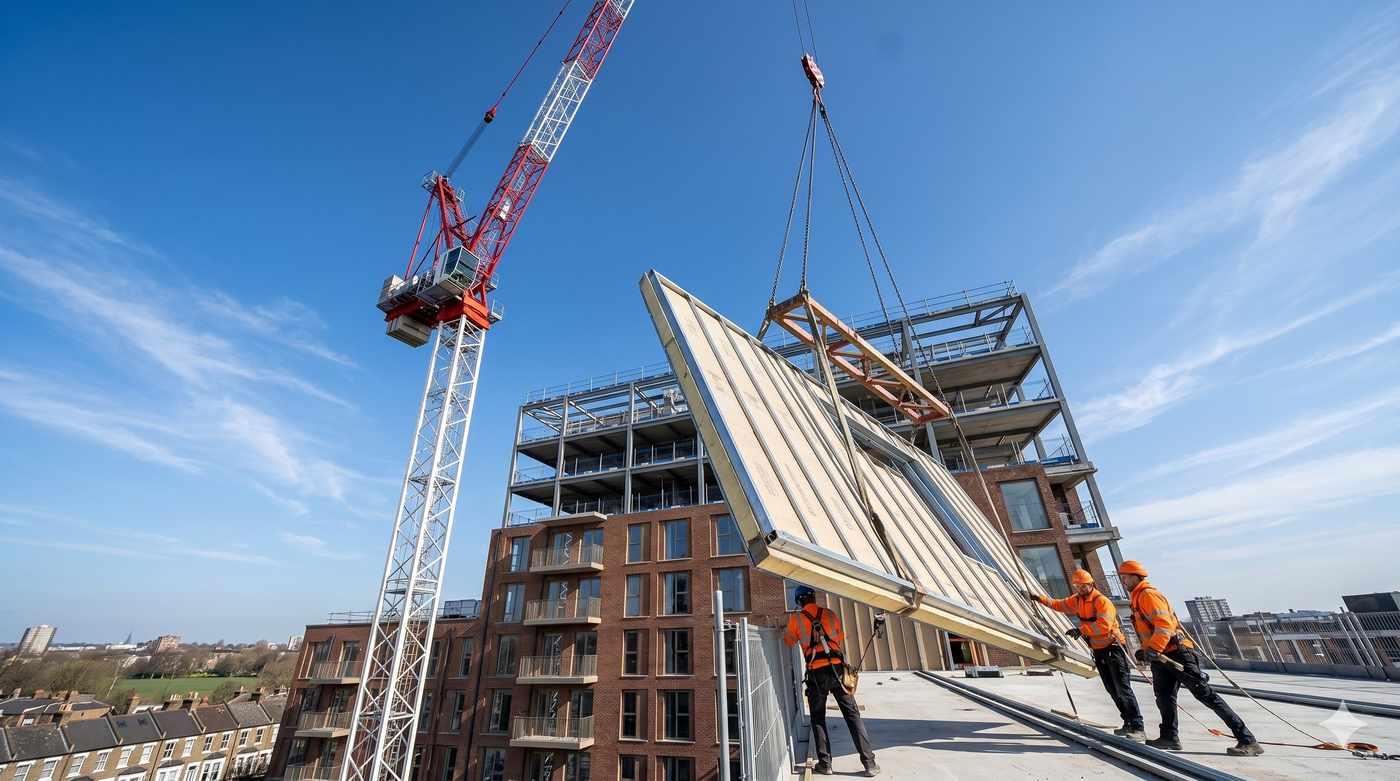
At the centre of that shift is the construction method. Traditional concrete and blockwork building approaches that worked for build-to-sell apartments do not always align with BTR’s economics, programme requirements, or risk appetite. Increasingly, Steel Frame Systems (SFS) — particularly panellised and full-build configurations — are becoming the default specification on BTR schemes above five storeys. This article explains why, and what BTR developer-operators should be asking of their SFS specialist.
The BTR triple test
BTR projects pass through a different evaluation grid than build-to-sale. Three pressures matter more than anything else: speed to stabilisation, standardisation of unit typologies, and cladding-risk exposure. Any construction method that aligns with all three has a structural advantage. SFS, particularly in its panellised form, aligns with all three more cleanly than any traditional alternative.
Speed to stabilisation
A BTR scheme’s financial model is fundamentally different from build-to-sale. Sale schemes recover capital through unit sales at completion. BTR schemes recover capital through rental income across decades. What matters is how quickly each unit moves from cost-incurring to revenue-generating — the point of stabilisation, when occupancy and rents have reached underwriting assumptions.
That stabilisation point sits roughly 6–12 months after practical completion. Every week of programme saved during construction is a week of accelerated stabilisation, and on a 300-unit scheme generating £6m+ annual rent, the value of those weeks is substantial. SFS — and particularly the BAS Frames panellised system — typically delivers a structural envelope 30–50 per cent faster than concrete and blockwork equivalents. On a 12-storey BTR block, that’s often two to four months of programme advantage, with corresponding interest savings on development finance and earlier stabilisation.
Standardisation of unit typologies
BTR operators run their buildings like a product. The same studio, the same one-bed, the same two-bed layout repeated across hundreds of units, with operational fit-out and management systems designed around that repetition. This is a fundamentally different procurement problem from build-to-sale, where every floor plate might have minor variations driven by views, plot orientation, or sales-led customisation.
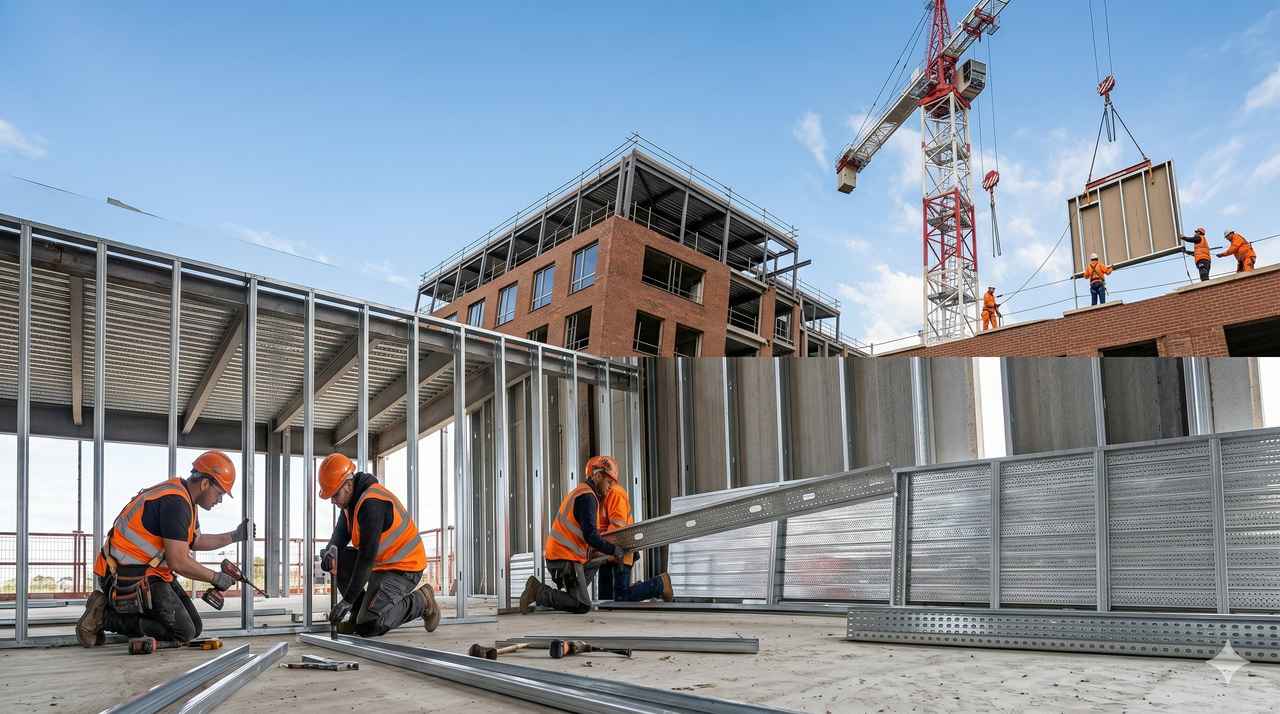
Standardised unit typologies suit prefabricated, panellised construction systems perfectly. Once a panel design is engineered, fabricated, and tested for one floor plate, the marginal cost of replicating it across twenty floor plates is far lower than re-engineering each floor as a bespoke piece. The BAS Frames panellised approach is specifically designed for this kind of repetition, and the BAS Frames stick-build full system provides the flanking solution for variations at podium, roof, and amenity levels.
The thing BTR procurement teams sometimes miss is that this efficiency only emerges with disciplined design. A scheme that asks for “standardised” units but specifies twenty minor variations across the building doesn’t get the panellisation benefit. The conversation with the SFS specialist needs to start at RIBA Stage 2 to lock in the typology rules that make panellisation viable.
Cladding-risk exposure
This is the third pressure and the most distinctive to BTR. Build-to-sale developers hand a building over and walk away. BTR developer-operators are the building’s long-term owner. They carry the cladding risk, the safety case obligations under the Building Safety Act, the future remediation exposure if anything goes wrong, and the insurance and lender-relations consequences of any defects emerging years after completion.
The Grenfell tragedy and its regulatory aftermath have made non-combustible structural systems a strong preference for institutional BTR owners. The Building Safety Regulator’s Gateway 2 process now requires extensive evidence that the external wall strategy is safe across its lifecycle, and the September 2026 amendments to Approved Document B have tightened the requirements further.
An SFS structural system is inherently non-combustible. The steel sections, the sheathing boards (cement particle board or equivalent), and the typical insulation specifications combine into a wall build-up that simplifies the cladding compliance position substantially. The BAS Frames technical reference on SFS fire resistance ratings covers the through-wall build-ups achieving 60, 90, and 120-minute ratings.
For a BTR owner holding the asset for twenty years, that simplification is not a minor convenience. It is a structural reduction in long-term risk exposure.
The operational angle: maintenance and refurbishment
BTR thinking goes beyond construction into operations. A BTR-owned building generates value through decades of occupancy, which means routine maintenance, periodic refurbishment, and eventually a major refresh sometime around year fifteen to twenty.
Steel framing has clear operational advantages in this lifecycle view. The structural system is dimensionally stable — it does not warp, creep, or settle in ways that distort internal finishes or require ongoing snagging. It is unaffected by moisture, pests, or biological deterioration. When a future refurbishment requires repositioning internal partitions or reconfiguring unit layouts, working within a steel frame system is significantly more straightforward than working within concrete and blockwork.
The same dimensional stability matters to BTR operators in a more day-to-day sense. Doors that don’t stick, windows that fit cleanly, plasterboard that doesn’t pop or crack — these are the small things that turn into maintenance tickets and reduce resident satisfaction scores. A building that requires fewer of those tickets across its first five years pays for itself in operational efficiency.
Where SFS doesn’t fit BTR
There are two scenarios where SFS is not the right answer for a BTR scheme. The first is on very tall buildings — above approximately twenty storeys — where the structural economics shift toward concrete or hybrid systems for the primary frame, though SFS infill can still play a role within those buildings. The second is on highly bespoke design-led schemes where unit standardisation is impossible because the building’s commercial proposition depends on differentiation. These are edge cases — most BTR pipeline sits comfortably in the typology range where SFS excels.
What to ask of your SFS partner
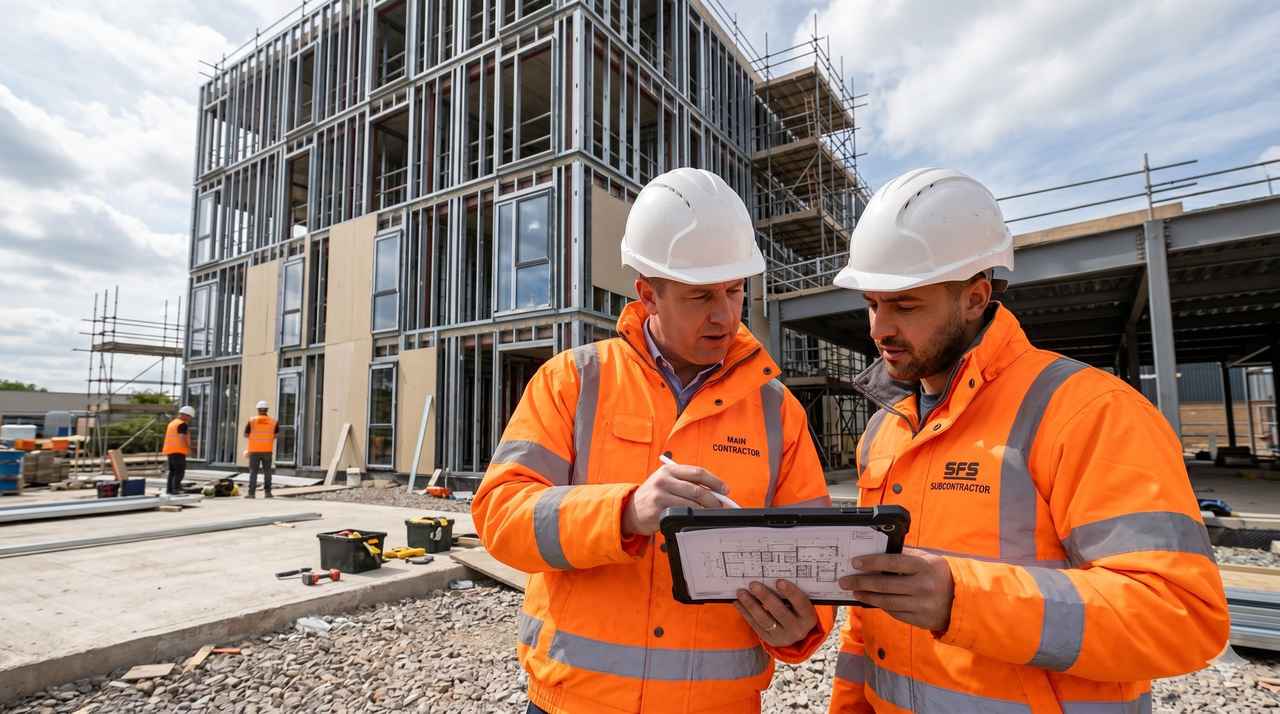
For a BTR developer-operator beginning a new scheme, the conversation with the SFS specialist needs to happen earlier than traditional procurement timing would suggest. By RIBA Stage 2, the engineering and panellisation strategy should already be informing the unit typology decisions. Ask the SFS specialist to demonstrate experience on comparable BTR schemes, to show how their panellised approach handles your specific unit count and typology mix, and to map out the programme savings on a floor-by-floor basis against a conventional alternative.
Ask about Gateway 2 evidence packaging, because as a BTR owner you’ll inherit the building’s safety case and need that documentation in a usable form. Ask about the supply chain — UK-rolled steel from established mills is increasingly preferred for traceability and lead-time certainty. The BAS Frames supply approach addresses both points.
And ask about the firm’s project track record on schemes of your scale. SFS as a category has scaled fast in the UK, and not every subcontractor calling themselves a specialist has the operational depth to deliver a 200-unit BTR block on programme. The portfolio matters.
The bigger picture
BTR has become the testing ground for the construction methods that will define UK mid-rise residential delivery for the next decade. SFS — and particularly panellised SFS — has emerged as the system most aligned with the sector’s specific commercial, operational, and risk profile. The developers who have understood that early have built faster, with lower long-term risk, and with operationally better buildings.
To discuss SFS specification on a BTR scheme or to request a typical programme-savings analysis, contact the BAS Frames team or review the completed project portfolio.
Further reading:Steel Construction Institute | Metsec Framing Systems
Related:Cost | Infill | What Is | Fire
Frequently asked questions
Why is SFS preferred for Build-to-Rent developments?
SFS is the preferred framing system for UK BTR schemes because it delivers the three things BTR developers prioritise: speed to stabilisation (SFS installs 30–40% faster than blockwork), standardisation (modular steel sections enable consistent apartment layouts across multiple floors), and cladding-risk management (tested SFS external wall systems provide clear fire compliance evidence for higher-risk buildings).
What are typical SFS installation rates on a BTR scheme?
On a well-managed BTR scheme with good access and standardised details, an SFS installation team can achieve 200–300m² of infill wall per week. On a 200-unit BTR block of 15,000m² gross wall area, the SFS infill package can typically be completed in 12–16 weeks from structural frame completion to watertight envelope.
How does SFS support acoustic performance in BTR apartments?
Acoustic performance between BTR apartments — required by Approved Document E — is achieved through a combination of SFS infill wall specification (mass, decoupling, sealing) and floor construction. Separating walls between dwellings typically require Rw 45 dB minimum; BTR operators often specify higher standards (Rw 50–55 dB) to differentiate the product. Twin-stud SFS configurations with acoustic plasterboard achieve these targets reliably.
What fire documentation is needed for SFS on a BTR building over 18 metres?
BTR buildings over 18 metres are higher-risk buildings under the Building Safety Act 2022. The SFS external wall system must be documented with tested system references, fire engineer sign-off, cavity barrier schedules, and installation inspection records as part of the golden thread. BAS Frames provides all required documentation as part of its standard package on qualifying buildings.