Key takeaways
- Steel frame systems use factory-made structural steel — columns, beams and connections — to carry a building’s loads in place of load-bearing masonry, from warehouses to multi-storey offices.
- The core components act together: columns take vertical load, beams span between them, and moment or braced connections give lateral stability (single-storey portals rely on the rigid eaves connection).
- Steel’s strength-to-weight ratio enables longer spans and open-plan layouts than timber or masonry, with factory precision and rapid on-site erection.
- Light steel framing (SFS) and heavy structural steelwork are related but distinct — SFS uses thin cold-formed sections, typically for infill and light-frame work, and is designed by a specialist engineer.
What Are Steel Frame Systems in Construction?
Steel frame systems form the structural backbone of modern construction across the UK — from sprawling industrial warehouses and logistics centres to multi-storey commercial offices, retail parks, and increasingly, residential developments. If you’ve ever watched a large building go up and marvelled at the skeletal grid of metal rising from the ground, you were looking at a steel frame system in action.
At its most fundamental level, a steel frame system is a load-bearing skeleton constructed from structural steel sections — columns, beams, and rafters — connected together to form a rigid, three-dimensional framework. This framework transfers all gravitational loads (the weight of floors, roofs, cladding, occupants, and contents) as well as lateral forces such as wind loads safely down through the structure and into the building’s foundations.
Unlike traditional masonry construction, where the walls themselves carry the load, steel frame construction separates the load-bearing function from the building envelope. The steel frame carries everything; the walls, cladding panels, and glazing are simply infill — giving architects and engineers extraordinary freedom in how a building looks and functions.
The Core Components of a Steel Frame System
A steel frame system is not simply a collection of steel sections bolted together. It is a carefully engineered assembly of interdependent components, each performing a specific structural role. Understanding these components is essential to appreciating how steel frame supply and structural design work together to deliver a complete building solution.
Columns
Columns are the primary vertical members of a steel frame. They carry compressive loads — the cumulative weight of everything above — and transfer them downward to the base plate and foundations. Universal Column (UC) sections are most commonly used in the UK, selected for their symmetrical profile which offers excellent resistance to bending in two directions simultaneously.
Beams and Rafters
Beams are horizontal members that span between columns, supporting floors or roof decks and transferring loads across to the columns. Universal Beam (UB) sections are the standard choice for their efficient bending resistance. In portal frame construction — the most prevalent form of single-storey industrial and agricultural steel frame in the UK — tapered rafters replace conventional beams, creating that characteristic pitched roof profile.
Connections and Joints
The connections between structural steel members are critical to how the entire system behaves under load. Steel frame connections are either pinned (allowing rotation, transferring only shear and axial forces) or rigid (moment-resisting, transferring bending moments as well). The choice between pinned and rigid connections directly determines whether a structure is a braced frame or an unbraced moment-resisting frame — a fundamental decision addressed during structural engineering.
Bracing Systems
Lateral stability — resisting horizontal forces from wind — is provided by bracing systems. These can take the form of cross-bracing (diagonal steel members creating a triangulated truss), moment frames, or reinforced concrete cores used in conjunction with the steel frame. In most single-storey steel frame buildings, the rigid moment connection at the eaves provides lateral resistance without the need for separate bracing.
Floor Decking and Secondary Steelwork
In multi-storey steel frame buildings, composite metal decking — corrugated steel sheet onto which concrete is poured — creates the floor slab. Secondary steel members such as purlins, side rails, and cleats support the roof and wall cladding, complete the structural system, and provide fixing points for the building envelope. Internal partitions and linings are often completed using our drylining services, which integrate seamlessly with the steel frame.
Types of Steel Frame Systems
Steel frame systems are not one-size-fits-all. The appropriate system depends on the building’s function, span requirements, height, loading conditions, and budget. At BAS Frames, we offer a range of proven infill, full build stick, and panellised systems to suit different project types.
Infill Steel Frame Systems
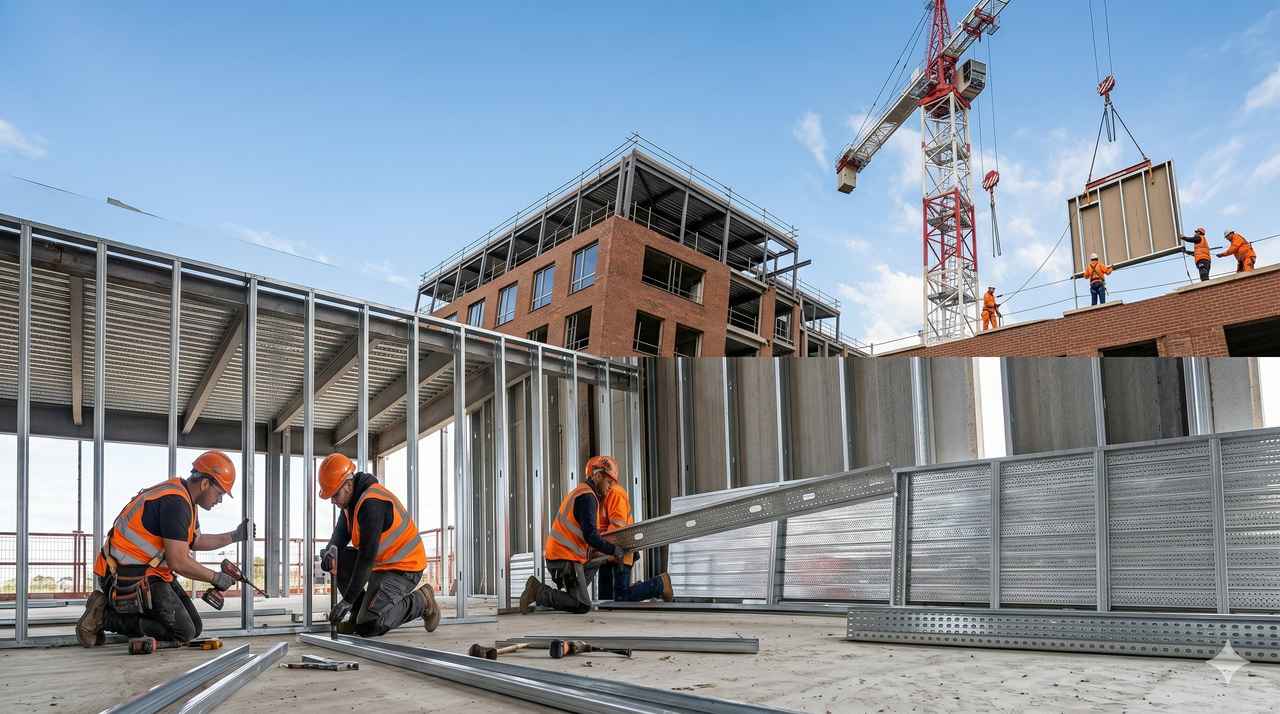
The infill system fills the space between a building’s structural frame and floors. Typically non-load-bearing, infill steel walls support cladding, brickwork, and other external finishes while withstanding wind loads. Steel-framed infill walls are lightweight, durable, and enhance the overall stability and structural performance of the building — making them a popular choice for mid-rise and high-rise commercial and residential developments where a separate primary structure already exists.
Full Build — Stick (Stand-Alone) System
The full build stick system provides a comprehensive structural solution using lightweight steel sections as the primary frame. It offers full design flexibility and fast-track construction for housing and apartments up to eight storeys, using floating floor chipboard slabs or Lewis deck floors with screed finish. This system is ideal where the steel frame itself forms the complete structural solution, with no separate primary concrete or structural steel frame required.
Full Build — Panellised System
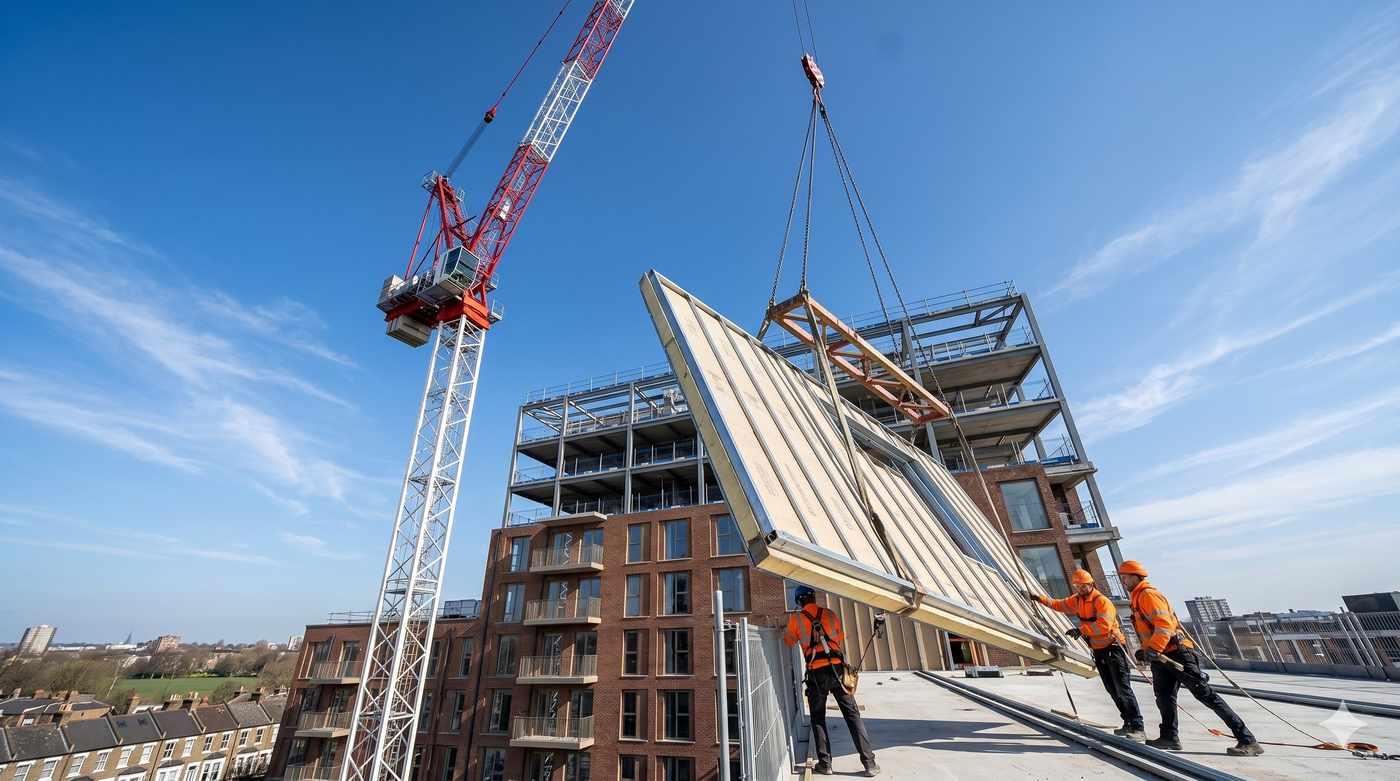
The panellised steel frame system is a prefabricated steel construction approach that is a top choice for clients seeking fast-track building solutions. By manufacturing wall and floor panels off-site to precise tolerances, on-site scaffolding and installation time are minimised, reducing overall project costs and accelerating the return on investment. This efficient modular approach is ideal for modern residential, commercial, and multi-storey building projects where programme certainty is a priority.
Steel Framed Houses
Light gauge steel framing is increasingly used in steel framed house construction as an alternative to traditional timber frame. Steel framed houses offer superior dimensional stability, resistance to warping and pests, excellent fire ratings, and compatibility with standard external cladding and internal drylining systems — making them a compelling choice for residential developers seeking a durable, fast-build solution.
Steel Frame vs. Other Structural Systems
While concrete frames and timber frame structures are viable alternatives for certain building types, steel frame systems offer a distinct combination of characteristics that make them the preferred choice across a wide range of commercial and residential construction in the UK.
Steel frames deliver an exceptional strength-to-weight ratio, long clear spans, and fast on-site erection. They are fully recyclable, adaptable to future modifications, and suitable for projects of all scales. Concrete frames offer excellent compression strength and thermal mass but are heavier, slower to construct, and harder to modify after completion. Timber frames perform well for low-rise residential and education buildings but are limited in long-span capability and multi-storey applications. Load-bearing masonry is cost-effective for simple structures but severely restricts internal planning flexibility and building height.
For projects requiring large open spans, rapid programme delivery, or the flexibility to reconfigure internal layouts over the building’s lifetime, a steel frame system is almost invariably the most technically and commercially sound choice. You can see this in practice across our completed projects.
The Steel Frame Construction Process
Understanding the steel frame construction process — from initial design through to erected structure — helps clients and project managers appreciate why proper planning and specification are so important.
Structural Design and Engineering
The process begins with structural engineers producing detailed calculations and design drawings, determining the size and section of each steel member based on the applied loads, span requirements, and building codes (principally the Eurocodes in the UK). At BAS Frames, our design service and structural engineering team work closely together from the earliest project stages, ensuring that structural efficiency, regulatory compliance, and buildability are all addressed before a single section is ordered.
Steel Frame Supply
We source high-quality steel frame components and related materials directly from trusted manufacturers. All materials are BS certified and supplied through our reliable network of suppliers. Our steel frame supply chain ensures cost-effective procurement, timely deliveries, and full material traceability — providing complete peace of mind on every project.
On-Site Installation
Our skilled steel frame installation teams — including SMAS and CHAS accredited operatives — carry out on-site works with precision and professionalism. With a strong focus on health and safety and effective programme management, we ensure every steel frame structure is completed safely, efficiently, and delivered on time.
Fire Protection and Internal Finishes
Structural steel loses strength at elevated temperatures, so fire protection is required in most occupied buildings. This is applied either as intumescent paint (which expands in a fire to insulate the steel) or as passive fire protection boarding systems. Internal wall and ceiling finishes are typically completed using light gauge steel partitioning and drylining, which provides thermal performance, acoustic separation, and a high-quality finish ready for decoration.
Why Choose Steel Frame Systems? Key Advantages
The enduring popularity of steel frame construction in the UK reflects a genuine combination of structural, commercial, and sustainability advantages that alternative structural systems struggle to match collectively.
Structural steel is one of the strongest materials available per unit of weight. This allows slender members to carry heavy loads across long spans, reducing the dead weight of the structure itself and the consequent size of foundations.
Steel frames allow architects to create large, column-free spaces — essential for warehouses, open-plan offices, sports facilities, and retail environments — that cannot be achieved economically with other structural systems at the same scale.
Because steel components are fabricated off-site to precise tolerances, on-site activity is reduced to erection and connection. This compresses programme timescales significantly, reducing financing costs and enabling earlier occupation — one of the reasons our clients return to BAS Frames project after project, as evidenced in our project portfolio.
Steel frame buildings can also be modified, extended, and reconfigured more readily than concrete or masonry structures. Openings can be cut, extensions added, or mezzanine floors inserted — making steel frame investment resilient to changes in occupant requirements over decades.
Finally, structural steel is one of the most recycled materials on earth. At end of life, the steel frame of a building retains its full material value — it can be dismantled, recycled, or reused. This circular characteristic, combined with the precision of off-site fabrication (which minimises waste), gives steel frame construction strong sustainability credentials.
Steel Frame Systems at BAS Frames
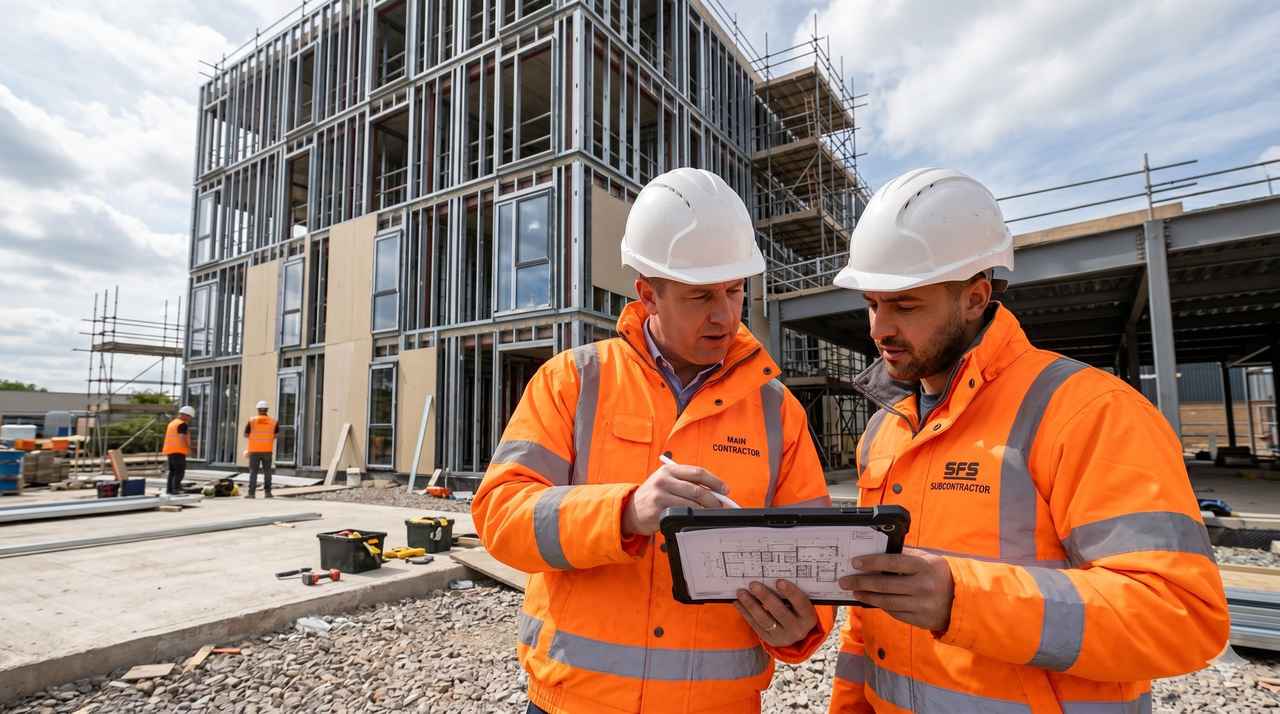
At BAS Frames, we design, supply, and install steel frame systems for a wide range of construction projects across the UK. Established in 2010, we have built a reputation as a trusted specialist subcontractor, delivering infill systems, full build stick frames, panellised systems, and steel framed houses to clients who demand speed, quality, and reliability.
Our fully integrated service — from design and structural engineering through supply and installation to drylining finishes — means a single, accountable partner manages your steel frame project from concept to completion.
Whether you are at the feasibility stage of a new development, planning an extension, or exploring modern methods of construction for a residential scheme, our team is ready to help you specify the right system for your project. Get in touch with BAS Frames today for an initial consultation.
Further reading:Steel Construction Institute | Metsec Framing Systems
Related:Cost | Infill | What Is | Fire
Frequently asked questions
What are Steel Frame Systems in UK construction?
Steel Frame Systems (SFS) in UK construction refers to cold-formed light gauge steel framing used for external infill walls and internal partitions in mid-rise residential and commercial buildings. The system uses C-section studs and U-section tracks to create a non-load-bearing framework that provides weather resistance, thermal performance, fire separation and the substrate for finishes and cladding.
What is the difference between SFS and structural steelwork?
SFS (Steel Frame Systems) uses cold-formed light gauge sections (typically 0.9mm–2.0mm thick) for non-load-bearing walls and partitions. Structural steelwork uses hot-rolled or fabricated heavy sections (typically 6mm–25mm thick) for primary structural frames. SFS is not a structural element — it hangs from or bears against the primary structural frame rather than carrying building loads.
What buildings are SFS used in?
SFS is used in mid-rise residential (5–20 storeys), build-to-rent apartments, student accommodation, commercial offices, healthcare facilities, education buildings and hotels. It is less commonly used in very low-rise domestic construction (where timber frame is traditional) or very tall buildings (above 20 storeys, where in-situ concrete is more common).
Who designs SFS in a UK construction project?
SFS structural design is typically provided by the SFS subcontractor’s in-house engineer or by an independent structural engineer appointed by the subcontractor or main contractor. The architect provides the architectural intent (wall build-up, U-value targets, fire rating) and the SFS engineer translates this into fabrication drawings, connection details and structural calculations.