Key takeaways
- Office drylining forms the smooth walls, partitions and ceilings inside commercial workspaces, and is central to flexible, reconfigurable fit-outs.
- Metal-stud partitions with the right board deliver the fire, acoustic and demountability performance offices need, and can be reconfigured with minimal disruption.
- Specification is driven by compliance — fire rating and Part E acoustic performance for separating and demising walls.
- Drylining installs fast across large floorplates and runs in parallel with M&E, protecting the commercial programme.
Commercial Office Drylining: Creating Flexible Workspaces
Office drylining is the use of internal plasterboard systems to create smooth walls, partitions and ceilings inside commercial workspaces. It is a key part of creating room layouts, improving acoustic performance, and achieving fire and insulation standards in modern offices. Drylining allows faster installation and neater finishes than traditional wet plastering. To know its use in practice, the general types, advantages and design points are given as follows.
The Strategic Edge of Office Drylining
Office dry lining provides a fast and flexible method to create and reshape internal partition walls, offering cleaner worksites and more predictable results than traditional wet plaster. Well-designed dry lining nurtures productivity, comfort, and long-term agility, which are vital as teams and work styles evolve.
1. Project Velocity
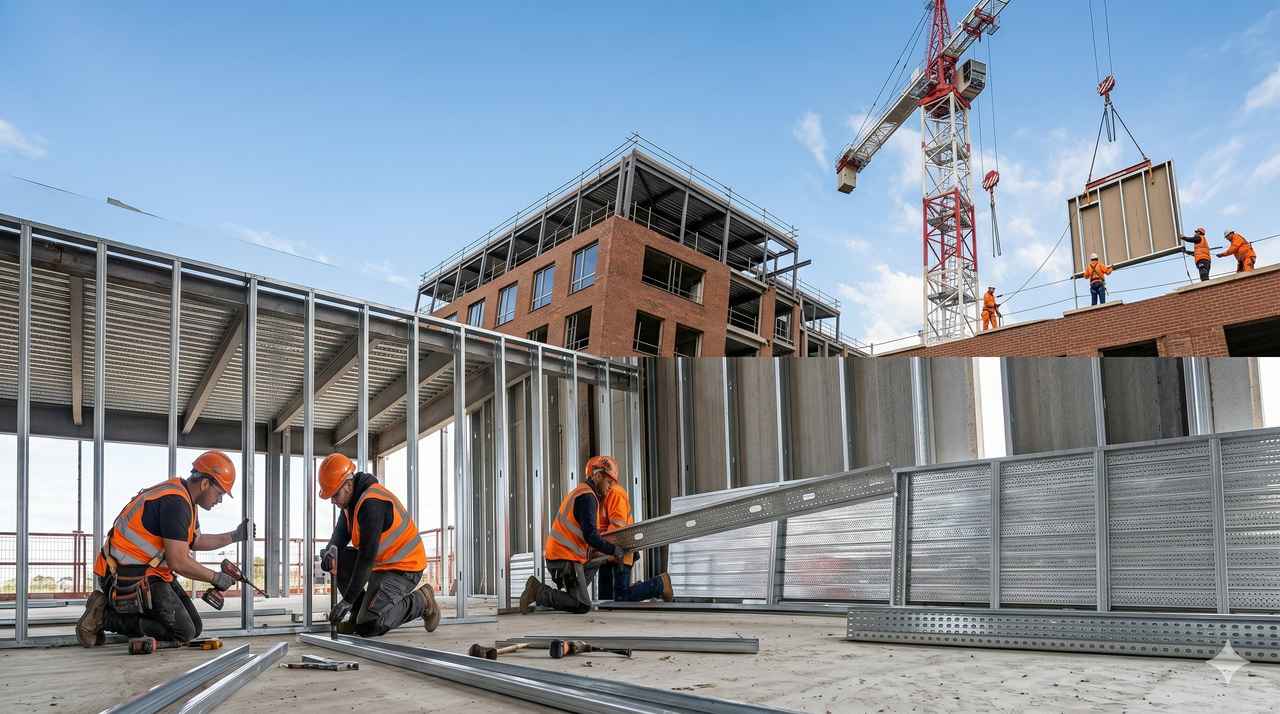
Drylining employs lightweight steel framing systems with plasterboard or composite boards, so partitions rise quickly and cleanly. Prefabricated components and standardised details reduce installation times, and internal surfaces are typically ready for decoration within 24 to 48 hours rather than waiting days for wet plaster to dry and cure. That speed assists phased refits. Contractors can finish one zone while another remains in use, minimising disruption to business activity and eliminating prolonged noise and dust. Teams can then move into new focus rooms, meeting rooms or project spaces as soon as each phase is complete.
Shorter drying periods allow follow-on trades – data cabling, floor finishes, joinery – to come in sooner, compressing the critical path of the programme. When dryliners and other contractors collaborate on their sequencing, project managers can condense the overall fit-out programme without jeopardising quality.
2. Cost Certainty
Opting for basic steel studs, plasterboards and traditional drylining systems offers more stable pricing than custom wet-trade alternatives. Material rates are more readily benchmarked and compared across suppliers. Modular and semi-off-site fabricated systems further constrain on-site variables, reducing the potential for unexpected labour overruns, rework and waste. Over the life of the building, resilient plasterboard partitions and premium glass systems are easy to maintain or patch, keeping costs steady across multiple tenant cycles.
3. Design Agility
Office drylining works well for flexible workplaces, as partitions can be reconfigured or demounted with comparatively little disturbance. Demountable systems and modular glass walls allow teams to resize meeting rooms, add breakout areas or convert open space into focus rooms as needed. Other working styles require different acoustic and visual environments. Drylining makes it easier to specify a deliberate mix of high‑performance acoustic office partitions for confidential work, glazed fronts for collaboration rooms, and hybrid solid‑and‑glass walls where privacy and daylight must both be protected.
Since services can run through partition voids, designers can change layouts without extensive structural work, provided early planning anticipates future storage requirements, potential headcount increases and service runs. This forethought helps prevent expensive rework when new technology, filing requirements or team structures arise.
4. Performance Control
A drylined office can be tuned to pretty specific performance targets. Sound-insulating boards, acoustic glazing and office screens keep noise from meeting rooms and project spaces out of quiet work zones, which aids concentration and reduces fatigue. Fire-resistant boards and robust compartmentation details help to meet code requirements and provide clear fire strategies, whilst thermal insulation in the cavity increases comfort and can assist energy-efficiency targets. Seamless plasterboard surfaces provide a solid substrate for paint, wallcoverings or specialist finishes, helping to ease later refresh cycles.
5. Future Proofing
Well-designed office drylining enables transformational change. Removable or relocatable partition systems enable growth, downsizing or novel hybrid ways of working with mobile dividers and sliding walls to transition between team spaces, project areas and event rooms. Forming service voids within partitions eases the introduction of new data, power or smart controls without having to break into concrete or masonry. Routine upkeep, including yearly inspections of door seals, closers and safety film, maintains acoustic, fire and privacy capabilities and secures asset value.
A considered drylining approach that combines flexibility, acoustic protection and integrated services can deliver an office that balances collaboration, focused work and employee well-being.
The Anatomy of Commercial Partitions
Commercial office partitions in dry lining are constructed as layered systems, including a structural frame and one or more layers of dry lining boards. The joints and finishes that seal everything together also play a crucial role in fire safety, acoustics, and overall performance, making it essential to prioritize technical factors over trends.
Steel Frame Systems
Light gauge steel framing serves as the primary structural backbone of office partitions due to its strength, lightweight nature, and predictable performance. In many contemporary offices, standard partition walls, which historically specified 90 mm (3½ inches) timber studs, are now often replaced by steel studs of equivalent width. These studs are riveted into top and bottom tracks to create a ‘plumb’ grid for dry lining, ensuring that dry lining walls are properly aligned. Accurate alignment for plasterboard sheets is crucial, especially when constructing tall partitions or long runs in open-plan offices. Installers can even adjust stud spacing for taller partitions or specific applications, such as shelving or wall-hung cabinetry, while still adhering to current drywall regulations.
In commercial projects, corrosion resistance is vital. Galvanised steel components, with protective coatings, effectively withstand average office humidity and minor leaks, making them ideal for dry lining in environments like kitchens and bathrooms. Their fire performance is well established, aiding in building control approval.
Board Selection
The selected dry lining boards determine the partition’s behavior in day-to-day use. In private meeting rooms or HR offices, higher-density acoustic plasterboard, typically in 12.5 mm or 15.9 mm thickness, enhances sound reduction, particularly when partnered with cavity insulation. Used for bathrooms, tea points, and near wet services, moisture-resistant boards minimise mould and degradation, making them ideal for wet areas.
Common gypsum board still works well and is economical for general workspaces and circulation zones. Gypsum plasterboard is a favorite for being lightweight, inexpensive, easy to cut, and providing decent acoustic insulation. These boards typically have thicknesses of 9.5 mm, 12.5 mm, and 15.9 mm and come in various types, finishes, and colors, enabling designers to balance weight, fire resistance, and impact resistance with appearance.
The exact type and thickness should always follow the acoustic, fire, and impact ratings as per the specification. Vetted suppliers such as British Gypsum or Knauf offer tested systems, not isolated products, to simplify proving compliance. For more rigorous uses, designers might pair specialist boards, such as render carrier boards at façades or laminated acoustic glass inserts into hybrid partitions, to attain targeted performance and aesthetic objectives.
Installation Integrity
The strength of an office partition is as much to do with craftsmanship as product selection. Boards have to be screed-fixed with the right screws and patterns to the steel or sometimes timber frame, with cavities generally stuffed with acoustic or thermal insulation to deaden noise transfer and improve fire rating. It is this build-up that provides the privacy so many office workers require for calls, one-to-ones and formal confidential meetings. Joints between boards typically receive up to three coats of joint compound. Each layer is put on over joint tape, dries, and is sanded before the next coat.
When done properly, this results in a seamless surface prepped for paint or wall coverings and no lines showing under grazing light. Corner detailing and junctions with ceilings and floors, door frames and service penetrations require especial care since badly sealed gaps can dramatically undermine acoustic and fire performance even where the main board is technically top-end. Inspection during installation, checking for alignment, flatness, fixing patterns and seals, helps ensure the finished partition actually matches the design assumptions on which approvals and calculations are based.
Why Performance Matters
Performance in office dry lining is not just about the aesthetics of the dry lining walls; it encompasses how the system effectively manages sound, fire, and heat, as well as the speed and safety of installation and servicing in a real working office.
Acoustic Privacy
Acoustic privacy is one of the first things staff appreciate in modern workplaces. Thin walls or poorly detailed sound-muffling partitions can lead to overheard conversations in a meeting room from adjacent desks, thereby compromising focus and confidentiality. High-performance dry lining systems address this issue by employing acoustic stud-partitions and soundproof glass partitions between rooms and open spaces. These effective dry lining materials minimize noise transfer, ensuring that a video call in a glass meeting pod will not disturb a focus area next door.
Within those stud walls, acoustic materials like mineral wool in the cavity provide additional sound damping. The use of thick plasterboards, double-layer boards, or specialist acoustic boards on each side of the frame adds mass and assists in blocking mid- and high-frequency noise, such as speech and office machinery. Furthermore, acoustic desk divider screens and full-height acoustic office walls can carve out “quiet zones” in open-plan offices while maintaining flexibility, which traditional masonry walls cannot achieve.
To meet target decibel (dB) ratings set by standards or client requirements, designers combine various elements: heavier board build-ups, acoustic panels, staggered studs, and resilient fixings or channels that effectively decouple the lining from the structure. This holistic approach, similar to the principles of traditional methods, ensures that all components work in harmony to create seamless walls.
In conclusion, the integration of quality plasterboard and acoustic solutions is essential for creating functional and soundproof interiors in contemporary commercial projects. By collaborating with expert dryliners, clients can achieve bespoke designs that enhance both aesthetics and acoustic performance in their interior spaces.
Fire Compartmentation
Fire performance is non-negotiable. Fire-rated plasterboards attached to intelligently designed steel frame systems compartmentalise the workspace into fire-safe zones, allowing occupants to evacuate and containing the spread of fires between floors or departments. At joints, deflection heads and around service penetrations, tested fire stops and intumescent sealants are required to maintain the fire rating demanded by building regulations. Materials should hold appropriate fire resistance certificates for both the board and the entire system. Where doors and vision panels are required in a corridor or meeting suite, these must be in keeping with the partition rating so escape routes remain protected and visible during an incident.
Thermal Efficiency
Thermal performance connects comfort, energy bills and sustainability. Insulated partition walls, thermal backing boards and detailed ceiling systems assist in retaining heat during the winter and limiting unwanted heat gain in the summer. This means HVAC systems work less, which helps energy-efficient, lower-carbon buildings. Cloistered walling with sealed joints minimises heat loss and cold spots between spaces of varying purpose, such as a server room alongside an open office. Choosing proprietary office-spec insulation materials with stable performance and low emissions enhances thermal comfort and air quality.
High-performance drylining makes later maintenance easier. Services can be accessed through removable panels, so electrical and plumbing work causes less disruption in occupied buildings. Fast deployment is yet another performance advantage. Drylining systems for walls and ceilings can be installed in as little as a few days, depending on size and complexity, rather than the longer programmes associated with old-school wet plastering. This reduces project timescales and minimises downtime while supporting businesses in ongoing operation during the works.
The Lifecycle Value Proposition
Office dry lining lies at the center of a building’s lifecycle value proposition. When designed and managed well through a defined project lifecycle, using quality dry lining materials can prolong asset life, sustain tenant satisfaction, and safeguard long-term value rather than merely addressing short-term fit-out requirements.
Tenant Retention
With thoughtful drylining, landlords can create interiors that feel intentional rather than makeshift. Bespoke partitioning, careful joint treatment and durable finishes, for example, impact‑resistant boards in corridors or washable paints in tea points, help offices feel “move‑in ready”. In practice, this narrows the scope of changes a new tenant needs to pay for, which is usually a key motivation for them to remain in a building or pick one over a rival. Flexibility feeds right into retention. Modular stud layouts, standardised door and glazing sizes and service voids that are easy to access mean walls can shift with less dust, noise and downtime when a tenant expands or needs to consolidate.
One straightforward example is combining two small rooms into one project space over a weekend without having to touch the ceiling grid or floor finishes. Drylining systems aid rapid, tidy installation, meaning tenant fit outs and churn projects disrupt less. Each phase (strip‑out, frame, board, finish) has clear milestones a project manager can track, making it easier to identify delays or communication black holes early on. Quality acoustic and thermal performance count towards day-to-day happiness. Properly detailed plasterboard linings with acoustic insulation reduce sound transfer between meeting rooms. Insulated linings on external walls enhance winter comfort and decrease energy consumption. These are easy technological decisions that occupants experience as less noisy, more pleasant workspaces.
Asset Adaptability
Future-proof floors against work style changes with demountable and modular wall systems, such as dry lining boards. The project lifecycle helps quantify this value. During planning, managers can model strategic alignment, which shows how layouts support hybrid working, financial impact, quality, and performance, rather than judging the dry lining package on initial cost alone. As the market changes, buildings with modular dry lining can respond quicker. Big floorplates can be broken down into smaller units, meeting rooms, or shared hubs via repeatable details and reused components. This encourages better space efficiency and enables different tenant types to exist on the same floorplate, making it an ideal choice for commercial projects.
Reusing studs, tracks, and even resistant plasterboards where possible cuts refit spend and waste down. Companies that handle such shifts with a mature benefits-realisation process deliver more successful projects. Surveys indicate around 79 percent, compared to 56 in less mature companies. Proximity of experienced project teams and trades on site can raise performance, with research suggesting those working next to high performers can improve by around 15%.
Sustainable Credentials
Drylining can work towards sustainability targets when specified wisely. Recyclable plasterboards, steel studs and mineral wool insulation enable a circular culture, especially if procurement and waste contractors are arranged for take-back and recycling across the project lifecycle, not just in a final push. Off‑site cut‑to‑length studs, pre‑formed openings and coordinated service zones minimise site off‑cuts, cutting waste and labour. Clear lifecycle stages facilitate waste intensity measurement, problem phase identification and improvement over time.
Many green building certification schemes recognise low-emission boards, high recycled-content steel, and high-performance linings that cut heating and cooling demand. Lifecycle thinking encourages teams to assess not only operational energy but durability. Choosing robust boards in high-traffic areas often means fewer repairs, fewer site visits and lower embodied carbon over the building’s life.
Designing with Plasterboard
Designing office drylining with plasterboard is mainly about control: control of space, light, sound and building services, while keeping the build fast, clean and adaptable. As plasterboard has a plaster core, it has excellent acoustic and fire performance and installs much faster than wet plaster, often in just a few days on a typical office floor. With both framed and frameless systems on offer, and board thicknesses from ultra-thin 6 to 9.5 millimetre sheets to solid 15 to 24 millimetre partitions, designers can perfect each space rather than settle for one inflexible solution.
Spatial Fluidity
Spatial fluidity in an office comes from being able to re-shape areas without major disruption. Drylining enables this via demountable and mobile partitions that rest on lightweight metal frames, enabling teams to slide, reposition or add walls with minimal disruption because the system uses so little water. In open plan, solid plasterboard up to a certain height paired with sliding or fixed glass above can zone workstations, circulation and collaboration spaces while still feeling open. Where privacy is required, for focus rooms or HR offices, thicker (15–24 mm) plasterboard in double-layer build-ups enhances sound insulation, particularly in combination with mineral wool in the cavity.
The plaster core itself already provides helpful acoustic damping, which can be augmented with certain acoustic-rated boards if speech privacy is a concern. For breakout corners or temporary project rooms, designers can choose lighter, part-height partitions that are more easily moved when teams shift. Maximising floor space means minimising bulky framing and planning wall lines carefully around existing columns, windows and escape routes. Slim stud framing with 12.5 mm boards either side generally offers sufficient rigidity for standard heights, yielding more usable space than masonry or extremely thick studwork. As drylining is less technically demanding than traditional plastering, minor alterations can be made on site without compromising the programme, facilitating a “living”, flexible office plan in the long term.
Aesthetic Finishes
Good looks in office dry lining begins with the choice of dry lining boards and joint finish. Taped, filled, and sanded, plasterboard provides a smooth, paint-ready surface that is difficult to tell from full-on plaster but is achieved in far less time. Designers can then opt for plain emulsion for a chilled backdrop or bolder hues to direct wayfinding and zoning. On this base, decoration is wide-ranging. Wallpaper or commercial-grade vinyl can add texture to reception or client-facing walls and is still simple to replace during future refits. In some environments, subtle architectural mouldings or shadow gaps at ceiling edges provide a more sophisticated appearance without great expense.
These solutions are perfect if a company wants to look professional while retaining the option of a branding refresh every few years. Glass is routinely deployed in conjunction with plasterboard sheets to maintain the flow of natural light further into the floor plate. Full-height glass partitions, frosted bands for privacy, or smaller glazed openings in plasterboard walls all help avoid a claustrophobic experience. Timber, perforated metal or acoustic fabric feature panels can be incorporated into plasterboard runs to deaden noise and introduce warmth, which is ideal in otherwise clinical looking open plan areas. Edge profiles and corner beads, not to mention trims, subtly influence the end effect. Rounded corners mitigate impact damage in busy corridors, whereas sharp shadow-line trims lend a modern, minimal edge to meeting suites. It’s about ensuring these selections fit with the interior design project as a whole so that partitions, ceilings, and joinery come together as one unified design rather than a mix of disparate parts.
Integrated Services
One of the most powerful benefits of dry lining in office spaces is its capacity to conceal services within partition cavities, allowing interiors to feel calm and uncluttered. Sockets, light switches, data points, and low-voltage controls can all be chased within the studwork, with back boxes flush-mounted to the plasterboard sheets. For high IT density areas, using double-layer dry lining boards in wider cavities can accommodate more cabling without visible trunking. Planning for HVAC, plumbing, and specialist services needs to be considered at the design stage. The depth of the partition and the choice between framed and frameless systems should reflect what must run within the wall: small fan-coil pipes, slim ductwork, or only power and data.
Medium-thickness 12.5 mm boards are usually sufficient for standard office walls, but thicker boards and deeper studs may be warranted where acoustic performance and service capacity are critical, as between noisy plant-adjoining rooms and quiet offices. Access can’t be an afterthought. Pull-out panels, hidden access hatches, and service boxes are placed where maintenance teams can access valves, junction boxes, and dampers without damaging finishes. This is particularly the case in larger commercial projects, but the same goes for smaller offices and even home-office conversions, where dry lining is adopted too as it’s quick, clean, and flexible in various rooms of a house.
Successful incorporation relies on collaboration with mechanical and electrical (M&E) contractors. Their comments on cable zones, fire-stopping details and route clashes safeguard the acoustic and fire properties of the plasterboard core while ensuring the wall build-up remains as slim as possible. When it is executed well, the effect is of a serene, orderly interior with tech and services there but not overbearing.
Mitigating Project Risks
Mitigating project risk in office drylining means getting decisions right from procurement to handover. Dry lining systems, including resistant plasterboards, commonly create firewalls, escape routes, and other passive fire protection, so any mistake can impact life safety, programme, cost, and durability.
Specification Errors
The majority of expensive issues begin at the specification stage. Partition definitions, performance requirements and supplier data need to align one by one. If the drawing specifies a 60-minute fire-rated wall at 45 dB, but procurement orders a run of standard non-fire board, the defect will not emerge until sign-off or, worse still, in a fire. Double-checking board type, stud gauge, fixings and insulation against manufacturer data sheets is fundamental and is one of the best protections. Compliance with building regulations and standards is non-negotiable. Drylining systems must be third-party certified, with fire, acoustic and structural testing to demarcated standards.
On specification, teams need to ensure that full systems (studs, boards, linings, fixings) are tested together, not as individual items from different manufacturers. This is essential for fire-resistant drylining, where “value engineering” substitutions are a frequent concealed risk. Clearer design documents reduce disputes and rework. Plans and schedules must detail each partition type, its precise location, and any special zones such as wet areas, service risers or high-impact corridors. Ambiguous notes such as “stud wall by contractor” invite variation claims and improvisation on site. Technical review before final sign-off is critical. Acoustic, fire and thermal performance must be tested concurrently. Increasing insulation for sound attenuation will not compromise fire testing or the cavity depths required for services. Keeping specifications aligned with current guidance such as BS 8000‑8: 2023 helps avoid outdated details and strengthens defensibility if claims arise.
On-site Coordination
On site, coordination is what ultimately decides whether risks remain theoretical or turn into actual issues. Deliveries of plasterboard, metal studs and accessories should be sequential to minimise double handling and damage. One plasterboard can weigh between four and nine stone. Repeated manual handling without forethought is a factor in musculoskeletal disorders, so good logistics, mechanical aids and realistic crew numbers become a health and safety measure and a productivity tool. Well-defined roles and responsibilities help to close gaps.
Main contractors, dryliners, M&E trades and ceiling installers need agreed interfaces: who closes which side of the wall, when services must be in place, and how penetrations will be sealed to maintain fire and acoustic performance. Digital tools and BIM models assist in early clash visualisation, such as ductwork conflicts with head details of high fire-rated partitions. You’re reporting against an agreed programme – not on an informal meet-up.” Forward notice of delays to prior trades allows resequencing rather than hurried installation which frequently causes defects. Public liability insurance is an essential backstop, but it is not a replacement for careful planning. It just covers you financially if damage to property or third-party injury occurs.
Quality Assurance
Quality assurance in drylining relies on a straightforward project-based checklist at each stage. That might include substrate condition, correct fixing centres, board orientation, joint treatment, fire stopping around openings and that installed systems match the tested specification. Level surfaces, firm fixings and well-finished joints aren’t just about looks; they affect acoustics, cracking risk and client trust. Documentation is just as critical. Site records show that installed walls meet required acoustic, fire and thermal ratings, referencing manufacturer literature, test certificates and any approved deviations.
For fire-resistant partitions creating escape routes, photographic records of internal layers before closing up can be priceless if queries emerge later. Get snags sorted as a systematic process, not a rushed final walk round. Documenting faults, attributing accountability and confirming resolution protects both the customer and the fitter. Across procurement, installation and contract conditions, this end-to-end approach, underpinned by current best practice guidance and risk-focused method statements, is what really alleviates project risk and lessens rework.
Conclusion
Office drylining now lies at the heart of how offices are designed, constructed, and transformed. When teams specify the right partition systems, they benefit from quieter meeting rooms, enhanced fire safety, and greater flexibility of layouts without increasing cost over the building’s lifecycle. Aspects like board type, framing and junctions really do matter to real-world performance, not just specification sheets. To reap the full benefits of drylining, project teams can gain from early collaboration between designers, contractors and manufacturers. That approach mitigates risk, eliminates rework, and delivers performance to budget. Ultimately, well-designed plasterboard partitions provide a pragmatic blend of speed, quality and flexibility that fits the bill for present-day fluid office requirements.
Frequently Asked Questions
What is office drylining and how is it used in commercial spaces?
Office dry lining is a technique for constructing internal partition walls and ceilings using quality plasterboard attached to aluminum or wood frames. This method is common in commercial projects to separate areas, enhance acoustics and fire resistance, and achieve a seamless finish quickly.
How does drylining give my office a strategic edge?
Dry lining encourages rapid fit-out and versatile layouts, making it an excellent building material for future reconfiguration. This practical solution enables you to accommodate workspace for growth, hybrid working, and new teams, optimising the lifetime use of your office floor space.
What performance factors should I look for in office partitions?
Essential performance characteristics of dry lining materials included sound insulation, fire protection, impact resistance, and structural integrity. Additionally, moisture and thermal performance are crucial for compliance with the office’s usage, building codes, and specific client or landlord requirements.
How does drylining affect the long-term cost of an office fit-out?
Good dry lining design can reduce life cycle costs significantly. Utilizing quality materials, they are much quicker to fit, easy to maintain, and can be reconfigured without too much structural work, saving on downtime and refurbishment costs in various projects.
What types of plasterboard are best for office design?
Typical choices include standard plasterboard, acoustic, fire-resistant, moisture-resistant, and high-impact plasterboards, which are essential dry lining materials. The right option to use will depend on the requirements of each area, such as dry lining walls for meeting rooms needing acoustic boards and escape routes requiring enhanced fire-rated boards.
Can drylining help with soundproofing between meeting rooms?
Acoustic dry lining systems utilise specialist plasterboard sheets, insulation, and staggered or twin frames to effectively reduce sound transfer. Proper detailing at joints, doors, and penetrations is crucial, as a proven system can enhance privacy in meeting rooms and various interior spaces.
What are the main risks in office drylining projects and how are they reduced?
Typical risks in construction projects involve inadequate acoustic or fire performance, delays, and regulatory non-compliance. These are mitigated by employing proven systems, quality materials, skilled installers, and early collaboration between designers, engineers, suppliers, and contractors.
Further reading:British Gypsum Technical Resources | Gypsum Products Development Association
Related:Cost | Infill | What Is | Fire
What drylining specification is needed for a commercial office?
Commercial offices typically require metal stud partitions with 12.5mm or 15mm plasterboard, acoustic performance of Rw 40–50 dB for internal walls, and 60-minute fire resistance for escape routes and plant room enclosures. Demountable partition systems are increasingly specified for open-plan floors where future reconfiguration is anticipated.
How quickly can a commercial office drylining package be installed?
A well-resourced drylining team can complete 150–250m² of partition per week on a commercial office project in good site conditions. A 2,000m² open-plan floor plate can typically be partitioned in four to six weeks, depending on complexity of the layout and acoustic specification.
What is the fire rating requirement for office drylining?
Under Approved Document B, office escape routes, stairwells and plant rooms typically require 60-minute fire-resisting partitions. Open-plan office areas may have lower requirements depending on the building’s fire strategy. All fire-rated drylining must be installed in accordance with a tested system from a recognised manufacturer.
Does drylining need to comply with Part E acoustic regulations in offices?
Approved Document E applies to residential buildings, not commercial offices. However, commercial leases and fit-out guides (such as BREEAM or BCO specification) typically set acoustic performance targets for meeting rooms and cellular offices. Acoustic testing is sometimes required as a condition of handover.