Fire-Rated Drylining in 2026: Meeting the New Approved Document B Amendments
As specialists in both Steel Frame Systems (SFS) and high-performance drylining, we understand that fire safety isn’t just about the boards you choose; it’s about the integrated system you install.
The 18-Metre Threshold: What’s Changed?
The most significant shift in the 2026 update is the mandatory requirement for more than one common stair in blocks of flats with a storey height of 18m or more. While this affects structural design, it has a massive “knock-on” effect for drylining:
-
Evacuation Lifts: New provisions support the use of evacuation lifts, requiring drylining teams to install specialised fire-rated shafts and lobby protection that meet updated BS EN standards.
-
Compartmentation: With two staircases, the integrity of the separating walls between stairwells and residential units is under higher scrutiny. Our metal stud partition systems are now being detailed to provide up to 120 minutes of fire integrity to protect these vital escape routes.
Technical Specification: 120-Minute Fire Integrity (Non-Loadbearing)
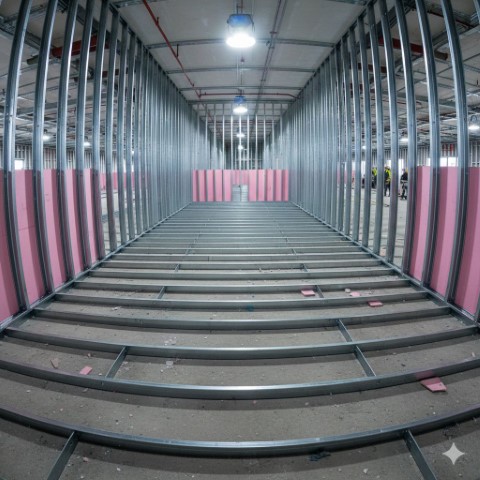
When designing for Approved Document B compliance, the assembly must be treated as a single tested unit. Mixing manufacturers or deviating from tested stud centres can void the fire certification. Below is the standard assembly used by BAS Frames for high-risk zones.
| Component | Specification Detail | Technical Function |
| Metal Framework | 70mm (min) C-Studs at 600mm centres | Provides a structural backbone and allows for thermal expansion. |
| Boarding (Layer 1) | 15mm Type F (Fire-Rated) Gypsum Board | Primary fire barrier: releases chemically bound water to cool the core. |
| Boarding (Layer 2) | 15mm Type F (Fire-Rated) Gypsum Board | Staggered joints to prevent a direct heat path to the metal studs. |
| Insulation | 50mm Mineral Wool (min. density 20kg/m³) | Increases thermal resistance and enhances acoustic dB rating. |
| Deflection Head | 25mm (min) Allowance | Accommodates structural movement without cracking the fire seal. |
| Sealants | Intumescent Acoustic Sealant | Blocks the passage of smoke and flame at all wall/floor junctions. |
Moving Beyond BS 476: The Shift to European Classifications
As we move toward the final 2029 transition, the 2026 amendments further emphasise the removal of national classes (BS 476). All new projects must prioritise BS EN 13501-1 classifications.
-
Reaction to Fire: We only specify products achieving Class A1 or A2-s1, d0 (non-combustible or limited combustibility) for high-risk areas.
-
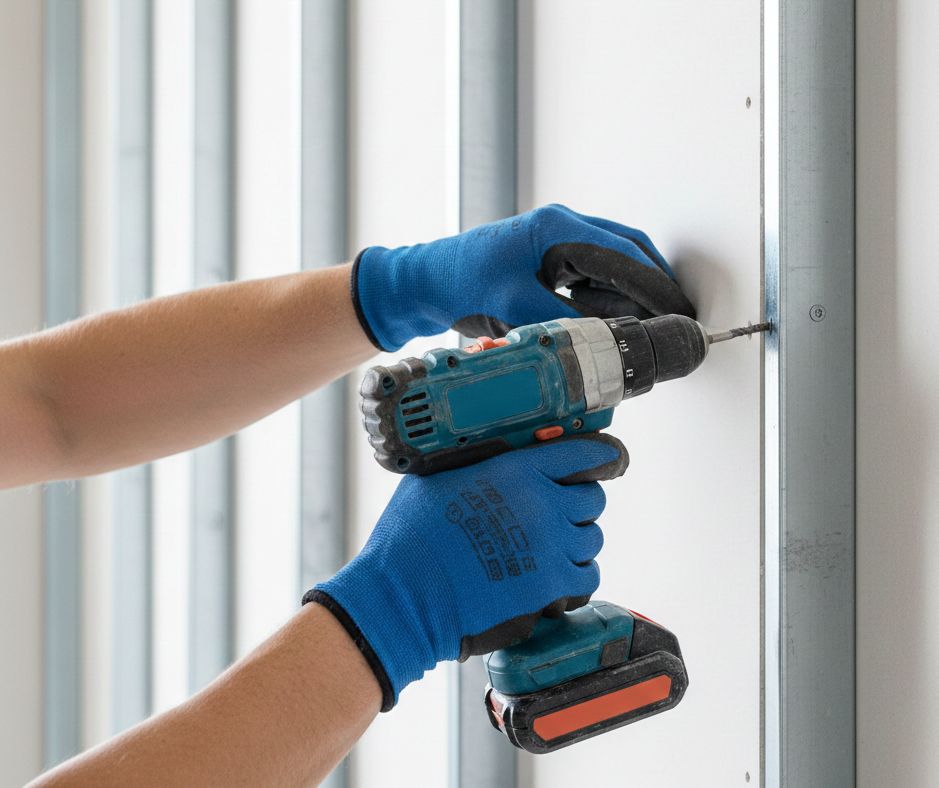
The “System” Approach: It is no longer enough to use a “pink” fire board. Compliance now requires proof that the specific combination of steel gauge, screw spacing, and insulation density has been tested as a unified assembly.
Critical Design Considerations for Architects
1. Staggered Joints
Vertical and horizontal joints between the first and second layers of plasterboard must be staggered by at least 300mm. This is the most common “fail” point during Building Control inspections.
2. Deflection Heads
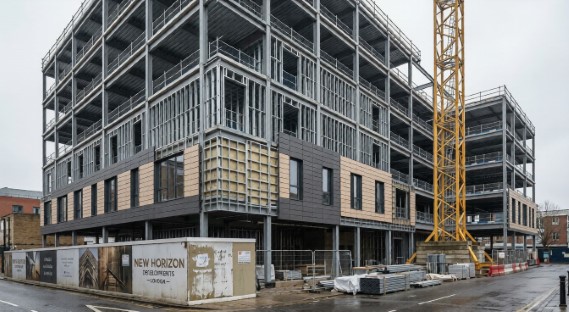
In multi-story steel-framed buildings (SFS), the partition must allow for the floor slab above to “deflect” under load. A fire-rated deflection head allows for this movement while maintaining a 120-minute smoke and flame seal.
3. Regulation 38: The Handover Challenge
Before a building can be occupied, a comprehensive fire safety “as-built” package must be handed over. BAS Frames assists this process by providing Digital Installation Records and 3D BIM Coordination, ensuring fire-stopping is planned around service penetrations before a single stud is fixed.
The BAS Frames Edge
Whether you are converting a commercial space under Material Change of Use or developing a new 20-story residential block, the drylining finish is only as good as the safety system behind it. By choosing a specialist who understands the synergy between steel frames and fire-rated linings, you reduce the risk of Building Control delays and ensure a safer future for your occupants.