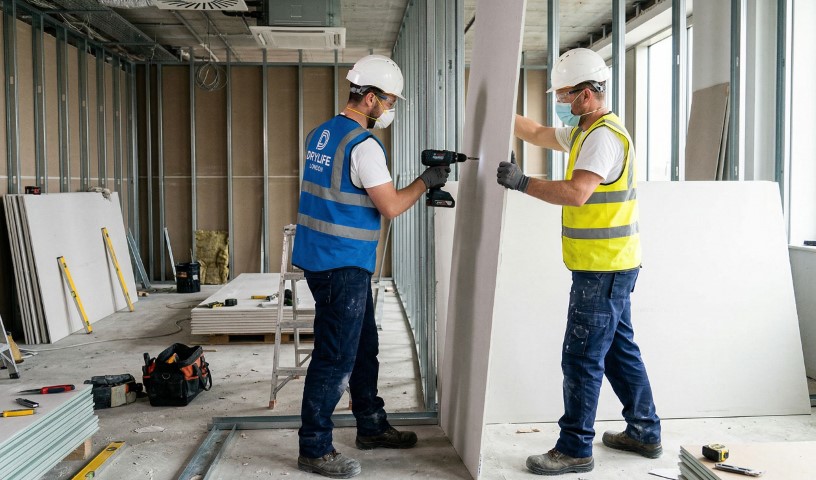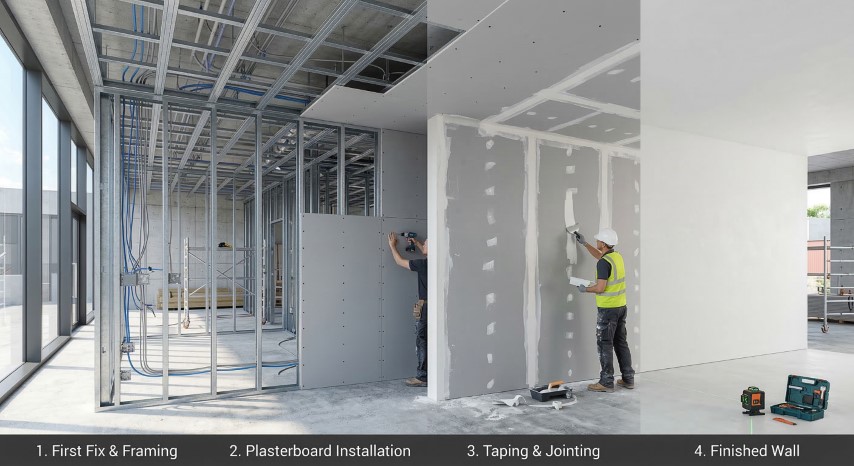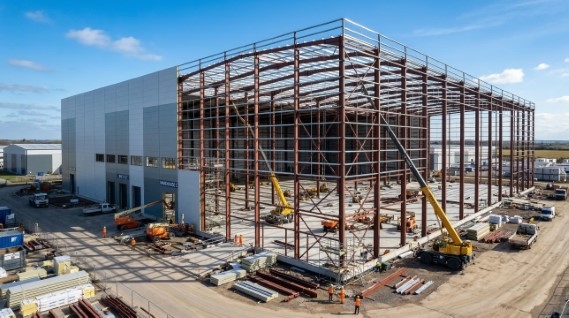
Selecting the right commercial drylining contractor is, in essence, a risk management exercise. This article sets out the criteria that experienced procurement professionals use to separate genuinely capable partners from those whose tender price looks attractive on paper but whose operational reality falls short.
Explore our commercial drylining services or contact our team to discuss your next project.
Why Subcontractor Selection Matters More Than Price
On large commercial contracts — multi-storey office fit-outs, hospitality refurbishments, healthcare facilities, or mixed-use developments — the drylining package is often the bellwether of the entire project. It spans the widest programme window, involves the greatest volume of coordinated labour, and creates the substrate upon which everything else depends.
Experienced QS professionals know that a subcontractor who wins a tender at 8% below the next bid, but then mobilises late, runs understaffed, or cannot demonstrate robust QA processes, will cost the main contractor multiples of that saving in prolongation, acceleration, and contra-charges.
“The lowest tender price and the lowest total project cost are rarely the same figure.”
The following criteria form the basis of a rigorous subcontractor assessment. Learn more about how Basframes approaches large-scale packages on our services page.
Financial Stability: The Non-Negotiable Foundation
Before any technical or operational assessment begins, the financial health of a drylining subcontractor must be verified. Contractor insolvency mid-project is one of the most disruptive events a commercial programme can face. On a busy London fit-out, replacing a failed subcontractor mid-package can cost weeks of programme and significant legal and procurement fees.
What to look for
- Audited accounts showing consistent turnover appropriate to the contract value — a subcontractor turning over £3m annually should not be expected to execute a £4m package without flagging this.
- Healthy net current assets and a current ratio above 1.0 indicate that the business can meet short-term obligations without relying on advance payments.
- A clear understanding of their bonding capacity and whether they can provide a performance bond if required under the contract.
- No County Court Judgements (CCJs) and a clean Companies House filing history, with accounts filed on time.
- Credit agency scores — tools such as Creditsafe or Experian Business are widely used to benchmark subcontractor financial risk.
A financially stable provider of large-scale drylining services will be transparent about their accounts. Reluctance to share financial information during pre-qualification is itself a risk signal. Find out more about Basframes.
Workforce Capacity: Matching Labour to Programme
Labour capacity is the most common point of failure in drylining subcontractor performance. A company may carry the right accreditations and present an impressive track record, yet simply lack the mobilisation capability to staff a major commercial project at the output rates required by the programme.
When reviewing tender packages, Commercial Managers should press subcontractors on the following:
Key capacity questions
- What is your current directly employed headcount, and how many operatives are engaged as labour-only subcontractors?
- Can you demonstrate that those operatives hold valid CSCS cards appropriate to their role — Blue Card (Skilled Worker) or Gold Card (Experienced Technical Supervisor)?
- What other live contracts are you running simultaneously, and at what percentage of total capacity?
- What is your realistic peak-week output in m² of partitioning and/or ceiling systems for this specific project type?
- Do you have a named site manager and contracts manager committed to this project, or will site management be spread across multiple schemes?
Reputable drylining subcontractors in London will have a dedicated workforce coordination function. They can provide a resource schedule alongside their programme — not just a Gantt chart with tasks, but with named or numbered operative allocations against each activity. View our approach to commercial projects.
Accreditations: CHAS, Constructionline, and Beyond
Accreditations exist to give the supply chain a standardised baseline of assurance. For commercial projects — particularly those in the public sector, healthcare, or education — these are not optional extras. They are the minimum entry requirement for a credible tender.
CHAS (Contractors Health and Safety Assessment Scheme)
CHAS accreditation demonstrates that a subcontractor’s health and safety management system has been independently assessed and meets the requirements of the Construction (Design and Management) Regulations 2015. For office fit-out specialists working in occupied or partially occupied buildings, robust H&S competence is critical. Ask to see the certificate, check its expiry date, and confirm the scope covers the type of work being tendered.
Constructionline
Constructionline membership — at Gold or Platinum tier — goes beyond health and safety to encompass financial standing, environmental management, quality assurance, and equality and diversity policies. A Platinum-rated subcontractor has been assessed against PAS 91:2013, meaning your PQQ process can reference their Constructionline status rather than duplicating that assessment from scratch.
Additional accreditations worth noting
- ISO 9001 — Quality Management Systems, providing assurance that the subcontractor’s QA processes are independently certified.
- ISO 14001 — Environmental Management, increasingly required on projects with BREEAM or LEED ratings targets.
- SafeContractor / SMAS — Alternative H&S assessment schemes; check which your main contract requires.
- Knauf / British Gypsum Approved Installer — Manufacturer certification indicating trained operatives and access to system warranties.
Accreditations should be verified directly, not simply accepted on the basis of a subcontractor’s own assertion. Contact Basframes to request our accreditation documentation.
QA Processes: Building Quality In, Not Inspecting It Out
Quality assurance on large commercial drylining packages is not a box-ticking exercise. It is the framework that protects programme by catching defects early — before plastering, before decoration, and certainly before the client walk-through.
When assessing the QA processes of a prospective subcontractor, look for:
- A written Inspection and Test Plan (ITP) specific to the scope of works, not a generic document.
- Hold points and witness points defined at key stages — typically stud and track installation, services coordination sign-off, boarding completion, and fire-stopping inspection.
- Evidence of photographic record-keeping, ideally via a site management app such as Procore, Fieldwire, or similar.
- A clear process for raising and closing RFIs when drawing information is ambiguous.
- Experience of working under a Golden Thread approach — particularly relevant on projects above 18m in height following the Building Safety Act 2022.
A mature office fit-out specialist will conduct their own rolling inspections and present QA records at progress meetings rather than waiting to be asked. Learn how Basframes manages quality on site.
On-Time Delivery: Programme Discipline as a Core Competency
In commercial fit-out, particularly in Central London and across major regional cities, programme is often non-negotiable. Lease commitments, phased occupancy requirements, and client business continuity pressures mean that slippage in the drylining package can trigger penalty clauses, loss of revenue, and reputational damage for the main contractor.
On-time delivery is not a product of optimism or good intentions — it is the result of systems, governance, and experience. When evaluating a subcontractor’s track record, ask for:
- References from main contractors on projects of comparable scope and value, specifically addressing programme adherence.
- Evidence of having successfully recovered a project that ran behind — and what the recovery plan looked like.
- Their approach to short-interval planning: do they produce two-week lookahead programmes? Do they attend weekly progress meetings with updated output data?
- Their contingency position — if a key gang leader is absent, what is the escalation and replacement protocol?
- Their approach to coordinating interfaces with mechanical and electrical trades.
Programme discipline also extends to the procurement of materials. Speak to our team about how we manage programme on complex schemes.
Assessing Fit for London and the South East
For projects procured in London and the South East, there are additional operational considerations specific to working in a dense urban environment. Drylining subcontractors in London must demonstrate familiarity with:
- Restricted delivery windows and loading bay management in city-centre locations.
- FORS accreditation or equivalent for logistics, where required by the client or planning condition.
- Working in occupied buildings — noise management plans, dust suppression, and communication with building management.
- Ultra-Low Emission Zone (ULEZ) compliance for site vehicles and delivery fleets.
- The logistical demands of high-rise fit-out — hoist scheduling, materials management on constrained floor plates, and safe stacking.
Structuring Your Assessment: A Practical Framework
For QS teams and Commercial Managers looking to build a repeatable evaluation framework, the following weighted criteria provide a starting point:
- Financial standing — Credit score, accounts review, bonding capacity
- Technical competence — System experience, manufacturer approvals, specialist capabilities
- Workforce capacity — Headcount, CSCS certification levels, concurrent commitments
- Accreditations — CHAS, Constructionline tier, ISO certifications
- QA processes — ITP quality, record-keeping systems, defects management
- Programme track record — References, short-interval planning evidence, recovery capability
- Commercial approach — Clarity of tender, daywork schedule competitiveness, payment terms
Scoring subcontractors against these criteria — before comparing prices — will consistently yield better outcomes than leading with cost and then attempting to qualify risk.
Conclusion: Partnership Over Price
The most effective relationships between main contractors and drylining subcontractors are built on transparency, mutual accountability, and shared programme ownership. These partnerships are developed over multiple projects — but they must begin with rigorous selection.
For Quantity Surveyors and Commercial Managers evaluating their next drylining tender package, the message is clear: look beyond the bill rates. Interrogate the business behind the bid. Ask for evidence, not assurances. And prioritise the partner who makes your programme their programme — because on a large commercial project, that alignment is ultimately what gets the job done.