Delivering 2,000m² of SFS Under a 6-Week Programme: Lessons from Denham Crematorium
Steel Frame Systems (SFS) are frequently specified for commercial buildings on the basis of their structural efficiency and programme advantages. But specifications are made in design offices. The real test of any system — and any installer — happens on site, where programmes compress, drawings arrive late, and logistics impose constraints no specification document anticipates. For a fuller introduction to how the system works, see our guide to Steel Frame Systems in construction.
The Denham Crematorium project in Uxbridge, completed in early 2026, is a case study in what competent SFS installation actually looks like under pressure. This article draws on that project to explore the practical demands of a full-package SFS delivery, the operational challenges the system must accommodate, and the qualities that distinguish a capable SFS subcontractor from one who simply carries the accreditation.
What ‘Full Package’ Actually Means
In many commercial SFS contracts, the scope is divided: one party supplies the framing system, another installs it, and a third follows with external boarding. Each handoff creates a coordination seam, and coordination seams are where programmes slip.
A full-package appointment — where a single subcontractor is responsible for SFS design input, supply, installation, and external boarding — eliminates those seams. It places accountability with one team, simplifying the main contractor’s management burden and removing the most common source of delay: the interface between separate trade packages.
At Denham, BAS Frames was appointed as the full-package SFS provider. That meant owning the entire scope from frame to boarded envelope — and it meant that every problem encountered on site was ours to solve, without the option of pointing to another trade.
A full-package appointment places accountability with one team — which simplifies the main contractor’s management burden and removes the most common source of programme slippage.
The Logistical Reality of First-Floor SFS Work
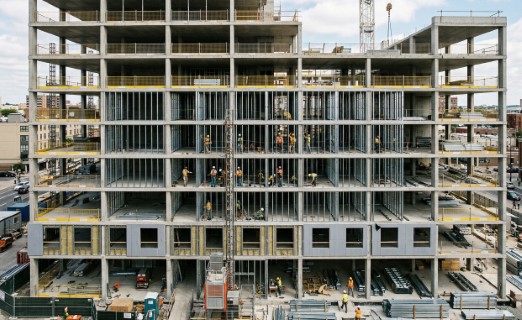
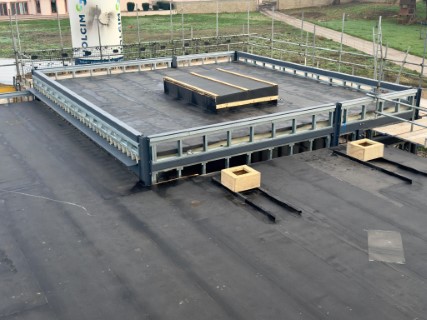
The installation at Denham was conducted entirely at first-floor level. That single fact shaped almost every operational decision on the project.
Access at height without a scaffold structure meant all works were carried out using scissor lifts. For a skilled operative working with lighter gauge framing, this is manageable. But the stud members on this project exceeded 5 metres in length, and completed wall sections reached over 6 metres in height. Manoeuvring and positioning steel of that scale from a mobile elevated work platform requires a different order of skill and coordination.
The physical demands are not trivial. A 5-metre galvanised steel stud weighs significantly more than a typical internal partition member, and the geometry of positioning it accurately within a scissor lift basket — while maintaining safe working practices and not compromising the integrity of the frame — is a genuine technical challenge. It is the kind of challenge that exposes the gap between operatives who understand SFS and those who have simply installed it under easier conditions.
What this means for programme planning
Height access constraints should be modelled explicitly in any pre-construction programme for SFS work above ground level. Output rates achievable from scissor lifts are lower than those on open scaffold or floor level, and sequencing becomes more critical because the machine itself creates a bottleneck. A programme that applies standard SFS output assumptions to elevated work will be optimistic.
Ventilation Openings and the Limits of the Drawings
One of the most practically significant challenges on any SFS project is the formation of openings: windows, doors, service penetrations, and in the case of Denham, a large number of ventilation openings, each with specific jamb and lintel details.
The more revealing challenge was the state of the façade drawings during installation. Design completion rarely aligns perfectly with construction programme on commercial projects. At Denham, façade drawings were still being finalised while frame installation was underway. Additional vents, absent from the original issue, needed to be incorporated after wall construction and boarding had already been completed.
The SFS system accommodated this. Working back through completed sections, the team incorporated the additional openings efficiently — within a single day. That outcome illustrates something important about how SFS performs in real conditions.
The ability to retrospectively modify a completed SFS assembly is one of the system’s practical advantages over alternatives — and it is an advantage that requires an installer who understands the system well enough to exploit it safely.
SFS Flexibility: More Than a Specification Claim
The flexibility of Steel Frame Systems is widely cited in product literature. In practice, its value depends on whether the design team and the installer know how to use it.
Flexibility in SFS does not mean structural indeterminacy. Openings must be framed correctly, with appropriate header sections, cripple studs, and connections. A retrospective modification is not simply cutting a hole — it is a structural intervention that requires understanding of load paths and connection details.
What the Denham project demonstrated is that a well-framed SFS assembly can absorb design changes that, in a masonry or concrete frame context, would require significant demolition and reconstruction. For projects with complex geometry or structural requirements, our structural engineering service provides the design support needed to make that flexibility safe and compliant.
For clients and main contractors specifying SFS on projects with evolving designs — which is most commercial projects — this capability should be a qualification criterion for subcontractor selection, not an assumption.
Delivering 2,000m² in Six Weeks: The Programme Arithmetic
The headline metric for the Denham project is straightforward: over 2,000 square metres of SFS and external boarding, delivered within a six-week programme, by a team of four operatives.
Six weeks of productive site time, accounting for mobilisation, materials deliveries, and the reduced output rates inherent in scissor lift working, leaves a demanding output requirement per operative per week. There is no slack in that programme for rework, materials delays, or the kind of coordination failures that arise when a team is not working as a coherent unit.
The project was completed and handed over within the required timeframe. That outcome was the product of planning the sequence correctly from the outset, maintaining consistent output through the programme, and resolving problems — including the late-issued ventilation openings — without surrendering programme time to delay and disruption.
What drives on-time delivery in SFS
- Accurate pre-construction sequencing that models constraints specific to the project — not a generic SFS programme template
- Materials procurement aligned to installation sequence, not simply ordered in bulk at the start
- A site management approach that identifies problems before they become delays, rather than reporting them after
- Operatives with the technical competence to work efficiently without constant supervision
- A direct line of communication between site and design teams when drawing information is incomplete or changes
The Case for Full-Package SFS Procurement
The commercial SFS market includes a range of procurement models. Some main contractors prefer to separate supply and install; others use specialist SFS subcontractors for installation only, with boarding let separately. You can explore BAS Frames’ approach across our design, supply, and installation services — each available independently or as a consolidated package.
The late ventilation openings at Denham were resolved within the same day because the team responsible for the original installation was also responsible for the modification. There was no interface negotiation, no delay while a separate boarding subcontractor mobilised, no dispute about responsibility for making good.
For commercial projects where programme certainty matters — and where the design is unlikely to be fully resolved before installation begins — full-package SFS procurement is worth examining carefully. The apparent efficiency of a divided scope often understates the coordination overhead and the risk of interface failures.
What to Look for in a Commercial SFS Subcontractor
Drawing on the demands of projects like Denham, and on the wider range of schemes in our commercial SFS portfolio, the criteria that distinguish genuinely capable SFS installers include:
- Direct experience with elevated working conditions, including scissor lift installation of long-span members
- Technical understanding of SFS jamb and lintel construction, not just the ability to follow a standard detail
- A track record of managing design changes in programme, not just in post-project accounts
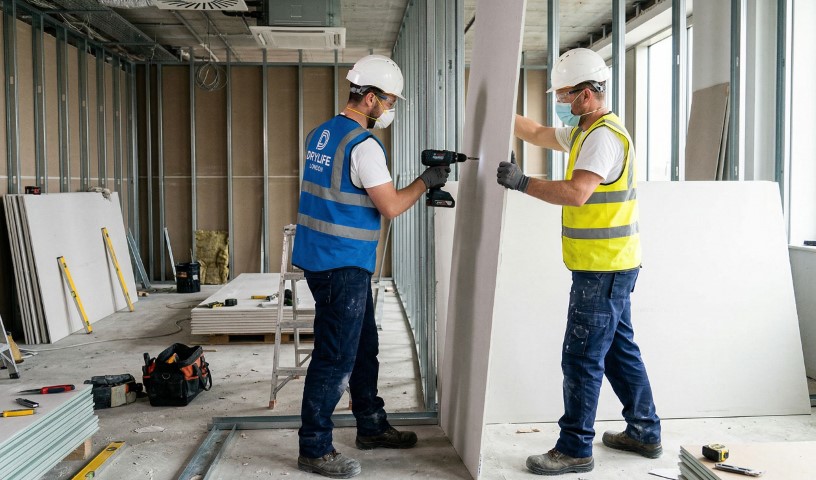
- The operational capacity to deliver full-package scopes — frame, drylining, and openings — within a single management structure
- Programme discipline demonstrated by references from main contractors on comparable projects, not just by tender commitments
Accreditations matter, and financial stability matters. But on a demanding commercial programme, the difference between a successful project and a difficult one is usually found in the operational capability and technical knowledge of the team on site.
Conclusion
The Denham Crematorium project is instructive because of what it demonstrates about the conditions under which SFS work is actually delivered: constrained access, evolving drawings, a tight programme, and a small team required to maintain consistent output while solving problems in real time.
Those conditions are not unusual. They are the norm on commercial construction projects. The relevant question for any main contractor or client appointing an SFS subcontractor is not whether the installer can perform under ideal conditions — it is whether they can perform under the conditions that will actually exist on site.
At BAS Frames, every commercial SFS appointment is treated as a full-package responsibility. That means owning the scope, managing the programme, and solving the problems — not escalating them.
View the Denham Crematorium project in our portfolio, or contact the BAS Frames team to discuss your next commercial SFS package.
View our commercial project portfolio → | Get in touch with BAS Frames →